
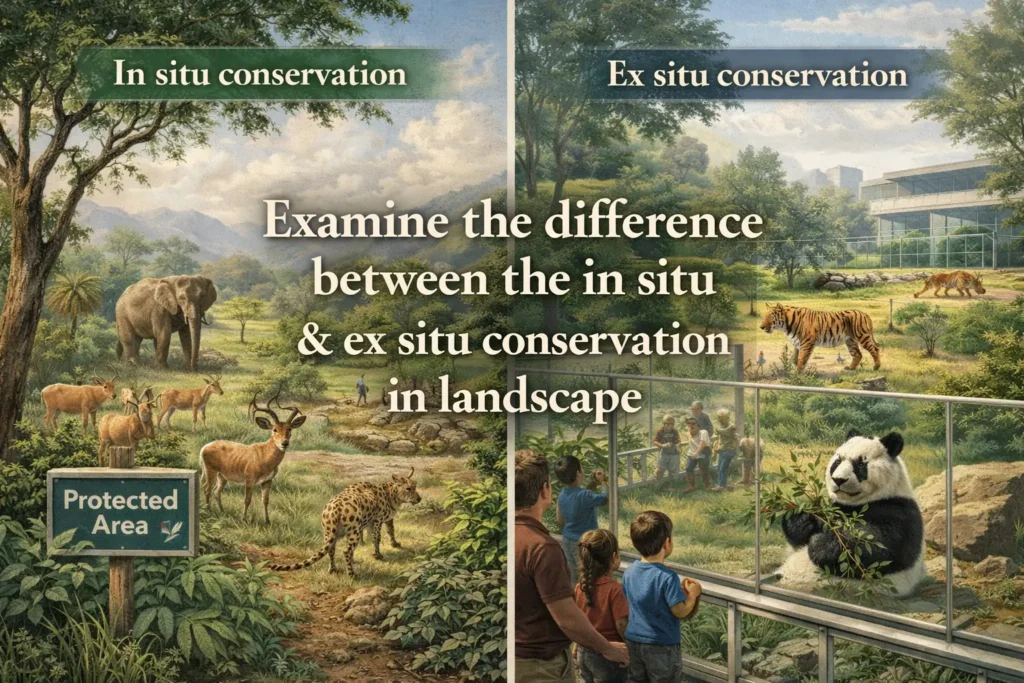
Examine the difference between the in situ & ex situ conservation
Conservation of biodiversity has become essential in the face of increasing environmental degradation, habitat loss, and species extinction. Two major strategies widely adopted for the protection of flora and fauna are in situ conservation and ex situ conservation. Though both aim at preserving biodiversity, they differ significantly in their methods, scope, advantages, and limitations. A critical examination of these approaches highlights their complementary roles in environmental protection.
In situ conservation refers to the protection of species within their natural habitats. It involves maintaining and recovering viable populations of organisms in the ecosystems where they have evolved. Examples include national parks, wildlife sanctuaries, biosphere reserves, and protected forests. In India, areas like Jim Corbett National Park and Kaziranga National Park serve as classic examples of in situ conservation.
The primary advantage of in situ conservation is that it allows species to live in their natural ecological context. This ensures the continuation of evolutionary processes, natural interactions, and ecological balance. It not only conserves individual species but also protects entire ecosystems, including microorganisms, plants, animals, and their physical environment. Additionally, it supports adaptation to environmental changes, as species continue to evolve naturally.
However, in situ conservation also has limitations. It requires large areas of land, which can be difficult to secure in densely populated countries. Human activities such as poaching, encroachment, deforestation, and climate change continue to threaten protected areas. Moreover, it may not be sufficient for species that are already critically endangered or have very small populations, as their survival in natural habitats becomes uncertain.
On the other hand, ex situ conservation involves the preservation of components of biodiversity outside their natural habitats. This includes zoos, botanical gardens, seed banks, gene banks, and tissue culture techniques. For example, endangered species may be bred in captivity in zoos, while rare plant species can be preserved in botanical gardens or through cryopreservation.
The major advantage of ex situ conservation is that it provides a controlled environment where species can be protected from immediate threats such as predators, diseases, or habitat destruction. It is particularly useful for species that are on the brink of extinction, as it allows for careful monitoring, breeding programs, and genetic management. Techniques such as artificial breeding and cloning can also help in increasing population size.
Despite these benefits, ex situ conservation has several drawbacks. Species are removed from their natural environments, which may affect their behavior, reproduction, and survival skills. It is often expensive and resource-intensive to maintain facilities like zoos and gene banks. Furthermore, conserving species outside their ecosystems does not address the root causes of biodiversity loss, such as habitat destruction and environmental degradation. Reintroducing species into the wild can also be challenging and may not always be successful.
A key difference between the two approaches lies in their scope. In situ conservation is ecosystem-based and holistic, focusing on the preservation of habitats and ecological processes. In contrast, ex situ conservation is species-specific and targeted, often used as a supplementary measure when in situ efforts are insufficient. While in situ conservation promotes long-term sustainability, ex situ conservation acts as a short-term or emergency strategy.
Another important distinction is the level of human intervention. In situ conservation involves minimal interference, allowing natural processes to operate freely. Ex situ conservation, however, requires significant human involvement in terms of management, breeding, and maintenance. This makes ex situ methods more controlled but less natural.
In conclusion, both in situ and ex situ conservation are vital for biodiversity preservation, but neither is sufficient on its own. In situ conservation remains the most effective and sustainable method, as it protects ecosystems and supports natural evolution. However, ex situ conservation plays a crucial supportive role, especially for endangered species that cannot survive in the wild. A balanced and integrated approach, combining both strategies, is essential to ensure the long-term conservation of biodiversity and the stability of our environment.
Examine the difference between the in situ & ex situ conservation Examine the difference between the in situ & ex situ conservation Examine the difference between the in situ & ex situ conservation Examine the difference between the in situ & ex situ conservation Examine the difference between the in situ & ex situ conservation Examine the difference between the in situ & ex situ conservation Examine the difference between the in situ & ex situ conservation Examine the difference between the in situ & ex situ conservation Examine the difference between the in situ & ex situ conservation Examine the difference between the in situ & ex situ conservation Examine the difference between the in situ & ex situ conservation