Discuss the main difference between colonialist & nationalist view
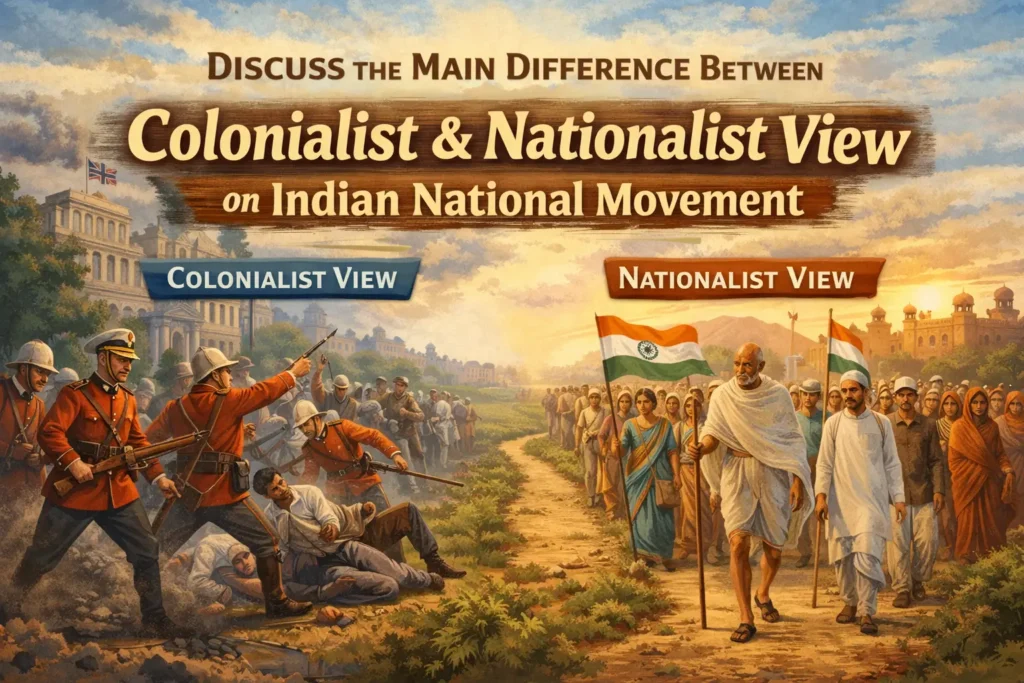
The Indian National Movement has been interpreted differently by colonialist and nationalist historians, each offering contrasting perspectives shaped by their ideological positions and historical contexts. These differences are significant as they influence how the movement is understood in terms of its nature, causes, leadership, and impact.
The colonialist view of the Indian National Movement was largely developed by British officials, administrators, and historians during the colonial period. From this perspective, the movement was often portrayed as a limited and elitist phenomenon. Colonialist historians argued that the movement was led by a small group of educated Indians who were disconnected from the masses. They depicted early leaders of the Indian National Congress as loyalists who merely sought administrative reforms rather than complete independence. According to this view, the British Empire was seen as a force for modernization and progress in India, bringing with it railways, education, legal systems, and political unity. Therefore, nationalist demands were often dismissed as premature or ungrateful reactions to British benevolence.
Furthermore, colonialist interpretations tended to downplay the mass character of the movement, especially during phases like the Non-Cooperation Movement and the Civil Disobedience Movement. They often described such movements as disorderly or driven by emotionalism rather than rational political thinking. Leaders like Mahatma Gandhi were sometimes portrayed as agitators who disrupted law and order. The colonialist narrative also emphasized divisions within Indian society—such as caste, religion, and region—to argue that India was not a unified nation and thus not ready for self-rule.
In contrast, the nationalist view emerged as a response to colonial interpretations and was developed by Indian historians and leaders who were part of or sympathetic to the freedom struggle. This perspective presents the Indian National Movement as a broad-based, inclusive, and popular struggle against colonial oppression. Nationalist historians emphasized the unity of the Indian people and highlighted the participation of diverse social groups, including peasants, workers, women, and students.
According to the nationalist view, the movement was not merely a political struggle but also a moral and ideological fight against injustice and exploitation. British rule was criticized for its economic drain, destruction of indigenous industries, and promotion of inequality. Leaders such as Bal Gangadhar Tilak, Jawaharlal Nehru, and Gandhi were portrayed as visionary figures who mobilized the masses and inspired a sense of national identity. Gandhi, in particular, was credited with transforming the movement into a mass struggle through his methods of non-violence and civil disobedience.
Another key difference lies in the interpretation of mass movements. While colonialist historians saw them as chaotic and irrational, nationalist historians viewed them as expressions of popular will and political awakening. Events like the Non-Cooperation Movement, the Salt March, and the Quit India Movement were celebrated as milestones in India’s journey toward independence.
The colonialist view also justified British rule by emphasizing its role in maintaining order and introducing modern institutions. In contrast, the nationalist perspective argued that these developments primarily served colonial interests and facilitated economic exploitation. For example, railways were seen by nationalists not just as symbols of progress but also as tools for resource extraction and administrative control.
However, it is important to note that the nationalist view has also been critiqued for sometimes being overly idealistic and for underplaying internal conflicts within Indian society. In recent years, historians have attempted to adopt more balanced approaches, incorporating elements from both perspectives as well as subaltern viewpoints that focus on marginalized groups.
In conclusion, the main difference between colonialist and nationalist views of the Indian National Movement lies in their interpretation of its nature, leadership, and significance. While colonialist historians minimized its importance and justified British rule, nationalist historians celebrated it as a unified and heroic struggle for freedom. Understanding these contrasting perspectives allows for a more nuanced and critical appreciation of India’s past.
Discuss the main difference between colonialist & nationalist view Discuss the main difference between colonialist & nationalist view Discuss the main difference between colonialist & nationalist view Discuss the main difference between colonialist & nationalist view Discuss the main difference between colonialist & nationalist view Discuss the main difference between colonialist & nationalist view Discuss the main difference between colonialist & nationalist view Discuss the main difference between colonialist & nationalist view Discuss the main difference between colonialist & nationalist view Discuss the main difference between colonialist & nationalist view Discuss the main difference between colonialist & nationalist view Discuss the main difference between colonialist & nationalist view