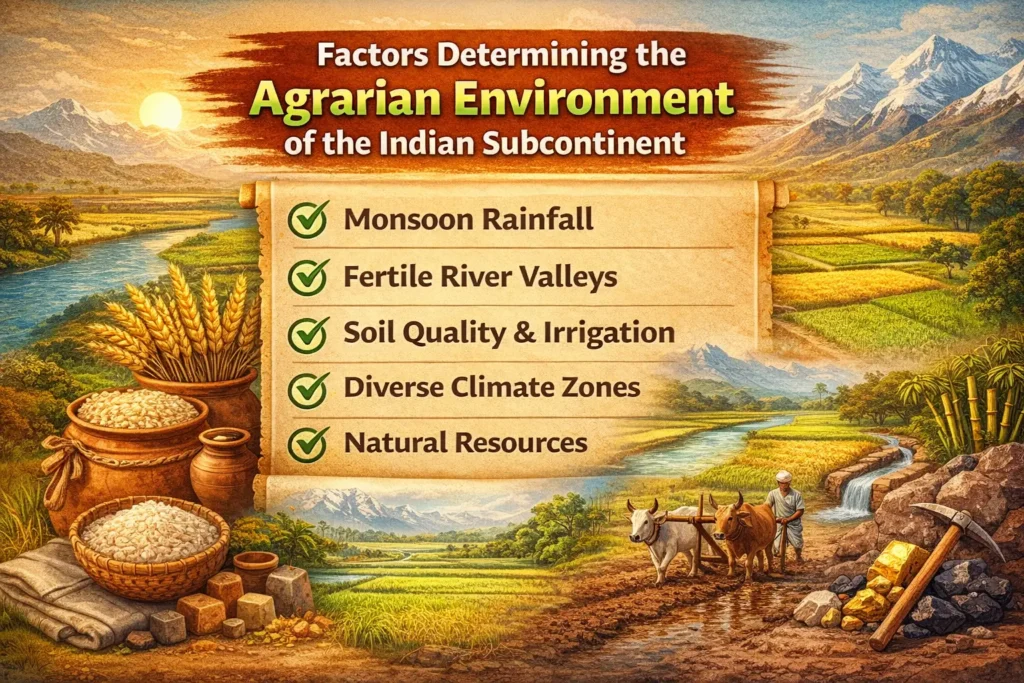
Factors Determining the Agrarian Environment of the Indian Subcontinent
The agrarian environment of the Indian subcontinent has been shaped by a complex interaction of natural, ecological, technological, social, and political factors over a long historical period. Agriculture has remained the backbone of the Indian economy since ancient times, and its nature and organization were deeply influenced by geography, climate, human intervention, and institutional frameworks. An examination of these factors helps in understanding the diversity and resilience of agrarian systems across the subcontinent.
1. Geographical Diversity
Geography played a foundational role in shaping agrarian conditions. The Indian subcontinent is marked by diverse physical features such as the fertile Indo-Gangetic plains, the Deccan plateau, coastal plains, deserts, forests, and hill regions. River systems like the Indus, Ganga, Yamuna, Godavari, Krishna, and Kaveri deposited fertile alluvium, making surrounding regions highly productive agricultural zones. In contrast, plateau and arid regions depended on rain-fed agriculture and dry farming. This geographical diversity led to region-specific cropping patterns and agricultural practices.
2. Climate and Monsoon System
The monsoon is one of the most decisive factors determining the agrarian environment of India. Seasonal rainfall governed sowing, harvesting, crop selection, and agricultural productivity. Regions receiving adequate and regular rainfall supported intensive wet-rice cultivation, while areas with scanty rainfall adopted drought-resistant crops such as millets, pulses, and barley. Variability and uncertainty of monsoons often resulted in famines, crop failures, and agrarian distress, influencing settlement patterns and agrarian resilience strategies.
3. Soil Types and Natural Resources
The subcontinent possesses a variety of soils — alluvial, black (regur), red, laterite, and desert soils — each suited to different crops. For example, black soil of the Deccan was ideal for cotton cultivation, while alluvial soil supported cereals like wheat and rice. Availability of forests, pastures, and water bodies complemented agrarian activities by providing manure, grazing land, and irrigation resources. Thus, soil composition and access to natural resources directly influenced agricultural sustainability.
4. Water Resources and Irrigation
Access to water through rivers, tanks, wells, canals, and reservoirs was crucial in shaping agrarian environments. Ancient and medieval India witnessed the construction of irrigation works such as canals in the Indus region, tank irrigation in South India, and step-wells in western India. Irrigation reduced dependence on rainfall, enabled multiple cropping, and enhanced agricultural productivity. Regions with advanced irrigation networks experienced more stable agrarian systems and higher surplus generation.
5. Technological Factors
Agricultural technology played a significant role in determining agrarian conditions. The use of iron tools, ploughs, sickles, and axes improved land clearance and cultivation efficiency. Crop rotation, mixed cropping, and use of organic manure enhanced soil fertility. Technological innovations influenced expansion of agriculture into forested and marginal areas, transforming landscapes and agrarian relations.
6. Social Organization and Agrarian Relations
The agrarian environment was also shaped by social structures such as caste, kinship, and community organization. Control over land and labor was often mediated by social hierarchies. The caste-based division of labor influenced agricultural tasks, tenancy relations, and access to resources. Peasant communities, tribal groups, and pastoralists adapted their agrarian practices according to ecological conditions, contributing to the plural nature of agrarian environments.
7. State Policies and Revenue Systems
The role of the state was crucial in shaping agrarian environments through land revenue systems, agrarian regulations, and infrastructure development. From Mauryan land surveys to Mughal revenue settlements, the state sought to extract surplus while ensuring agricultural stability. Policies regarding land grants, irrigation maintenance, and protection of cultivators influenced agrarian productivity and land use patterns.
8. Environmental and Ecological Factors
Environmental factors such as deforestation, floods, droughts, and soil erosion affected agrarian sustainability. Human interventions altered ecological balances, leading to expansion or decline of agricultural zones. Adaptation to ecological constraints shaped long-term agrarian strategies and settlement choices.
Conclusion
In conclusion, the agrarian environment of the Indian subcontinent was not determined by a single factor but by a dynamic interplay of geography, climate, resources, technology, social relations, and state intervention. This complexity produced diverse agrarian systems adapted to local conditions, making Indian agriculture resilient yet vulnerable to environmental and institutional changes. Understanding these factors provides deeper insight into the historical evolution of India’s agrarian landscape.
Click Here Buy @Rs.1/- only from Amazon
Agrarian Environment of the Indian Subcontinent Agrarian Environment of the Indian Subcontinent Agrarian Environment of the Indian Subcontinent Agrarian Environment of the Indian Subcontinent Agrarian Environment of the Indian Subcontinent Agrarian Environment of the Indian Subcontinent Agrarian Environment of the Indian Subcontinent