Salient Features of Agrarian Structure under Maratha Rule
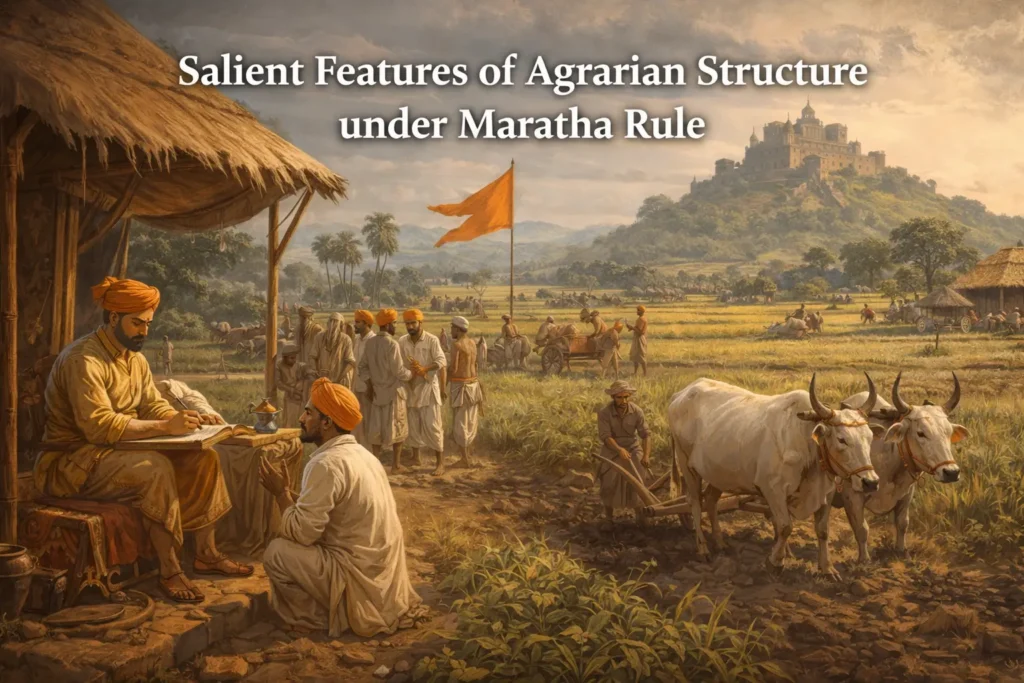
The agrarian structure under Maratha rule (c. 17th–18th centuries) was shaped by regional conditions of the Deccan, inherited administrative practices, and the military-fiscal needs of the Maratha state. Agriculture formed the economic backbone of Maratha power, and the state’s revenue system was designed to mobilize agrarian surplus efficiently while maintaining peasant cultivation. The agrarian structure reflected a complex interaction between the state, intermediaries, and cultivators.
1. Centrality of Land Revenue
Land revenue was the principal source of income for the Maratha state. The Marathas adopted and modified earlier Deccan revenue systems, particularly those of the Bahmani and Ahmadnagar Sultanates. Revenue was generally assessed based on the fertility of the land, nature of crops, and local conditions. The state claimed a substantial share of the produce, often ranging between one-third and one-half, though actual collection varied according to circumstances such as drought or war.
2. Ryotwari-Like Features
A distinctive feature of the Maratha agrarian structure was the emphasis on direct relations between the state and the cultivator (ryot). The state sought to limit the power of intermediaries and encouraged cultivators to retain occupancy rights over land as long as they paid revenue. This gave the system a ryotwari character, particularly in regions under stable Maratha control.
3. Role of Village Community
The village community was the basic unit of agrarian organization. Village officials such as the patil (headman), kulkarni (accountant), and deshmukh played a crucial role in revenue assessment and collection. These officials often held hereditary rights and enjoyed rent-free lands (inam), giving them significant influence over local agrarian relations. However, their authority was supervised by the state to prevent excessive exploitation.
4. Chauth and Sardeshmukhi
A unique aspect of Maratha agrarian extraction was the levy of chauth (one-fourth of revenue) and sardeshmukhi (additional 10 percent). While these were initially imposed on territories outside direct Maratha control, they had implications for agrarian society, as peasants ultimately bore the burden. These levies linked military expansion directly with agrarian surplus.
5. Land Tenures and Grants
The Maratha period witnessed the prevalence of various land tenures such as inam, jagir, and watan lands. Inam lands were granted to religious institutions and officials, while watan lands were hereditary service holdings attached to village offices. Although such grants reduced the state’s direct revenue, they helped maintain administrative and social stability.
6. Protection of Peasant Interests
Maratha rulers, especially under Shivaji, adopted policies aimed at protecting peasants from excessive exactions. Revenue demand was often moderated during natural calamities, and officials were instructed not to harass cultivators. This policy helped ensure continuity of cultivation and loyalty of the peasantry, which was essential for sustaining the Maratha military apparatus.
7. Expansion and Mobility of Agriculture
The Maratha state encouraged the extension of cultivation into forested and marginal lands. Migrant cultivators were attracted by favorable revenue terms and protection. This led to increased agricultural production and expansion of the agrarian base.
8. Military-Fiscal Character
The agrarian structure under Maratha rule had a strong military-fiscal orientation. Revenue extraction was closely tied to maintaining armies and financing warfare. This often resulted in fluctuating revenue demands, particularly during periods of conflict, placing pressure on agrarian society.
In conclusion, the agrarian structure under Maratha rule was characterized by state dominance in revenue collection, a direct relationship with cultivators, regulated role of village intermediaries, and a strong military-fiscal orientation. While the system sought to protect peasant interests and ensure agricultural continuity, the demands of warfare and expansion also imposed significant burdens on the agrarian economy. The Maratha agrarian structure thus combined pragmatism with extraction, reflecting the needs of a dynamic early modern state.
Agrarian Structure under Maratha Rule Agrarian Structure under Maratha Rule Agrarian Structure under Maratha Rule Agrarian Structure under Maratha Rule Agrarian Structure under Maratha Rule Agrarian Structure under Maratha Rule Agrarian Structure under Maratha Rule Agrarian Structure under Maratha Rule