
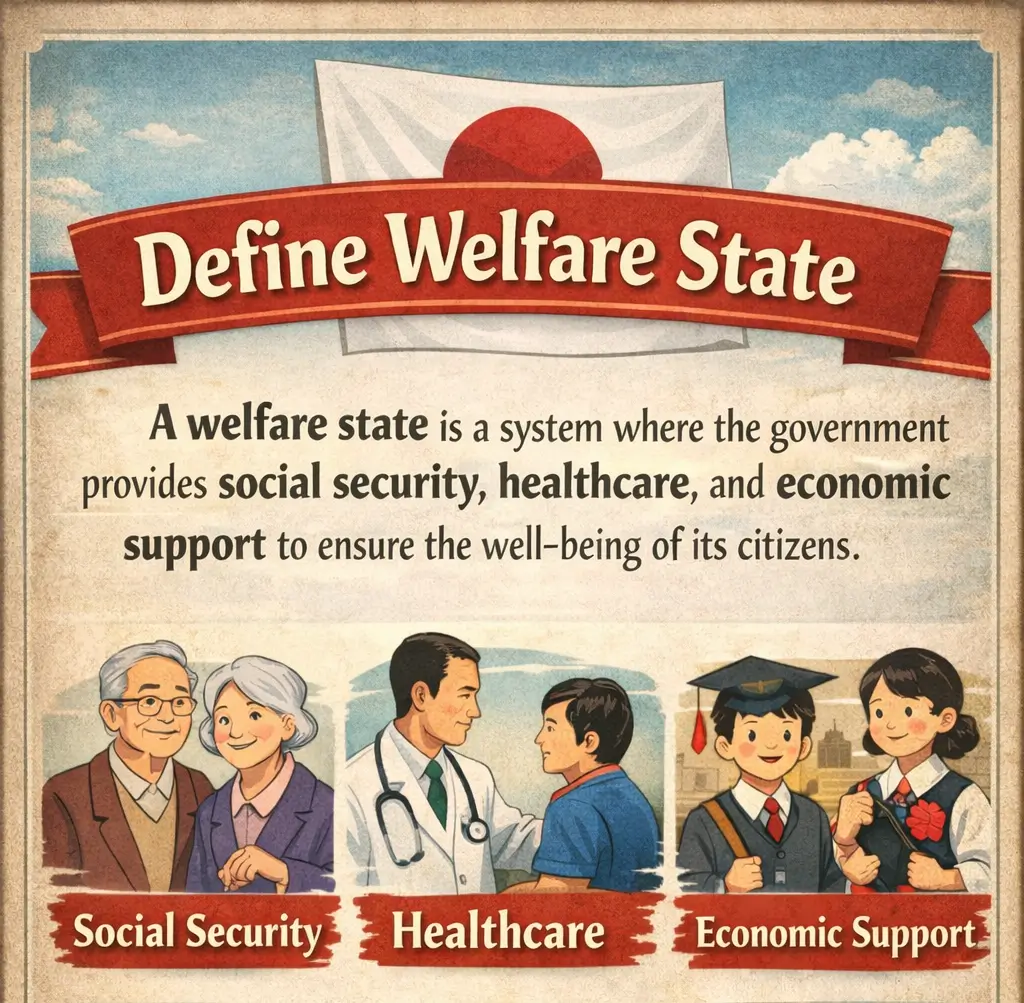
Define welfare state. Define the welfare measures and policies of Japan in 19th-20th century
A welfare state is a system in which the government assumes responsibility for the well-being of its citizens by providing social security, basic economic support, public services, and protection against risks such as unemployment, illness, and old age. It aims to reduce inequality, ensure a minimum standard of living, and promote social justice through policies like healthcare, education, labor protection, and social insurance.
The development of welfare measures in Japan during the 19th and 20th centuries reflects a gradual transition from a traditional society to a modern industrial welfare state. This transformation began in the period of the Meiji Restoration, which marked the end of feudal rule and the beginning of modernization.
In the late 19th century, Japan’s primary focus was on industrialization and nation-building rather than welfare. The government encouraged rapid economic growth, but social policies were minimal. However, some early welfare-oriented measures were introduced. The government established modern education systems, public health initiatives, and rudimentary poverty relief. The Poor Relief Regulation of 1874 was one of the first attempts to assist the destitute, although it was limited in scope and based on strict eligibility conditions.
As industrialization progressed, labor exploitation and poor working conditions became widespread. In response, the government began introducing labor laws. The Factory Act of 1911 (implemented in 1916) was a significant step, as it regulated working hours, especially for women and children, and improved workplace safety. Although weakly enforced, it marked the beginning of state intervention in labor welfare.
During the early 20th century, especially in the Taishō period, Japan experienced social and political changes that led to increased attention to welfare. The government introduced health insurance and workers’ compensation systems. In 1922, the Health Insurance Act was enacted, providing limited medical coverage to industrial workers. This was a crucial step toward building a social insurance system.
However, welfare development was interrupted during the militarist period of the 1930s and World War II. Social policies during this time were primarily aimed at supporting the war effort rather than improving citizens’ welfare. The state implemented measures to control labor and resources, but these were not welfare-oriented in the modern sense.
A major turning point came after World War II under the influence of the Allied Occupation led by Douglas MacArthur. Japan adopted a new constitution in 1947, which guaranteed fundamental human rights and emphasized social welfare. Article 25 of the Constitution explicitly recognized the right to maintain a minimum standard of living, laying the foundation for a welfare state.
Post-war Japan saw rapid expansion of welfare measures. The government introduced comprehensive social security systems, including universal healthcare and pension schemes. The National Health Insurance system was expanded in 1961 to cover all citizens, ensuring access to medical services. Similarly, the National Pension system was established to provide financial security to the elderly.
The government also implemented policies to support employment and economic stability. Labor laws were strengthened to protect workers’ rights, ensure fair wages, and improve working conditions. The Employment Security Act and Labor Standards Act played significant roles in safeguarding workers.
Education and housing were also important components of Japan’s welfare policies. The state invested heavily in public education, making it accessible and compulsory, which contributed to human capital development. Public housing programs were introduced to address urbanization and provide affordable living conditions.
Japan’s welfare model in the post-war period is often described as a “developmental welfare state.” Unlike Western welfare states, Japan relied heavily on economic growth and employment-based benefits. Companies played a significant role in providing welfare to employees through lifetime employment systems, company pensions, and health benefits.
By the late 20th century, Japan had established a relatively comprehensive welfare system, though it remained modest compared to European countries. The focus was on social insurance rather than direct redistribution. The state ensured basic security while encouraging self-reliance and family support systems.
In conclusion, Japan’s welfare state evolved gradually from minimal early efforts in the late 19th century to a more structured and inclusive system in the post-World War II era. The transformation was shaped by industrialization, social changes, and external influences. While initially limited, Japan’s welfare policies expanded significantly in the 20th century, creating a system that balanced economic growth with social protection.
Define welfare state. Define the welfare measures and policies of Japan in 19th-20th century Define welfare state. Define the welfare measures and policies of Japan in 19th-20th century Define welfare state. Define the welfare measures and policies of Japan in 19th-20th century Define welfare state. Define the welfare measures and policies of Japan in 19th-20th century
Click Here Buy @Rs.1/- only from Amazon
Define welfare state. Define the welfare measures and policies of Japan in 19th-20th century