Write a note on the Deindustrialization of Indian economy during colonial period
The de-industrialization of the Indian economy during the colonial period is a crucial theme in understanding the economic impact of British rule in India. It refers to the decline of traditional handicrafts and indigenous industries, alongside the transformation of India from a manufacturing economy into a supplier of raw materials and a market for British manufactured goods. This process was neither sudden nor uniform, but it had far-reaching consequences for India’s economic and social structure.
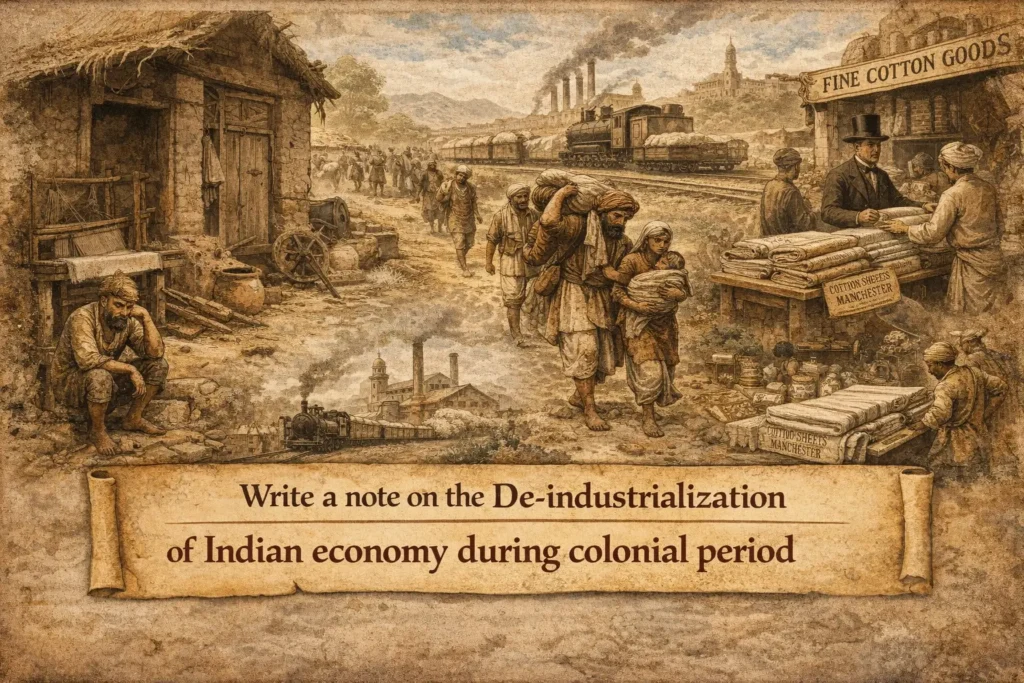
Before colonial rule, India was renowned for its thriving handicraft industries, especially in textiles, metalwork, shipbuilding, and handicrafts. Regions like Bengal and Gujarat were famous for fine cotton and silk textiles, which were exported across the world. Indian artisans possessed high levels of skill, and the economy had a balanced relationship between agriculture and industry. However, this structure began to change with the expansion of the British East India Company in the 18th century.
One of the primary causes of de-industrialization was the discriminatory trade policies imposed by the British. Indian goods entering Britain faced heavy tariffs, while British manufactured goods were allowed to enter India with minimal or no duties. This created an uneven playing field, making Indian products less competitive. At the same time, the Industrial Revolution in Britain led to the mass production of cheap machine-made goods, particularly textiles, which flooded Indian markets and displaced local artisans.
Another important factor was the destruction of the traditional system of patronage. Indian rulers, nobles, and courts had long supported artisans by providing them with employment and markets for luxury goods. With the decline of these political centers under British rule, artisans lost their primary patrons. The weakening of courts and urban centers contributed significantly to the decline of crafts.
The policies of the colonial administration also played a direct role in undermining indigenous industries. The British often forced Indian artisans to sell their goods at low prices or work under coercive conditions. In some cases, weavers were compelled to produce exclusively for the Company at unfavorable rates. Such exploitation reduced their income and discouraged production.
The introduction of modern transportation systems, such as railways, further accelerated de-industrialization. While railways facilitated trade, they also enabled the easy distribution of British goods throughout India, even in remote areas. This intensified competition and led to the decline of local industries that could not compete with machine-made imports.
The impact of de-industrialization was severe and multifaceted. One of the most immediate consequences was the large-scale unemployment of artisans. As traditional industries collapsed, many craftsmen were forced to abandon their occupations and migrate to rural areas, where they joined the ranks of agricultural laborers. This increased pressure on land and contributed to rural poverty and overpopulation.
De-industrialization also led to the “ruralization” of the Indian economy. Instead of a diversified economy with both agricultural and industrial sectors, India became predominantly agrarian. This made the economy more vulnerable to famines and economic fluctuations, as agriculture was heavily dependent on monsoons.
Moreover, the process contributed to the “drain of wealth,” a concept famously articulated by Dadabhai Naoroji. He argued that India’s wealth was being systematically transferred to Britain through various mechanisms, including trade, taxation, and administrative expenses. De-industrialization was a key component of this process, as it ensured India remained economically dependent on Britain.
However, it is important to note that de-industrialization was not absolute. Some modern industries, such as jute and cotton mills, did emerge in the late 19th century, particularly in cities like Bombay and Calcutta. Yet, these developments were limited and could not compensate for the widespread decline of traditional industries.
In conclusion, the de-industrialization of India during the colonial period was a complex and deeply transformative process. Driven by colonial policies, global economic changes, and technological advancements, it led to the decline of traditional industries, increased unemployment, and economic dependency. Its long-term effects continued to shape India’s economic challenges even after independence, making it a critical subject in the study of colonial economic history.
Write a note on the Deindustrialization of Indian economy during colonial period Write a note on the Deindustrialization of Indian economy during colonial period Write a note on the Deindustrialization of Indian economy during colonial period Write a note on the Deindustrialization of Indian economy during colonial period Write a note on the Deindustrialization of Indian economy during colonial period Write a note on the Deindustrialization of Indian economy during colonial period Write a note on the Deindustrialization of Indian economy during colonial period