Discuss the role of french revolution in the emergence of new political culture
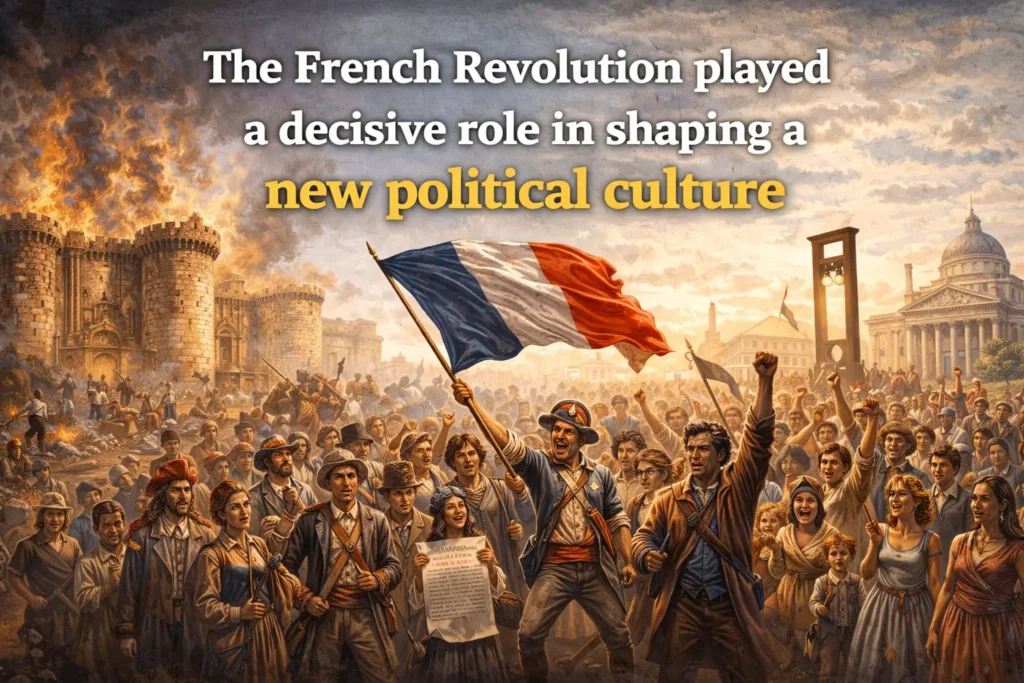
The French Revolution played a decisive role in shaping a new political culture, not only in France but across the world. It marked a fundamental break from the old order of monarchy, aristocracy, and feudal privileges, and introduced ideas and practices that transformed the relationship between the state and its citizens. The Revolution gave birth to modern concepts such as citizenship, equality, rights, and popular sovereignty, which became the foundation of contemporary political culture.
One of the most important contributions of the French Revolution was the idea of popular sovereignty. Before 1789, political authority in France rested with the king, who ruled by divine right. The Revolution challenged this notion and asserted that power ultimately belongs to the people. This principle was clearly expressed in the Declaration of the Rights of Man and of the Citizen, which proclaimed that sovereignty resides in the nation. This marked a shift from a monarch-centered political system to a people-centered one, laying the groundwork for modern democracy.
The Revolution also promoted the concept of citizenship. Under the ancien régime, society was divided into estates with unequal rights and privileges. The Revolution abolished these distinctions and introduced the idea that all individuals are equal before the law. Citizens were no longer subjects of a king but active participants in political life. This new political culture encouraged individuals to engage in public affairs, vote, and express their opinions, thus fostering a sense of political awareness and participation.
Another key feature of the new political culture was the emphasis on rights and liberties. The Declaration guaranteed fundamental rights such as freedom of speech, equality before the law, and protection of property. These rights became central to modern political thought and influenced later democratic movements around the world. The Revolution thus transformed the idea of governance from one based on authority and privilege to one based on rights and justice.
The French Revolution also led to the rise of political participation and mobilization. For the first time, large sections of society, including the middle class, workers, and peasants, became actively involved in politics. Political clubs, newspapers, and public debates flourished, creating a vibrant political culture. Groups like the Jacobins played a crucial role in shaping public opinion and mobilizing people. This expansion of political participation marked the beginning of mass politics, which is a defining feature of modern political systems.
Another significant development was the emergence of secularism in politics. The Revolution reduced the influence of the Church in state affairs and promoted the separation of religion from politics. Church lands were confiscated, and the clergy were brought under state control. This shift contributed to the development of a political culture based on rationality and secular values rather than religious authority.
The Revolution also introduced new symbols, rituals, and political language that shaped political culture. Symbols like the tricolor flag, the slogan “Liberty, Equality, Fraternity,” and the use of terms such as “citizen” replaced traditional monarchical symbols and titles. Public festivals, national celebrations, and revolutionary songs helped create a sense of unity and collective identity among the people. These cultural elements played an important role in fostering nationalism and political consciousness.
However, the new political culture was not without contradictions. The period of the Reign of Terror showed how revolutionary ideals could lead to violence and authoritarianism. Under leaders like Maximilien Robespierre, the state exercised extreme control in the name of protecting the Revolution. This phase highlighted the tensions between liberty and authority in the emerging political culture.
Furthermore, the French Revolution had a global impact. Its ideas inspired revolutionary movements in Europe, Latin America, and beyond. It encouraged people to challenge oppressive systems and demand political rights. The spread of these ideas contributed to the decline of absolute monarchies and the rise of democratic institutions worldwide.
In conclusion, the French Revolution played a transformative role in the emergence of a new political culture based on popular sovereignty, equality, rights, and active citizenship. It replaced the hierarchical and privilege-based system of the past with a more inclusive and participatory political order. Despite its challenges and contradictions, the Revolution laid the foundation for modern democratic values and practices, making it one of the most significant events in world history.
Discuss the role of french revolution in the emergence of new political culture Discuss the role of french revolution in the emergence of new political culture Discuss the role of french revolution in the emergence of new political culture Discuss the role of french revolution in the emergence of new political culture Discuss the role of french revolution in the emergence of new political culture Discuss the role of french revolution in the emergence of new political culture Discuss the role of french revolution in the emergence of new political culture