Discuss the roll of urban center in the decline of feudalism
The decline of feudalism in medieval Europe was a complex and gradual process influenced by economic, social, and political transformations. Among the most significant factors in this transition was the rise and development of urban centers. Towns and cities played a crucial role in weakening the foundations of feudal society, which had been primarily rural and agrarian in nature.
Feudalism was based on a hierarchical system of land ownership, where lords controlled land and peasants or serfs worked on it in exchange for protection and subsistence. This system was largely self-sufficient, with limited trade and mobility. However, the emergence of urban centers disrupted this structure by introducing new economic opportunities and social dynamics.
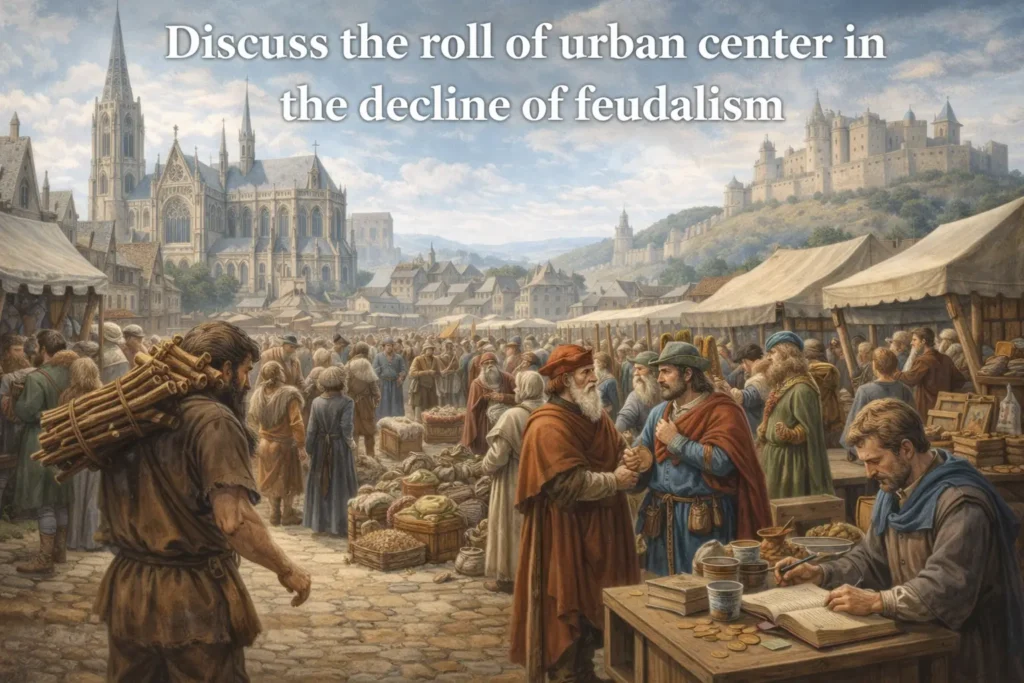
One of the key contributions of urban centers was the revival of trade and commerce. Towns became hubs of economic activity, where merchants, artisans, and traders gathered to exchange goods. The growth of long-distance trade, especially after events like the Crusades, brought wealth and new ideas into Europe. Markets and fairs in towns facilitated the circulation of money, gradually replacing the barter system that had dominated feudal economies. This shift weakened the economic self-sufficiency of manors and reduced the dependence of peasants on their lords.
Urban centers also contributed to the rise of a new social class—the bourgeoisie or middle class. This group consisted of merchants, craftsmen, and professionals who gained wealth and influence through trade and industry rather than land ownership. Their growing economic power challenged the traditional dominance of the feudal nobility. Unlike the rigid hierarchy of feudal society, towns offered greater social mobility, allowing individuals to improve their status through skill and enterprise.
Another important factor was the decline of serfdom. As towns expanded, they created demand for labor in various trades and crafts. Many serfs left the manors to seek better opportunities in urban areas. There was even a popular saying in medieval Europe: “Town air makes free,” meaning that a serf who lived in a town for a certain period could gain freedom. This migration reduced the labor force available to feudal lords and weakened their control over the peasantry.
Urban centers also promoted the use of money economy. Instead of providing services or labor, peasants increasingly paid rents in cash. Lords, in turn, needed money to participate in the growing market economy. This monetization of the economy reduced the importance of traditional feudal obligations and transformed relationships between lords and peasants into more contractual and economic ones.
The growth of towns led to the development of guilds, which regulated trade and crafts. Guilds protected the interests of their members and maintained standards of production. They also contributed to the economic independence of towns from feudal lords. Many towns obtained charters granting them self-governance, reducing the direct control of feudal authorities.
Politically, urban centers supported the rise of centralized monarchies. Kings often allied with the townspeople and the bourgeoisie to counterbalance the power of feudal lords. In return, towns provided financial support to monarchs through taxes and loans. This alliance helped strengthen royal authority and contributed to the decline of feudal decentralization.
Urbanization also encouraged intellectual and cultural growth. Towns became centers of education, learning, and innovation. Universities, schools, and cultural institutions flourished in urban environments, promoting new ideas that questioned traditional feudal values and hierarchies.
In conclusion, urban centers played a vital role in the decline of feudalism by transforming the economic, social, and political landscape of medieval Europe. Through the growth of trade, the rise of a middle class, the decline of serfdom, and the strengthening of centralized states, towns undermined the rigid structures of feudal society. The expansion of urban life marked the transition from a feudal to a more modern, market-oriented society, laying the foundation for the development of capitalism and the modern state system.
Discuss the roll of urban center in the decline of feudalism Discuss the roll of urban center in the decline of feudalism Discuss the roll of urban center in the decline of feudalism Discuss the roll of urban center in the decline of feudalism Discuss the roll of urban center in the decline of feudalism Discuss the roll of urban center in the decline of feudalism