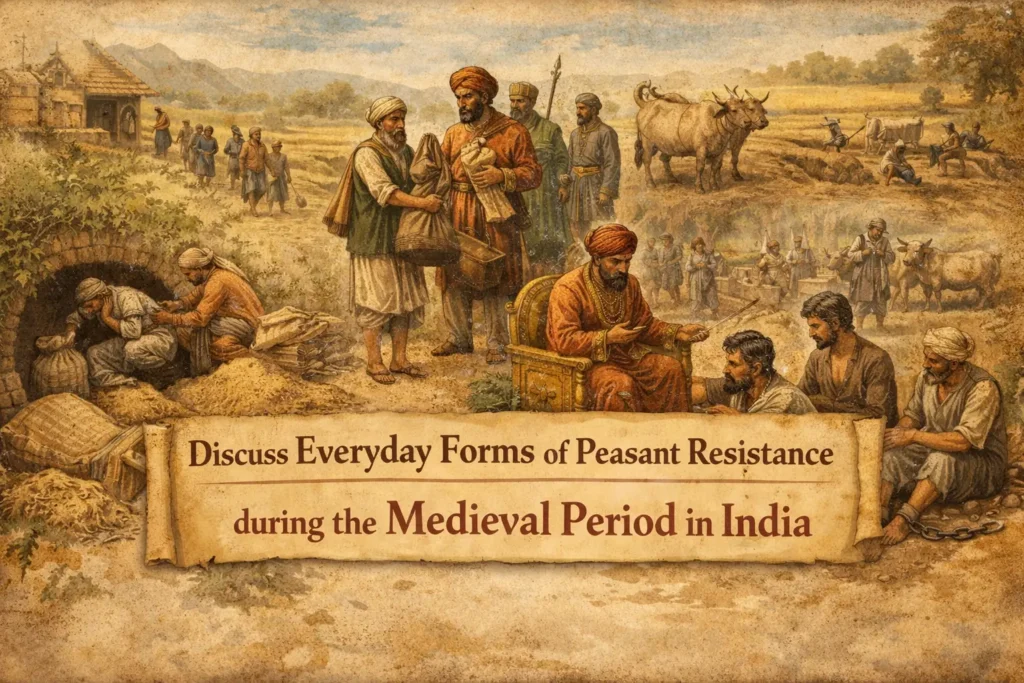
Discuss everyday forms of peasant resistance during the medieval period
Peasant resistance in medieval India was not always expressed through large-scale rebellions or open revolts. Instead, it often took subtle, everyday forms that reflected the peasants’ continuous struggle against oppressive economic demands, social hierarchies, and political authority. These “everyday forms of resistance” were less visible but deeply significant in shaping agrarian society.
One of the most common forms of peasant resistance was non-payment or delayed payment of taxes and rent. In a system where land revenue was the primary source of state income—especially under regimes like the Delhi Sultanate and the Mughal Empire—peasants were often burdened with heavy taxation. When faced with excessive demands or crop failures, they resisted by withholding payment, underreporting produce, or fleeing their villages. Such acts, though not openly confrontational, directly challenged state authority and revenue mechanisms.
Another important method was evasion and concealment. Peasants frequently hid part of their agricultural produce to avoid full taxation. They might misrepresent the size of their landholdings or the yield of their crops. This form of resistance required collective effort and local cooperation, as entire communities often participated in deceiving revenue officials. It demonstrated the agency of peasants in negotiating with authority, even within restrictive systems.
Migration or desertion of villages was also a significant form of resistance. When exploitation became unbearable, peasants abandoned their lands and moved to forested or less controlled regions. This not only allowed them to escape immediate oppression but also deprived landlords and the state of labor and revenue. In many cases, such migration forced authorities to reduce taxes or offer incentives to bring peasants back, highlighting the effectiveness of this strategy.
Peasants also engaged in slowdowns and reduced productivity. By deliberately lowering the intensity of their labor, they could protest against harsh conditions without directly confronting their superiors. This passive resistance was difficult to detect and control, making it a practical tool for peasants who lacked the resources for open rebellion.
Everyday defiance of authority was another subtle form of resistance. This included ignoring orders, showing disrespect to local officials, or refusing to cooperate with landlords. While such acts might appear minor, they collectively weakened the authority of the ruling classes and reflected a persistent undercurrent of dissent.
In addition, social and cultural forms of resistance played a crucial role. Peasants often expressed their grievances through folk songs, stories, and local traditions that criticized exploitation and injustice. These cultural expressions helped preserve a sense of identity and solidarity among oppressed groups. Religious movements, particularly the Bhakti and Sufi traditions, also provided a platform for challenging social hierarchies and promoting egalitarian values, indirectly supporting peasant resistance.
Another dimension of resistance was collective organization at the village level. Although not always leading to open revolts, peasants sometimes acted together to oppose unjust demands. They could negotiate with landlords, refuse to perform forced labor (begar), or protect fellow villagers from exploitation. Such collective actions strengthened community bonds and made resistance more effective.
It is important to note that these everyday forms of resistance were shaped by the limitations faced by peasants. Open revolts were risky and often brutally suppressed, so subtle methods offered a safer alternative. These acts were not necessarily aimed at overthrowing the system but at mitigating exploitation and asserting some degree of autonomy.
However, the impact of these forms of resistance was significant. They forced rulers and landlords to remain cautious in their demands and sometimes led to reforms or concessions. They also revealed the inherent tensions within the agrarian system and the inability of authorities to exercise complete control over rural society.
In conclusion, everyday forms of peasant resistance in medieval India were varied, subtle, and deeply embedded in daily life. Through tax evasion, migration, slowdowns, cultural expression, and collective action, peasants continuously negotiated and contested the structures of power. Though often overlooked, these forms of resistance played a crucial role in shaping the dynamics of medieval agrarian society and demonstrated the resilience and agency of the peasantry.
Discuss everyday forms of peasant resistance during the medieval period Discuss everyday forms of peasant resistance during the medieval period Discuss everyday forms of peasant resistance during the medieval period Discuss everyday forms of peasant resistance during the medieval period Discuss everyday forms of peasant resistance during the medieval period Discuss everyday forms of peasant resistance during the medieval period Discuss everyday forms of peasant resistance during the medieval period