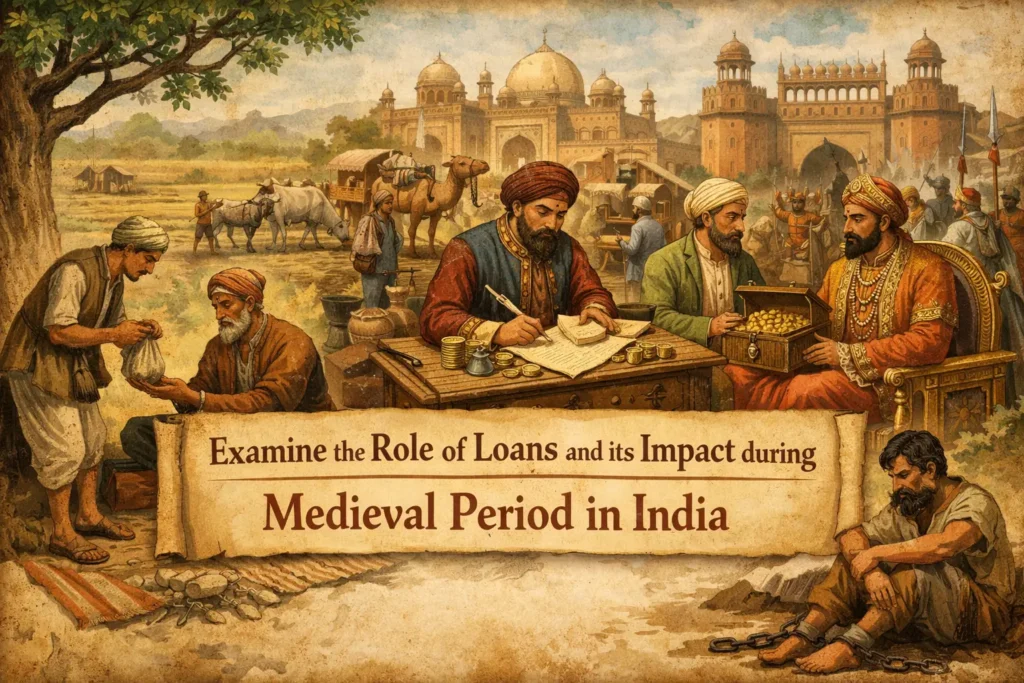
Examine the role of loans and its impact during medieval period in India
The role of loans and credit in medieval India was both significant and complex, deeply influencing economic activity, social relations, and agrarian structures. In a predominantly agrarian society, access to credit became essential for peasants, artisans, traders, and even the state. However, while loans facilitated production and trade, they also led to indebtedness and social inequalities.
One of the most important roles of loans in medieval India was in agriculture. Cultivators often required credit for purchasing seeds, cattle, tools, and for meeting subsistence needs during lean seasons. Since agricultural production was heavily dependent on monsoons, crop failures were frequent, making peasants vulnerable. In such situations, they turned to moneylenders, commonly known as sahukars or mahajans. These lenders provided loans at high rates of interest, often leading to a cycle of debt. In many cases, peasants were unable to repay loans and had to mortgage or even lose their land, leading to land alienation and the emergence of a class of landless laborers.
Loans also played a vital role in promoting trade and commerce. Merchants relied on credit to finance long-distance trade, especially in regions connected by trade routes such as those under the Delhi Sultanate and the Mughal Empire. Instruments like hundis (bills of exchange) facilitated the transfer of money across regions without the physical movement of cash, reducing the risk of theft and promoting commercial expansion. Merchant communities such as Banias and Multanis developed sophisticated systems of credit and banking, which contributed to the growth of urban centers and markets.
In the artisanal sector, loans were equally important. Artisans required credit to purchase raw materials and sustain production. In many cases, they were dependent on merchants or intermediaries who provided advances. While this system ensured a steady supply of goods, it also tied artisans into exploitative relationships, limiting their independence and bargaining power. This system can be seen as an early form of the putting-out system, where production was controlled by merchants rather than producers.
The state also depended on loans, particularly during times of war or fiscal crisis. Rulers and nobles sometimes borrowed from wealthy merchants and bankers to finance military campaigns or administrative expenses. This created a close relationship between the state and commercial classes. In some cases, bankers gained significant political influence due to their financial power.
However, the impact of loans was not entirely positive. One of the most serious consequences was the problem of chronic indebtedness. High interest rates, lack of regulation, and exploitative practices by moneylenders often trapped borrowers in a cycle of debt. This was particularly severe in rural areas, where peasants had limited means of repayment. Indebtedness also reinforced social hierarchies, as upper-caste and wealthy groups dominated moneylending activities, while lower-caste peasants and laborers were the primary borrowers.
Moreover, the legal and institutional framework for regulating credit was weak. Although some rulers attempted to control excessive interest rates or provide relief to peasants, these measures were often ineffective. The absence of formal banking institutions meant that credit systems were largely informal and based on personal relationships, trust, and social networks.
Despite these challenges, loans contributed to the monetization of the economy. The increasing use of money in transactions, especially during the Mughal period, led to greater economic integration and commercialization. Credit networks connected rural and urban economies, facilitating the flow of goods and services.
In conclusion, loans in medieval India played a dual role. On one hand, they were indispensable for sustaining agriculture, trade, and artisanal production, and contributed to economic growth and commercialization. On the other hand, they led to widespread indebtedness, exploitation, and social inequality. Thus, the system of credit was both a driver of economic activity and a source of economic distress, reflecting the broader contradictions of medieval Indian society.
Examine the role of loans and its impact during medieval period in India Examine the role of loans and its impact during medieval period in India Examine the role of loans and its impact during medieval period in India Examine the role of loans and its impact during medieval period in India Examine the role of loans and its impact during medieval period in India Examine the role of loans and its impact during medieval period in IndiaExamine the role of loans and its impact during medieval period in India Examine the role of loans and its impact during medieval period in India