Major Features of the Harappan Economy
The Harappan or Indus Valley Civilization (c. 2600–1900 BCE) represents one of the earliest and most advanced urban economies of the ancient world. Spread across a vast region covering present-day northwest India and Pakistan, the Harappan economy was characterized by agricultural surplus, craft specialization, standardized production, extensive trade networks, and efficient urban management. Unlike later civilizations with monumental palaces or temples, Harappan economic organization reflected a balanced integration of rural and urban activities.
1. Agricultural Foundation
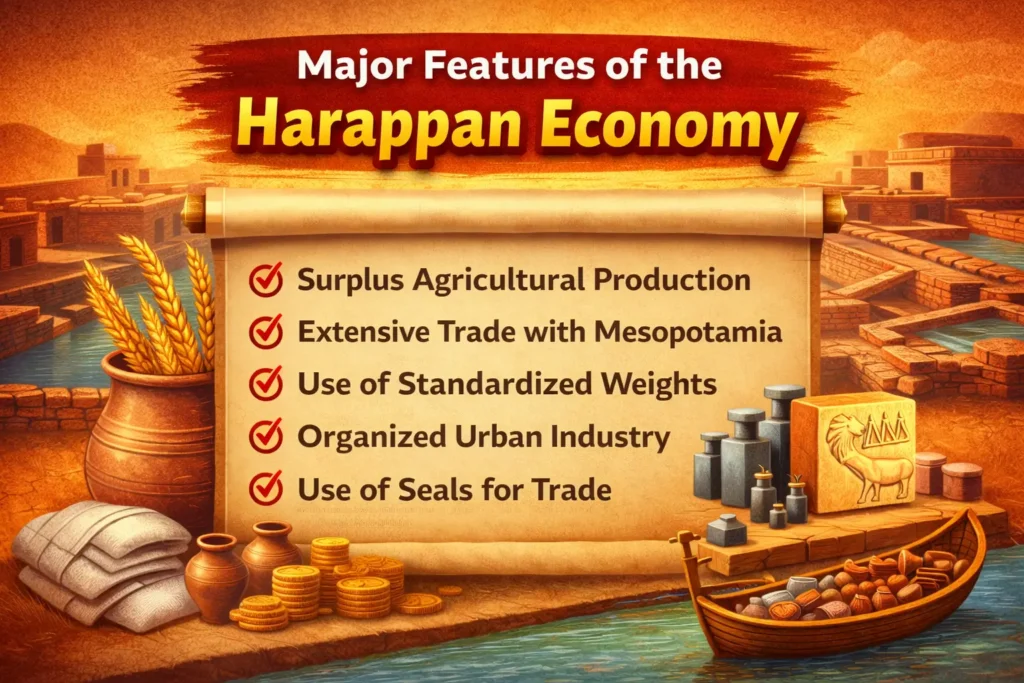
Agriculture formed the backbone of the Harappan economy. Archaeological evidence from sites such as Harappa, Mohenjo-daro, and Kalibangan indicates the cultivation of wheat, barley, peas, sesame, dates, and cotton. The Harappans were among the earliest producers of cotton textiles. Farming was supported by the fertile alluvial plains of the Indus and its tributaries, supplemented by seasonal flooding that replenished soil fertility. In some regions, plough agriculture and floodwater farming were practiced, ensuring regular crop production and surplus generation.
2. Animal Husbandry
Animal domestication played a vital role in the economy. Cattle, buffalo, sheep, goats, and pigs were reared for dairy products, meat, hides, and agricultural labor. Evidence of bullock-drawn carts and ploughs suggests the use of animals in transportation and cultivation. Animal resources complemented agriculture and enhanced economic sustainability.
3. Craft Specialization and Production
One of the most striking features of the Harappan economy was its high degree of craft specialization. Artisans were engaged in bead-making, pottery, metallurgy, shell-working, stone carving, and textile production. Centers like Chanhudaro were known for bead-making, while Lothal was famous for shell and ivory crafts. The use of copper, bronze, gold, and silver indicates advanced metallurgical knowledge. Standardized tools and techniques suggest organized production possibly regulated by civic authorities.
4. Standardization of Weights and Measures
The Harappans developed a highly standardized system of weights and measures, generally based on binary and decimal systems. Cubical stone weights made of chert were used across settlements, indicating uniformity in commercial transactions. This standardization facilitated trade, ensured fairness in exchange, and reflects a sophisticated understanding of economic regulation.
5. Trade and Exchange Networks
Trade was a crucial component of the Harappan economy. Both internal and external trade flourished. Internally, goods such as agricultural produce, pottery, tools, and luxury items were exchanged between urban centers and rural hinterlands. Externally, Harappan trade links extended to Mesopotamia, Oman, Bahrain (Dilmun), and Central Asia. Archaeological evidence such as seals, beads, and Mesopotamian texts referring to “Meluhha” attest to long-distance maritime and overland trade.
6. Transportation and Infrastructure
Efficient transportation supported economic activity. The presence of dockyard facilities at Lothal suggests maritime trade, while riverine routes along the Indus facilitated inland transport. Bullock carts and boats were commonly used. Well-planned roads, granaries, and storage facilities ensured smooth movement and storage of goods.
7. Urban Planning and Economic Organization
The Harappan cities exhibit advanced urban planning, which was closely linked to economic organization. Cities were divided into citadel and lower town areas, with granaries, warehouses, and workshops strategically located. Massive granaries at Harappa indicate state or community control over surplus storage and redistribution, ensuring food security and economic stability.
8. Absence of Coinage and Market Economy
Despite extensive trade, there is no evidence of coinage in the Harappan civilization. Exchange likely operated through barter systems regulated by standardized weights and seals. Seals bearing animal motifs and symbols probably functioned as markers of ownership, authority, or trade identity.
Conclusion
In conclusion, the Harappan economy was a well-organized, diversified, and integrated system based on agricultural surplus, craft specialization, standardized production, and extensive trade networks. Its economic success supported large urban centers and sustained one of the world’s earliest civilizations. The efficiency, uniformity, and scale of the Harappan economy reflect a high degree of administrative coordination, making it a landmark in the economic history of ancient India.
Click Here Buy @Rs.1/- only from Amazon
Major Features of the Harappan Economy Major Features of the Harappan Economy Major Features of the Harappan Economy Major Features of the Harappan Economy Major Features of the Harappan Economy Major Features of the Harappan Economy Major Features of the Harappan Economy