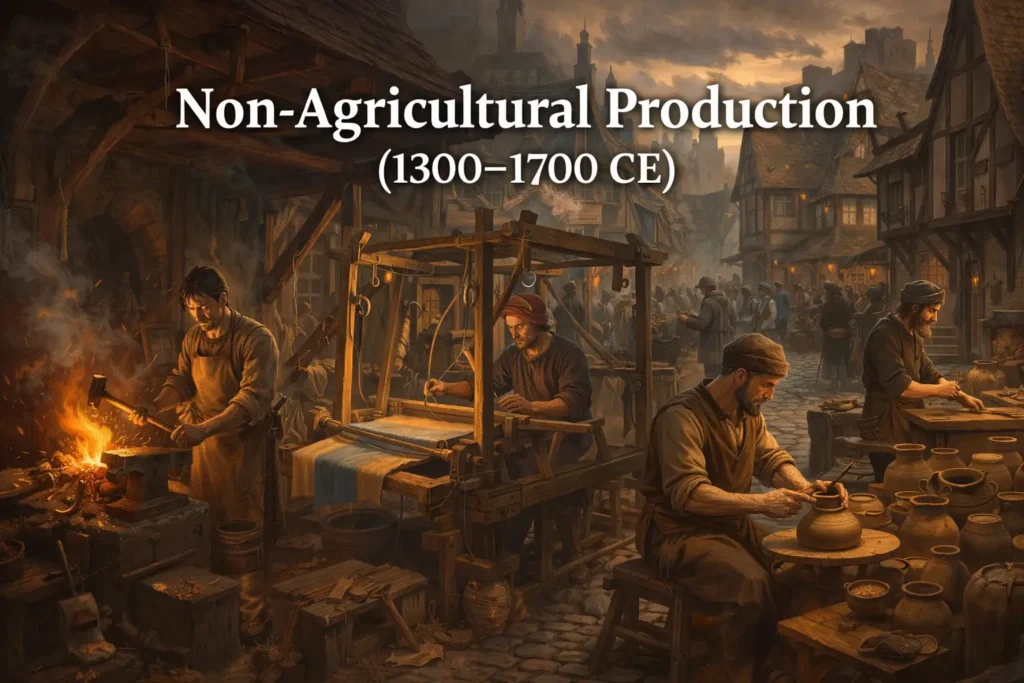
Non-Agricultural Production (1300–1700 CE)
Between 1300 and 1700 CE, the Indian subcontinent witnessed a significant expansion and diversification of non-agricultural production, closely linked with urbanization, commercialization, and the growth of long-distance trade. This period, covering the later Delhi Sultanate and the Mughal Empire, saw the strengthening of craft industries, mining, metallurgy, construction activities, and service sectors, which together formed an essential component of the medieval economy.
Expansion of Craft Production
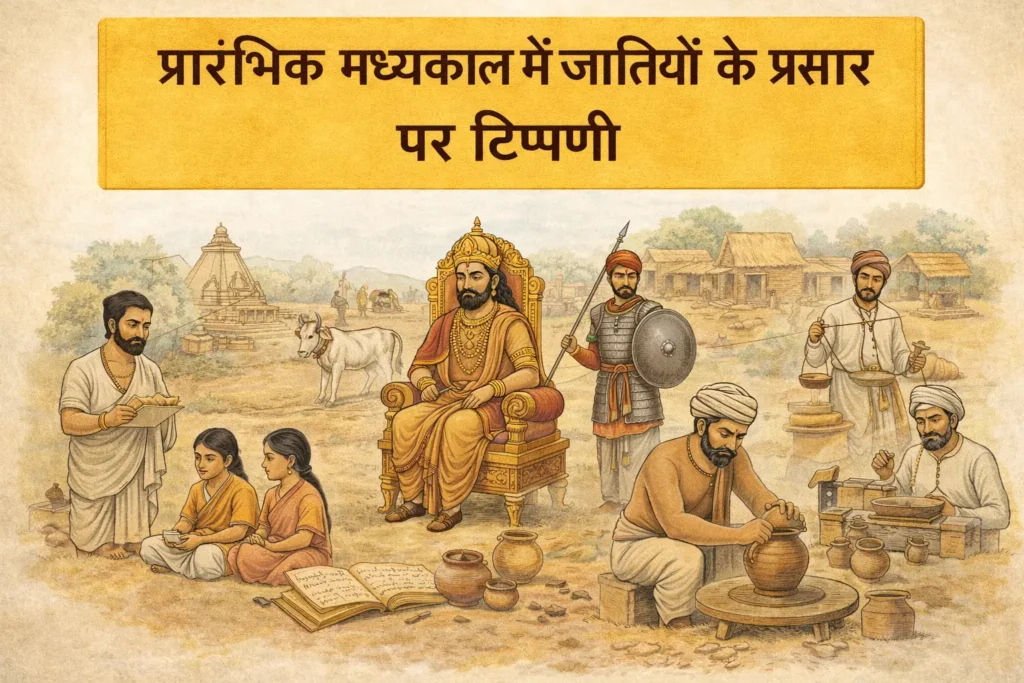
Craft production was the most prominent form of non-agricultural activity during this period. Artisans were engaged in a wide range of occupations such as weaving, dyeing, metalworking, leather processing, pottery, carpentry, stone cutting, and jewellery making. These crafts were largely organized on a hereditary basis and often clustered in towns and villages. The textile industry, especially cotton and silk weaving, emerged as the leading manufacturing sector. Regions like Gujarat, Bengal, the Coromandel Coast, and the Deccan became renowned for high-quality textiles such as muslin, calico, brocades, and printed cloth.
Organization of Production and Guilds
Production was organized through artisan communities and guild-like associations, though medieval guilds were less rigid than their ancient counterparts. These associations regulated training, quality, and prices, and represented artisans’ interests before the state. Many artisans worked in household-based units, while others were employed in workshops under merchants or state patronage. The Mughal state actively supported crafts by maintaining royal workshops (karkhanas), which produced luxury goods such as arms, carpets, paintings, and fine textiles for the court and nobility.
Mining and Metallurgy
Mining and metallurgy constituted another important area of non-agricultural production. India produced iron, copper, gold, silver, and salt. The manufacture of arms and weapons expanded due to constant warfare and the military needs of the state. India was also famous for high-quality steel, particularly wootz steel, used for swords and exported to West Asia. Salt production, especially in Rajasthan and coastal regions, was a major state-controlled industry and a significant source of revenue.
Construction and Architecture
Large-scale construction activities were a hallmark of this period. The building of forts, palaces, mosques, temples, tombs, roads, bridges, and caravanserais required skilled labor such as masons, stone cutters, architects, and engineers. State-sponsored construction not only displayed imperial power but also generated employment and stimulated allied industries like lime, brick, and timber production.
Trade, Markets, and Services
Non-agricultural production was closely linked to the expansion of trade and markets. Artisans depended on merchants for raw materials and access to markets, while merchants invested capital in production. Urban centers like Delhi, Agra, Lahore, Ahmedabad, Surat, and Masulipatnam emerged as hubs of manufacturing and commerce. The growth of transport, banking, moneylending, and brokerage services further supported non-agricultural economic activity.
Role of the State
The state played an important role in promoting and regulating non-agricultural production. It provided patronage, ensured security of trade routes, regulated prices of essential goods, and sometimes fixed wages. However, artisans were also subjected to taxation and, in some cases, forced labor. Despite these constraints, the overall trend was one of growth and specialization.
In conclusion, non-agricultural production between 1300 and 1700 CE formed a dynamic and integral part of the Indian economy. The expansion of crafts, mining, construction, and services contributed to urbanization, commercialization, and integration with global trade networks. Supported by state patronage and merchant capital, non-agricultural production played a crucial role in sustaining the economic vitality of medieval India.