What were the objectives of the colonial revenue policy
The objectives of the colonial revenue policy in India under the British Empire were primarily economic, administrative, and political. Land revenue formed the backbone of the colonial economy, and the policies introduced by the British were designed to maximize revenue extraction while consolidating their control over Indian society and economy. These policies significantly transformed traditional agrarian relations and had long-lasting consequences.
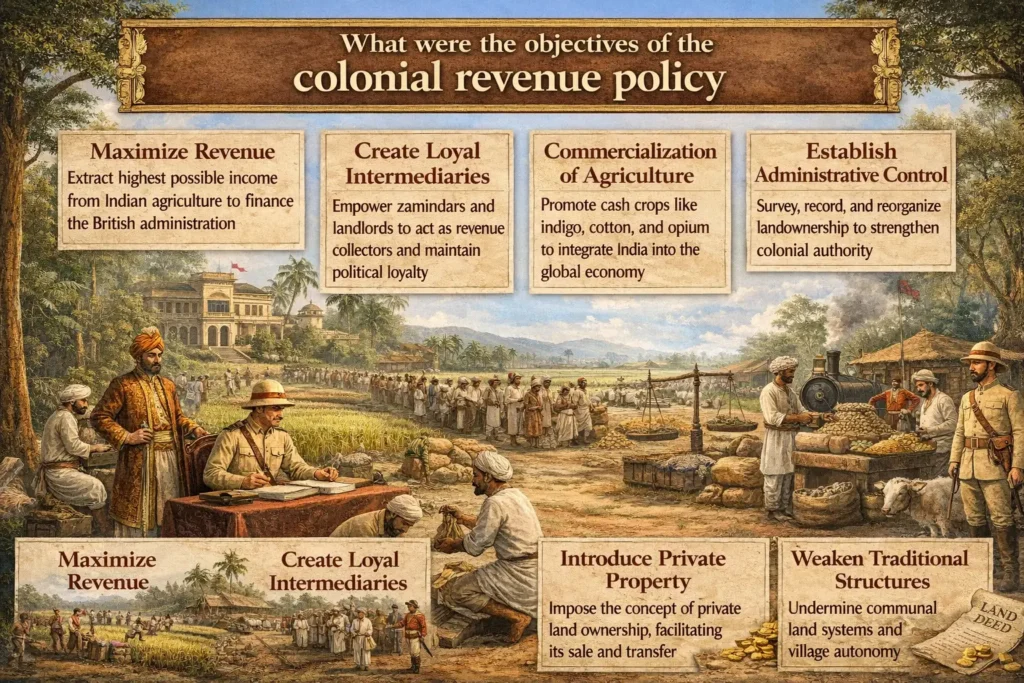
The foremost objective of colonial revenue policy was maximization of revenue. The British administration depended heavily on land revenue as its main source of income. This revenue financed the colonial bureaucracy, military expenditures, and trade activities. To ensure a steady and high flow of income, the British introduced various land revenue systems such as the Zamindari, Ryotwari, and Mahalwari systems. These systems were structured to extract the highest possible revenue from agricultural production, often without considering the economic condition of the peasants.
Another key objective was the creation of a loyal class of intermediaries. Under the Zamindari system, particularly introduced in Bengal, landlords (zamindars) were recognized as the legal owners of land. These zamindars were responsible for collecting revenue from peasants and paying it to the state. By granting them ownership rights and privileges, the British aimed to secure their political loyalty. This class acted as a buffer between the colonial state and the rural population, helping maintain stability and reducing the risk of rebellion.
The policy also aimed at the commercialization of agriculture. The British encouraged the cultivation of cash crops such as indigo, cotton, jute, and opium, which were in demand in international markets. This shift from subsistence farming to commercial agriculture ensured a steady supply of raw materials for British industries. It also integrated the Indian economy into the global capitalist system, but often at the cost of food security for local populations.
Another objective was to establish administrative control over rural areas. By restructuring land ownership and revenue collection systems, the British were able to penetrate deeply into village society. Detailed surveys, land measurements, and record-keeping were introduced to make the system more efficient and transparent from the colonial perspective. This helped in strengthening bureaucratic control and monitoring agricultural production.
The colonial revenue policy also sought to introduce the concept of private property in land. Traditionally, land rights in India were often communal or based on customary usage. The British replaced these with legally defined property rights, making land a transferable commodity. This facilitated buying, selling, and mortgaging of land, which aligned with capitalist economic principles. However, it also led to increased land alienation, as many peasants lost their land due to inability to pay high taxes.
A further objective was to ensure regular and fixed income for the state. Systems like the Permanent Settlement fixed the amount of revenue to be paid, providing certainty to the colonial government. However, this rigidity often worked against peasants, as they were required to pay revenue regardless of agricultural output or natural calamities like droughts and floods.
Lastly, the revenue policy indirectly aimed at weakening traditional rural structures. By altering existing social and economic relations, the British disrupted village communities and reduced the power of traditional institutions. This made it easier for the colonial state to impose its authority without facing organized resistance.
In conclusion, the colonial revenue policy was designed primarily to serve the economic interests of the British Empire. Its objectives included maximizing revenue, creating loyal intermediaries, promoting commercial agriculture, strengthening administrative control, and introducing private property. While these policies helped the British maintain their rule and economic dominance, they had adverse effects on Indian agriculture, leading to peasant exploitation, indebtedness, and widespread rural distress.
What were the objectives of the colonial revenue policy What were the objectives of the colonial revenue policy What were the objectives of the colonial revenue policy What were the objectives of the colonial revenue policy What were the objectives of the colonial revenue policy What were the objectives of the colonial revenue policy What were the objectives of the colonial revenue policy What were the objectives of the colonial revenue policy What were the objectives of the colonial revenue policy What were the objectives of the colonial revenue policy