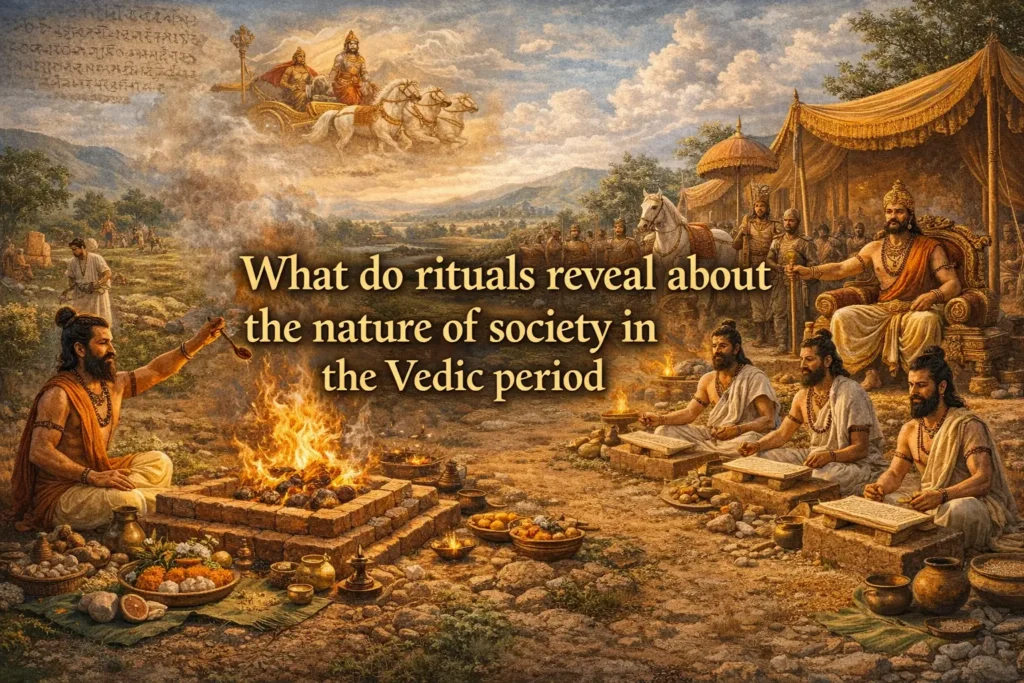
What do rituals reveal about the nature of society in the Vedic period
Rituals occupy a central place in understanding the nature of society during the Vedic period. They were not merely religious practices but reflected the social structure, economic life, political authority, and cultural values of the time. By examining Vedic rituals, particularly those described in texts like the Rigveda, Yajurveda, and Brahmanas, historians gain deep insights into how society was organized and how power and belief systems functioned.
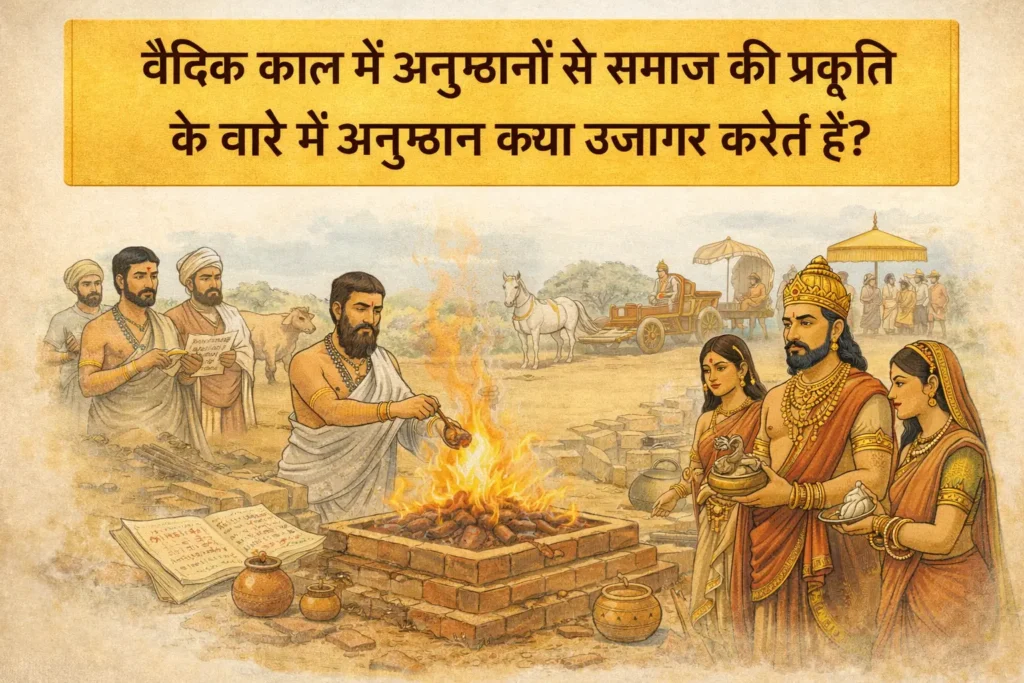
One of the most significant aspects revealed through rituals is the hierarchical nature of Vedic society. Rituals were often conducted by specialized priests (Brahmanas), who held a position of high authority due to their knowledge of sacred chants and procedures. The complexity of rituals, especially elaborate sacrifices (yajnas), ensured that common people depended on priests for their performance. This indicates the growing importance of the Brahmanical class and the emergence of a stratified social order, later formalized into the varna system. The prominence of priests in rituals highlights how religion reinforced social hierarchy.
Rituals also reflect the patriarchal character of Vedic society. Most rituals were performed by male members, particularly the head of the household, known as the grihapati. Women participated in certain domestic rituals but had a secondary role in major sacrificial ceremonies. This suggests that authority within both family and society was largely male-dominated. At the same time, the presence of women in some rituals indicates that they were not entirely excluded, pointing to a complex social structure with defined but varied roles.
The economic life of the Vedic people is also mirrored in their rituals. Many rituals involved offerings of agricultural produce, cattle, ghee, and other resources. The importance of cattle in sacrifices highlights their economic and symbolic value, as wealth was often measured in terms of cattle. Rituals such as the Ashvamedha (horse sacrifice) and Rajasuya were not only religious ceremonies but also displays of wealth and power. These rituals required substantial resources, indicating the existence of surplus production and an economy capable of supporting large-scale ceremonial activities.
Political authority and kingship are another dimension revealed through rituals. Royal rituals like the Ashvamedha and Rajasuya were performed by kings to assert their sovereignty and legitimize their rule. These ceremonies symbolized the king’s control over territory and his divine sanction to govern. The participation of priests in these rituals further strengthened the alliance between religious and political authority. Thus, rituals served as instruments of political consolidation and social control.
Rituals also provide insight into the religious beliefs and worldview of Vedic society. Early Vedic rituals were centered around natural forces and deities such as Indra, Agni, and Varuna. These deities were associated with elements like rain, fire, and cosmic order, reflecting a close relationship between humans and nature. Rituals were performed to seek prosperity, protection, and harmony with these forces. Over time, rituals became more elaborate and symbolic, indicating a shift from simple nature worship to more complex religious ideas.
Another important feature revealed through rituals is the collective nature of Vedic society. Many rituals, especially sacrifices, were communal events involving the participation of different sections of society. They reinforced social cohesion and a shared cultural identity. At the same time, the exclusivity of certain rituals to specific groups also highlights social divisions and the controlled access to religious practices.
Rituals further indicate the transition from a relatively simple tribal society to a more complex and organized one. In the early Vedic period, rituals were simpler and more flexible, reflecting a semi-nomadic lifestyle. In the later Vedic period, rituals became highly elaborate and codified, requiring strict adherence to procedures. This change reflects the increasing complexity of society, the rise of settled agriculture, and the consolidation of social and political hierarchies.
In conclusion, rituals in the Vedic period were not just religious acts but powerful indicators of the nature of society. They reveal a hierarchical and patriarchal structure, an economy based on agriculture and cattle, and a political system that relied on religious legitimacy. They also reflect evolving religious beliefs and the growing complexity of social organization. By studying these rituals, historians can better understand the interconnected aspects of Vedic life and the foundations of later Indian society.
What do rituals reveal about the nature of society in the Vedic period What do rituals reveal about the nature of society in the Vedic period What do rituals reveal about the nature of society in the Vedic period What do rituals reveal about the nature of society in the Vedic period What do rituals reveal about the nature of society in the Vedic period What do rituals reveal about the nature of society in the Vedic period What do rituals reveal about the nature of society in the Vedic period What do rituals reveal about the nature of society in the Vedic period