
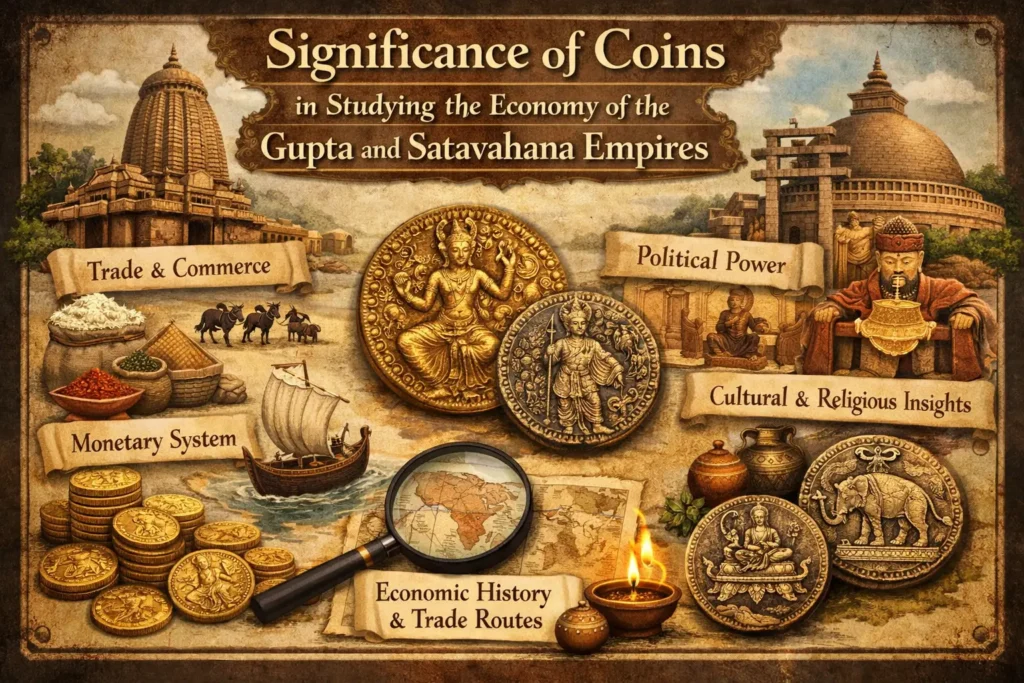
Significance of Coins in Studying the Economy of the Gupta and Satavahana Empires
Coins constitute one of the most important archaeological sources for understanding the economic history of ancient India. For the Gupta (c. 4th–6th century CE) and Satavahana (c. 1st century BCE–3rd century CE) empires, numismatic evidence provides valuable insights into monetary systems, trade networks, state authority, economic prosperity, and patterns of exchange. Since literary sources often present idealized or normative descriptions, coins offer more concrete and empirical data for reconstructing economic realities.
Coins as Evidence of Monetization and Economic Activity
The circulation of coins indicates the degree of monetization in an economy. The Satavahanas issued coins mainly of lead, copper, and potin, reflecting a regional economy where small-scale transactions, local trade, and market exchanges were significant. The extensive use of lead coins, especially in the Deccan, points to adaptation to locally available resources and the needs of a market-oriented economy.
In contrast, the Guptas are best known for their abundant gold coinage, which suggests a high level of economic prosperity and surplus generation. Gold coins such as dinara indicate flourishing trade, accumulation of wealth, and strong state finances. The presence of such high-value currency reflects elite consumption, long-distance trade, and the ability of the state to control precious metal resources.
Coins and Trade Networks
Coins help trace both internal and external trade. Satavahana coins have been found in large numbers along inland trade routes, urban centers, and port towns such as Sopara and Kalyan. Their wide distribution demonstrates the integration of agrarian hinterlands with urban markets and coastal trade networks. Moreover, the Satavahanas facilitated trade between northern India and the Roman world, a fact corroborated by the discovery of Roman coins in the Deccan region.
Gupta coins, though less commonly found in overseas contexts, reveal a vibrant internal economy. Their circulation across the Gangetic plains indicates commercial connectivity between cities, rural areas, and administrative centers. The continuity of gold coinage also reflects India’s participation in long-distance trade networks, even if on a reduced scale compared to earlier Indo-Roman trade.
Political Authority and Economic Control
Coins were instruments of state authority and economic regulation. The Satavahana kings issued coins bearing their names, titles, and symbols, often bilingual (Prakrit and sometimes symbols understood by diverse populations). This suggests a flexible monetary policy catering to a heterogeneous society and promoting economic integration across regions.
Gupta coins, with finely engraved portraits of rulers and elaborate legends in Sanskrit, reflect centralized political power and economic stability. The uniformity in weight and design implies effective administrative control over minting and currency circulation, which is essential for a stable economy.
Economic Ideology and Occupational Representation
The iconography on coins provides clues to the economic base of the empires. Satavahana coins frequently depict symbols such as ships, animals, and religious motifs, reflecting their engagement with maritime trade, agriculture, and popular beliefs.
Gupta coins are particularly significant in portraying kings performing activities like archery, horse riding, hunting, and playing musical instruments. These images indicate royal patronage of martial traditions, leisure activities, and cultural pursuits, which were possible only in a prosperous economy. Such representations indirectly point to surplus production and economic confidence.
Debasement and Economic Change
Changes in coin metal, weight, and quality help historians assess economic transitions. The gradual decline in the purity and frequency of gold coins toward the later Gupta period has been interpreted as a sign of economic stress, reduced trade, or political instability. Similarly, fluctuations in Satavahana coinage reflect regional economic conditions and the pressures of sustaining a vast empire.
Coins as Chronological and Regional Markers
Coins are also valuable for establishing chronology and regional economic patterns. Variations in legends, symbols, and metals help identify different phases of economic development and regional autonomy. The wide geographical spread of both Satavahana and Gupta coins assists historians in mapping the extent of markets and zones of economic influence.
In conclusion, coins are indispensable sources for studying the economy of the Gupta and Satavahana empires. They illuminate levels of monetization, trade networks, political authority, economic prosperity, and structural changes over time. While coins must be used in conjunction with literary and archaeological evidence, numismatics remains a powerful tool for reconstructing the economic history of ancient India, offering tangible insights into how these empires functioned and sustained their economies.
Buy anything @Rs.1 Only on Amazon
Significance of Coins in Studying the Economy Significance of Coins in Studying the Economy Significance of Coins in Studying the Economy Significance of Coins in Studying the Economy Significance of Coins in Studying the Economy Significance of Coins in Studying the Economy Significance of Coins in Studying the Economy Significance of Coins in Studying the Economy Significance of Coins in Studying the Economy