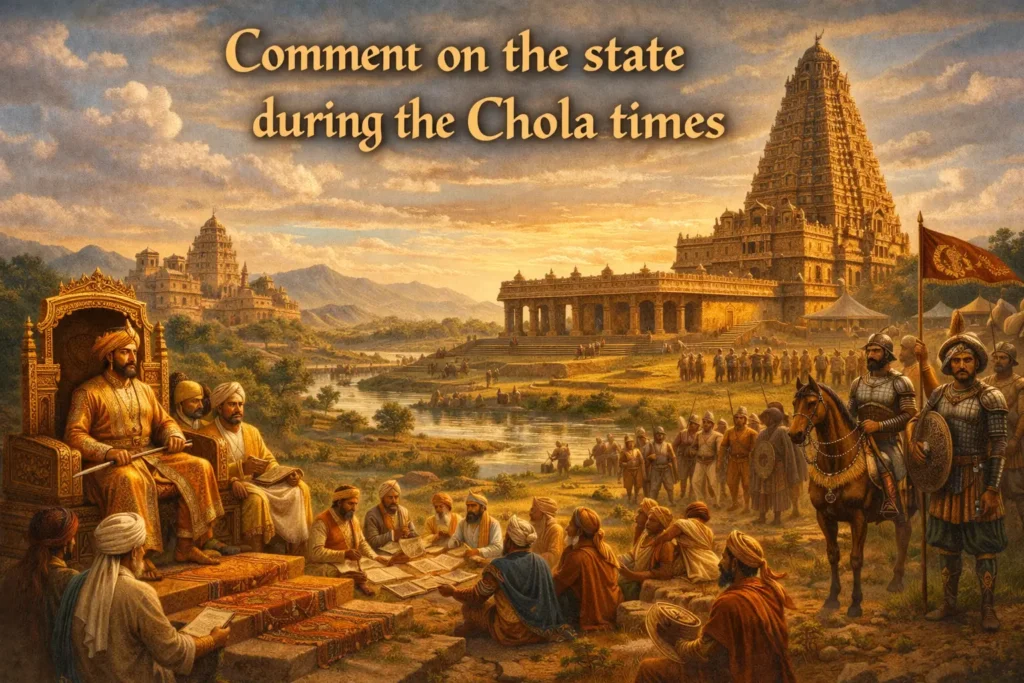
Comment on the state during the Chola times
The state during the Chola period represents one of the most developed and sophisticated political systems in early medieval South India. The Chola dynasty (c. 9th–13th centuries CE) established a powerful and centralized monarchy, while also allowing significant autonomy to local institutions. Their system combined imperial authority, efficient administration, and vibrant local self-governance, making it a distinctive model in Indian history.
At the apex of the Chola state stood the king, who was regarded as the supreme authority in political, military, and religious matters. Kings such as Rajaraja Chola I and Rajendra Chola I expanded the empire through successful military campaigns across South India, Sri Lanka, and even Southeast Asia. The king was seen not only as a ruler but also as a protector of dharma and a patron of temples and culture. Royal authority was often legitimized through elaborate rituals, inscriptions, and temple endowments.
The Chola administration was highly organized and hierarchical. The empire was divided into provinces called mandalams, which were further subdivided into valanadus, nadus, and villages. Each level had its own administrative officials who were responsible for maintaining law and order, collecting revenue, and implementing royal policies. This multi-tiered structure ensured effective governance over a vast territory.
One of the most remarkable features of the Chola state was its well-developed system of local self-government. Village assemblies played a crucial role in administration, especially in rural areas. Two important types of assemblies were the ur (general assembly of villagers) and the sabha or mahasabha (assembly of Brahmin landholders in Brahmadeya villages). These assemblies managed local affairs such as irrigation, land distribution, taxation, and justice.
The functioning of these assemblies is well documented in inscriptions, particularly the famous Uttaramerur inscriptions. These records describe a sophisticated electoral system where members were selected through a method known as kudavolai (lottery system). This indicates that the Chola state encouraged participatory governance at the grassroots level, even though ultimate authority rested with the king.
Revenue administration formed the backbone of the Chola state. Land revenue was the primary source of income, and the state undertook detailed land surveys to assess and classify land for taxation. Taxes varied depending on the type of land, its fertility, and the crops cultivated. The Cholas also invested heavily in irrigation, constructing tanks, canals, and reservoirs to enhance agricultural productivity. Efficient revenue collection allowed the state to maintain a strong army and support public works.
The military organization of the Chola state was another important aspect of its power. The Cholas maintained a large standing army and a formidable navy. Their naval strength enabled them to control maritime trade routes and undertake expeditions to Southeast Asia, including campaigns against the Srivijaya kingdom. Military regiments were often named after the king, reflecting loyalty and royal patronage.
Temples played a central role in the Chola state, functioning not only as religious institutions but also as economic and administrative centers. Grand temples like the Brihadeeswarar Temple, built by Rajaraja Chola I, served as hubs of social and economic activity. They owned vast lands, employed numerous people, and acted as centers for the redistribution of resources. The state actively supported temple construction and maintenance, thereby strengthening its ideological and cultural base.
Another significant feature of the Chola state was its integration of trade and commerce. The Cholas encouraged both inland and overseas trade, maintaining links with regions such as Southeast Asia and China. Merchant guilds like the Ayyavole and Manigramam played an important role in economic life and often operated with state support.
Despite its strengths, the Chola state was not entirely centralized. It functioned through a balance between royal authority and local autonomy. While the king exercised control over major decisions, local institutions handled everyday administration. This decentralized element contributed to the stability and longevity of the empire.
In conclusion, the state during Chola times was a complex and dynamic political system characterized by strong monarchy, efficient administration, and active local governance. It successfully combined central control with regional autonomy, supported by a robust economic base and military strength. The Chola model of governance remains a significant example of early medieval statecraft in India, highlighting the advanced administrative and political practices of the period.
Comment on the state during the Chola times Comment on the state during the Chola times Comment on the state during the Chola times Comment on the state during the Chola times Comment on the state during the Chola times Comment on the state during the Chola times Comment on the state during the Chola times Comment on the state during the Chola times Comment on the state during the Chola times Comment on the state during the Chola times Comment on the state during the Chola times Comment on the state during the Chola times