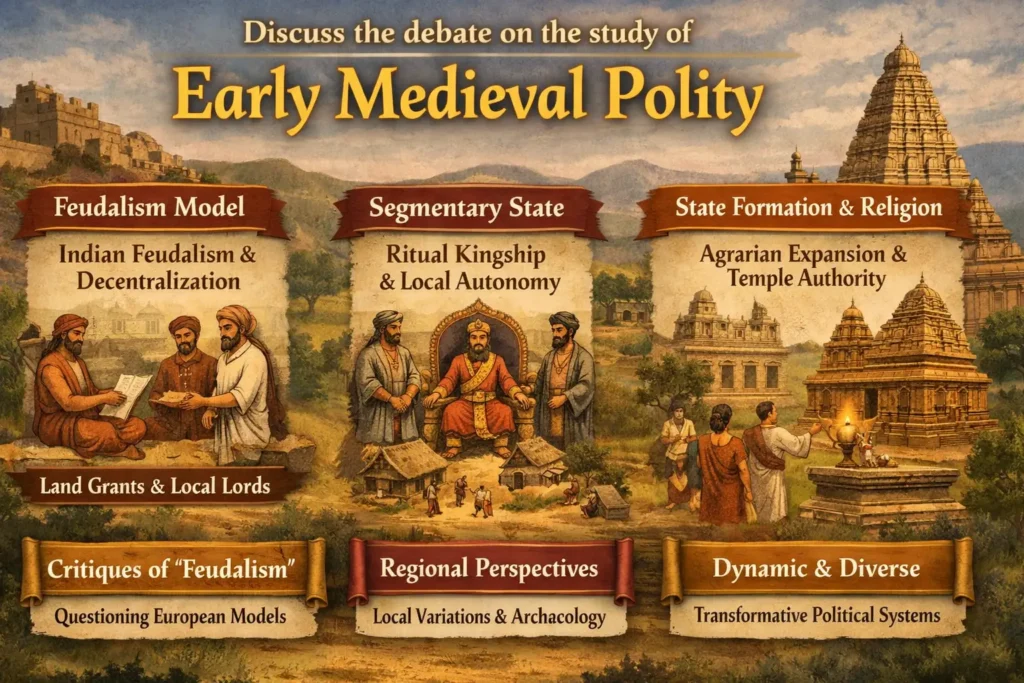
Discuss the debate on the study of early medieval polity
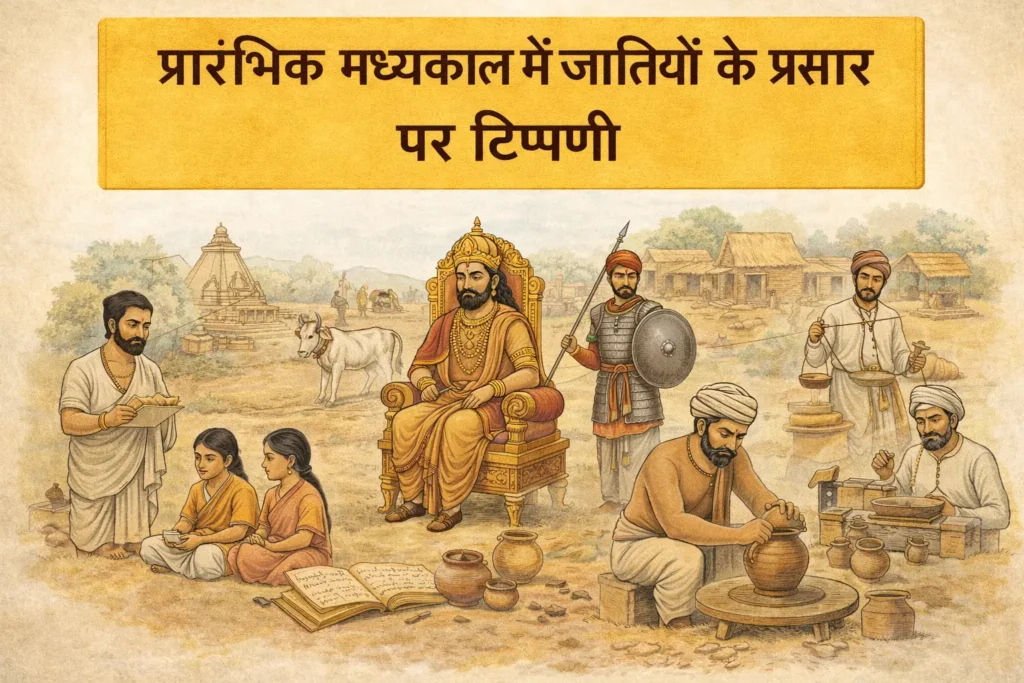
The study of early medieval polity—roughly covering the period between the 6th and 13th centuries in many parts of the world, especially in the Indian context—has generated intense historiographical debate. Scholars have differed widely in their interpretations of the nature of political structures, state formation, and the relationship between rulers and local authorities. These debates have evolved over time, reflecting changes in methodology, sources, and theoretical frameworks.
One of the earliest dominant interpretations was the “feudalism model”, largely influenced by Marxist historians. Scholars such as R.S. Sharma argued that early medieval polity in India was characterized by a process of “Indian feudalism.” According to this view, there was a decline of centralized authority after the fall of large empires like the Guptas, leading to the emergence of regional powers. Land grants to Brahmins, officials, and temples played a crucial role in this transformation. These grants often included administrative and fiscal rights, which weakened the central authority and led to the rise of a class of intermediaries. This, in turn, resulted in a fragmented polity where power was dispersed among local chiefs, resembling feudal structures seen in medieval Europe.
However, this interpretation has been challenged by several historians. Critics argue that the application of the European concept of feudalism to the Indian context is problematic. Scholars like Harbans Mukhia and Burton Stein have questioned the universality of feudalism as a model. They point out that Indian society did not exhibit all the defining features of European feudalism, such as serfdom in the strict sense or a rigid hierarchy of vassalage. Instead, they suggest that early medieval polity in India had its own unique characteristics that cannot be fully explained by the feudalism framework.
An alternative perspective is offered by Burton Stein’s concept of the “segmentary state.” According to this model, the state in early medieval South India, particularly under the Cholas, was not a centralized bureaucratic structure but a loosely integrated system of segments. The king exercised ritual sovereignty and symbolic authority at the center, while actual administrative control was often exercised by local units such as villages and regional elites. These segments retained considerable autonomy, and the cohesion of the polity was maintained through ritual, kinship ties, and redistributive mechanisms rather than direct political control.
Another important debate revolves around the nature of state formation and integration. Some historians emphasize the role of agrarian expansion in the early medieval period. The extension of agriculture into forested and tribal areas led to the incorporation of new regions into the political framework. This process involved alliances between ruling elites and local chiefs, as well as the integration of tribal groups into the caste hierarchy. Land grants were seen not merely as signs of political decline but as instruments of state formation and expansion. Thus, instead of viewing the early medieval polity as a period of decay, this perspective highlights its dynamic and transformative nature.
The role of religion and ideology has also been a subject of debate. Temples and religious institutions were not just spiritual centers but also played significant economic and political roles. They acted as landholders, employers, and centers of redistribution. Some scholars argue that the legitimation of political authority was closely tied to religious patronage, with rulers using temple-building and land grants to assert their power and gain social support.
More recent approaches have focused on regional variations and the use of new sources, such as inscriptions and archaeological evidence. These studies emphasize that early medieval polity was not uniform across the subcontinent. Different regions exhibited different patterns of political organization, depending on local conditions, resource bases, and historical trajectories. This has led to a more nuanced understanding that moves away from grand, overarching models toward localized studies.
In conclusion, the debate on the study of early medieval polity reflects broader shifts in historiography—from rigid, universal models like feudalism to more flexible, region-specific interpretations. While the feudalism debate highlighted issues of decentralization and socio-economic change, later models such as the segmentary state and agrarian expansion have enriched our understanding of the complexity and diversity of early medieval political systems. The ongoing dialogue among historians continues to refine our knowledge, making this field a vibrant area of historical inquiry.
Discuss the debate on the study of early medieval polity Discuss the debate on the study of early medieval polity Discuss the debate on the study of early medieval polity Discuss the debate on the study of early medieval polity Discuss the debate on the study of early medieval polity Discuss the debate on the study of early medieval polity Discuss the debate on the study of early medieval polity Discuss the debate on the study of early medieval polity Discuss the debate on the study of early medieval polity