write the thoughts of ancients Greek philosophers
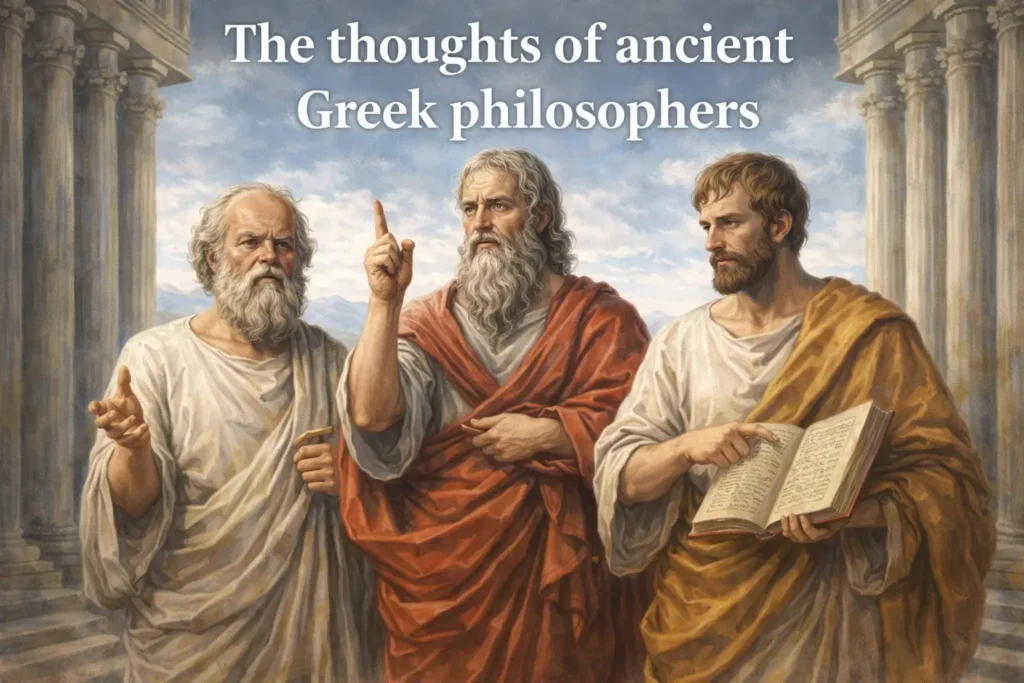
Ancient Greek philosophy laid the foundation of Western intellectual thought. The early Greek philosophers were deeply concerned with understanding the nature of reality, human life, ethics, and knowledge. Their ideas continue to influence modern philosophy, politics, science, and education. The thoughts of major ancient Greek philosophers such as Socrates, Plato, and Aristotle represent the core of this tradition.
Socrates (469–399 BCE) is often regarded as the founder of moral philosophy. He did not write any texts himself; his ideas are known through the works of his students, especially Plato. Socrates believed that the pursuit of truth and self-knowledge was the highest aim of life. His famous method, known as the Socratic method, involved asking probing questions to expose ignorance and stimulate critical thinking. He emphasized ethics and virtue, arguing that “knowledge is virtue” and that wrongdoing arises from ignorance. According to him, a virtuous life leads to true happiness. His commitment to truth ultimately led to his execution, as he was accused of corrupting the youth of Athens.
Plato (427–347 BCE), a student of Socrates, expanded his teacher’s ideas and developed a systematic philosophy. Plato is best known for his theory of Forms or Ideas. He argued that the physical world is imperfect and constantly changing, while the world of Forms is eternal and unchanging. True knowledge, according to Plato, comes from understanding these abstract Forms rather than relying on sensory experience. In his famous work The Republic, he described an ideal state governed by philosopher-kings, who possess wisdom and rationality. Plato also emphasized the importance of justice, education, and the role of reason in achieving a harmonious society.
Aristotle (384–322 BCE), a student of Plato, took a more empirical and practical approach. Unlike Plato, Aristotle believed that knowledge comes from observation and experience. He made significant contributions to various fields, including logic, biology, ethics, politics, and metaphysics. In ethics, Aristotle introduced the concept of the “Golden Mean,” which suggests that virtue lies between extremes. For example, courage is a balance between recklessness and cowardice. He also believed that the ultimate goal of human life is “eudaimonia” (flourishing or happiness), achieved through rational activity and virtuous living. In politics, Aristotle viewed humans as “political animals” and supported a balanced form of government.
Before these classical philosophers, early thinkers known as the Pre-Socratics, such as Thales, Heraclitus, and Pythagoras, focused on understanding the natural world. Thales considered water as the fundamental substance of the universe. Heraclitus believed in constant change, famously stating that one cannot step into the same river twice. Pythagoras emphasized the importance of numbers and mathematical harmony in understanding reality.
Another important school of thought was represented by philosophers like Epicurus and Zeno of Citium. Epicurus taught that pleasure is the highest good, but he defined it as freedom from pain and disturbance rather than indulgence. Zeno, the founder of Stoicism, emphasized self-control, rationality, and acceptance of fate. According to Stoics, happiness comes from living in accordance with nature and reason.
In conclusion, ancient Greek philosophers explored fundamental questions about existence, knowledge, and ethics. From Socrates’ emphasis on self-knowledge to Plato’s idealism and Aristotle’s empirical reasoning, their ideas shaped the intellectual tradition of the Western world. Their thoughts continue to inspire philosophical inquiry and provide guidance on how to live a meaningful and virtuous life.
write the thoughts of ancients Greek philosophers write the thoughts of ancients Greek philosophers write the thoughts of ancients Greek philosophers write the thoughts of ancients Greek philosophers write the thoughts of ancients Greek philosophers write the thoughts of ancients Greek philosophers write the thoughts of ancients Greek philosophers