Transport and Communication in Economic Growth (1300–1700 CE)
Between 1300 and 1700 CE, improvements in transport and communication played a crucial role in the growth and integration of the Indian economy. Covering the late Delhi Sultanate and the Mughal period, this era witnessed the expansion of internal and external trade, urbanization, and commercialization. Efficient transport networks and communication systems enabled the movement of goods, people, and information, thereby linking agrarian production with markets and contributing to overall economic development.
Expansion of Road Networks
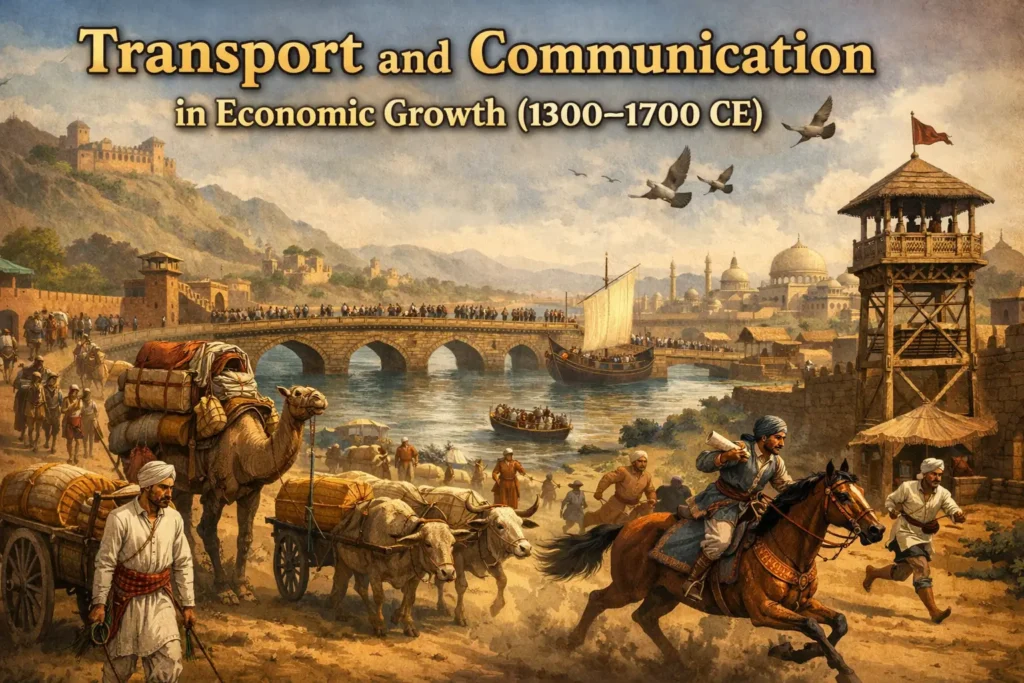
The construction and maintenance of road networks were among the most significant contributions of medieval states to economic growth. Major highways connected political capitals with provincial centers and ports. The most famous route was the Grand Trunk Road, stretching from Bengal to the north-west frontier. Roads facilitated the movement of agricultural surplus from rural areas to urban markets and allowed manufactured goods to reach distant regions.
Riverine and Inland Water Transport
Rivers served as vital arteries of transport, especially in regions like Bengal, the Gangetic plains, and the Deccan. Riverine transport was cheaper and more efficient than overland routes for bulky goods such as grain, timber, salt, and textiles. Boats and ferries connected interior regions with ports, integrating inland production with maritime trade. Seasonal navigation adapted to monsoon patterns, enhancing commercial mobility.
Maritime Transport and Overseas Trade
Maritime transport was central to the expansion of overseas trade during this period. Indian ports such as Surat, Cambay, Masulipatnam, Cochin, and Hugli emerged as major commercial hubs. Indian, Arab, and later European merchants used monsoon winds to conduct trade with West Asia, Africa, Southeast Asia, and Europe. Efficient maritime transport enabled large-scale export of textiles, spices, indigo, and precious goods, generating wealth and employment.
Infrastructure for Travel and Trade
States invested in supporting infrastructure such as sarais (rest houses), bridges, ferries, and wells along major routes. These facilities ensured safety, reduced travel time, and encouraged merchant mobility. Caravanserais functioned as centers for storage, exchange of information, and financial transactions, strengthening commercial networks.
Communication and Administrative Efficiency
Communication networks were essential for governance and economic coordination. The Mughal state developed an efficient postal system (dak chowki) with relays of horses and runners, enabling swift transmission of orders, revenue records, and commercial information. Reliable communication enhanced administrative control, stabilized markets, and reduced transaction costs.
Impact on Markets and Urbanization
Improved transport and communication encouraged the growth of markets (mandis) and urban centers. Towns emerged along trade routes, becoming centers of craft production and exchange. Integration of regional markets led to greater price stability and specialization of production, promoting commercialization of the economy.
Role in State Revenue and Military Logistics
Efficient transport and communication also strengthened state power. They facilitated revenue collection, troop movement, and supply chains. A strong transport network allowed the state to extract surplus efficiently while protecting trade routes, indirectly supporting economic growth.
In conclusion, transport and communication were fundamental to economic growth between 1300 and 1700 CE. By integrating rural and urban economies, enabling long-distance trade, supporting administration, and encouraging market expansion, they laid the foundation for a vibrant and interconnected medieval Indian economy. Their significance extended beyond commerce, shaping political authority and social mobility during this period.
View Complete MHI-105 Answer Click Here
Download PDF
Buy on Amazon @Rs.1
Transport and Communication in Economic Growth Transport and Communication in Economic Growth Transport and Communication in Economic Growth Transport and Communication in Economic Growth Transport and Communication in Economic Growth Transport and Communication in Economic Growth Transport and Communication in Economic Growth Transport and Communication in Economic Growth Transport and Communication in Economic Growth