Explain various theories of demographic changes
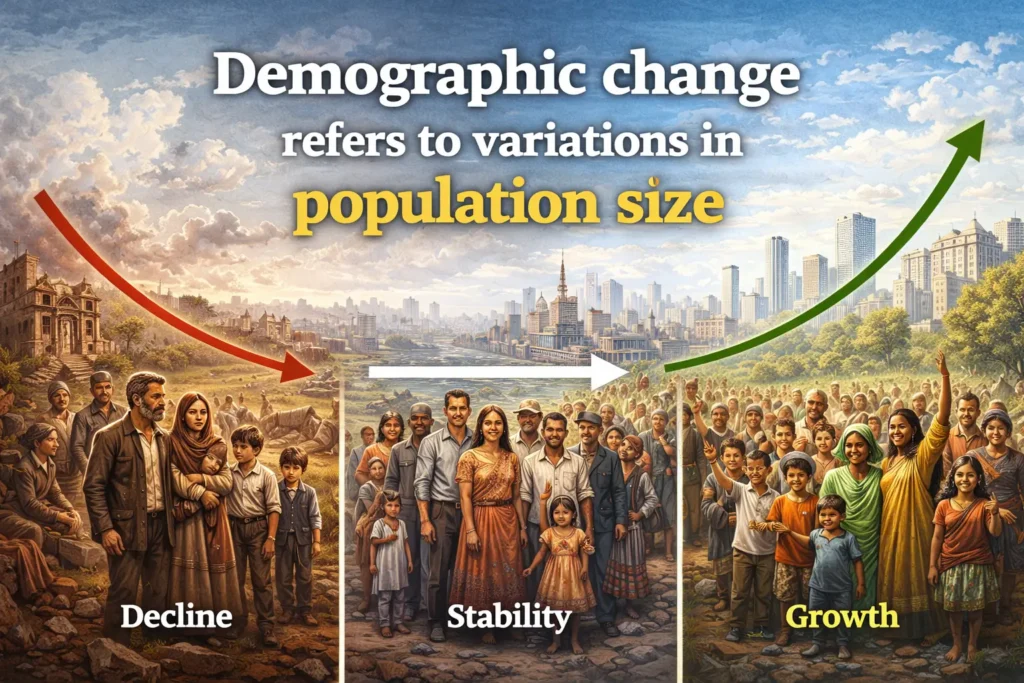
Demographic change refers to variations in population size, structure, and distribution over time. Scholars have developed several theories to explain how and why populations grow, stabilize, or decline. These theories help us understand patterns of birth rates, death rates, migration, and age composition across different societies.
One of the most influential explanations is the Demographic Transition Theory. This theory describes population change as a process that occurs in stages as a country develops economically. In the first stage, both birth rates and death rates are high, resulting in a stable but low population growth. In the second stage, death rates decline due to improvements in healthcare, sanitation, and food supply, while birth rates remain high, leading to rapid population growth. In the third stage, birth rates begin to fall due to urbanization, education, and changing social values. Finally, in the fourth stage, both birth and death rates are low, resulting in a stable or slowly growing population. Some scholars also propose a fifth stage, where birth rates fall below death rates, causing population decline. This theory is widely used but criticized for being based mainly on the European experience.
Another important perspective is the Malthusian Theory of Population, proposed by Thomas Robert Malthus. Malthus argued that population grows geometrically (exponentially), while food production increases only arithmetically (linearly). According to him, this imbalance would eventually lead to crises such as famine, disease, and war, which he called “positive checks” on population growth. He also suggested “preventive checks” like moral restraint and delayed marriage. Although Malthus’s predictions were not fully realized due to technological advances in agriculture, his theory remains important in discussions about overpopulation and resource scarcity.
The Marxist theory of population offers a contrasting viewpoint. Associated with Karl Marx, this approach rejects the idea that population growth is the root cause of poverty. Instead, it argues that social and economic inequalities under capitalism create conditions like unemployment and poverty. According to this theory, population problems are not natural but are shaped by the unequal distribution of resources. Thus, demographic issues must be understood in relation to class structure and economic systems.
Another significant explanation is the Theory of Optimum Population. This theory suggests that there is an ideal population size that maximizes economic productivity and standard of living. If the population is below this level, resources remain underutilized; if it exceeds this level, resources become scarce, leading to a decline in living standards. This theory focuses on the balance between population and available resources, though it is difficult to determine the exact “optimum” level in practice.
The Notestein model, developed by Frank W. Notestein, is closely related to the demographic transition theory. It emphasizes the role of modernization—industrialization, urbanization, education, and technological progress—in shaping demographic behavior. It explains how societies move from high fertility and mortality rates to low fertility and mortality rates as they modernize.
The Caldwell theory of fertility decline, proposed by John Caldwell, focuses on changes in family structure and intergenerational wealth flows. Caldwell argued that in traditional societies, children contribute economically to the family, encouraging high fertility. In modern societies, however, the flow of wealth reverses, and parents invest more in children’s education and well-being, making large families less desirable. This shift leads to declining birth rates.
Migration theories also play a crucial role in understanding demographic change. One such theory is the Push-Pull Theory of Migration, which explains why people move from one place to another. “Push” factors such as unemployment, poverty, and conflict drive people away from their place of origin, while “pull” factors like better job opportunities, education, and living conditions attract them to new areas. Migration significantly influences population distribution and growth patterns.
Lastly, the Second Demographic Transition Theory focuses on changes in values and lifestyles in advanced societies. It highlights trends such as delayed marriage, increased cohabitation, lower fertility rates, and greater individualism. This theory emphasizes cultural and social changes rather than purely economic factors in shaping demographic behavior.
In conclusion, demographic changes are complex and influenced by multiple factors, including economic development, social structure, cultural values, and technological progress. Theories such as the Demographic Transition Theory, Malthusian Theory, Marxist perspective, Optimum Population Theory, and others provide valuable insights into these changes. Each theory highlights different aspects of population dynamics, and together they offer a comprehensive understanding of how populations evolve over time.
Explain various theories of demographic changes Explain various theories of demographic changes Explain various theories of demographic changes Explain various theories of demographic changes Explain various theories of demographic changes Explain various theories of demographic changes Explain various theories of demographic changes Explain various theories of demographic changes Explain various theories of demographic changes Explain various theories of demographic changes