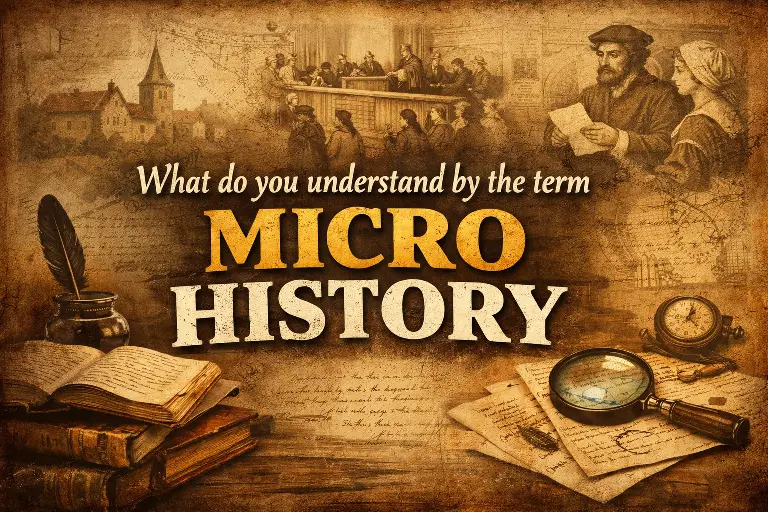
What do you understand by the term micro history
Micro-history (microhistory) is a distinctive approach to historical writing that concentrates on the intensive study of small units—such as an individual, a family, a village, or a single event—to illuminate broader historical processes. Emerging prominently in the 1970s, especially in Italy, micro-history developed as a reaction against large-scale, structural histories that often overlooked the experiences of ordinary people. Instead of generalizing about entire societies, micro-historians delve deeply into specific cases, using them as windows to understand wider cultural, social, and economic realities.
The core principle of micro-history is that the particular can reveal the universal. By reconstructing the lives of common individuals or marginal groups, historians attempt to uncover hidden dimensions of the past—such as beliefs, mentalities, social tensions, and everyday practices—that are often absent in conventional narratives. Micro-history relies heavily on archival sources, including court records, inquisitorial documents, personal letters, and local registers. It also emphasizes narrative style, often presenting history in a vivid, almost story-like manner while maintaining scholarly rigor.
Several historians have been central to the development of this tradition.
One of the pioneers is Carlo Ginzburg. His celebrated work, The Cheese and the Worms, exemplifies the micro-historical method. In this book, Ginzburg reconstructs the worldview of Menocchio, a 16th-century Italian miller, using Inquisition records. Through this single life, he explores the interaction between popular culture and elite ideas, demonstrating how ordinary individuals could creatively reinterpret dominant beliefs.
Another important figure is Giovanni Levi, who further refined the theoretical foundations of micro-history. In his work Inheriting Power (also known as The Power of the Weak), Levi examines social relationships and power dynamics within a small Italian community. He shows that even individuals with limited authority could influence outcomes through negotiation and social networks, thereby challenging simplistic notions of power.
Natalie Zemon Davis is another major contributor to micro-history. Her book The Return of Martin Guerre tells the story of a 16th-century French peasant whose identity was assumed by an impostor. Davis uses this intriguing case to explore themes of identity, gender roles, and social norms, demonstrating how a single घटना can reflect broader cultural patterns.
Similarly, Emmanuel Le Roy Ladurie made significant contributions with his work Montaillou. Based on Inquisition records, the book reconstructs the daily life of a medieval French village. It provides insights into the beliefs, practices, and social structures of ordinary villagers, making it a classic example of micro-historical research.
Another influential historian is Robert Darnton, whose work The Great Cat Massacre explores unusual cultural practices in 18th-century France. By analyzing seemingly bizarre events, Darnton uncovers the symbolic meanings embedded in popular culture and highlights how ordinary people understood their world.
In conclusion, micro-history represents a significant shift in historical methodology by prioritizing the lived experiences of individuals and small communities. Through detailed and imaginative use of sources, micro-historians demonstrate that even the smallest subjects can yield profound insights into larger historical realities. This approach not only enriches our understanding of the past but also gives voice to those who were previously marginalized in historical narratives.
What do you understand by the term micro history What do you understand by the term micro history What do you understand by the term micro history What do you understand by the term micro history What do you understand by the term micro history What do you understand by the term micro history What do you understand by the term micro history