
Comment on the nature of rural society in the Peninsular India
Comment on the nature of rural society in the Peninsular India
The nature of rural society in Peninsular India, especially during the early medieval period (c. 600–1200 CE), was complex, dynamic, and regionally varied. It reflected a gradual transformation from relatively simple agrarian communities into more stratified and institutionally organized societies. This transformation was shaped by the expansion of agriculture, the growth of local political structures, the influence of religion, and the emergence of new social hierarchies.
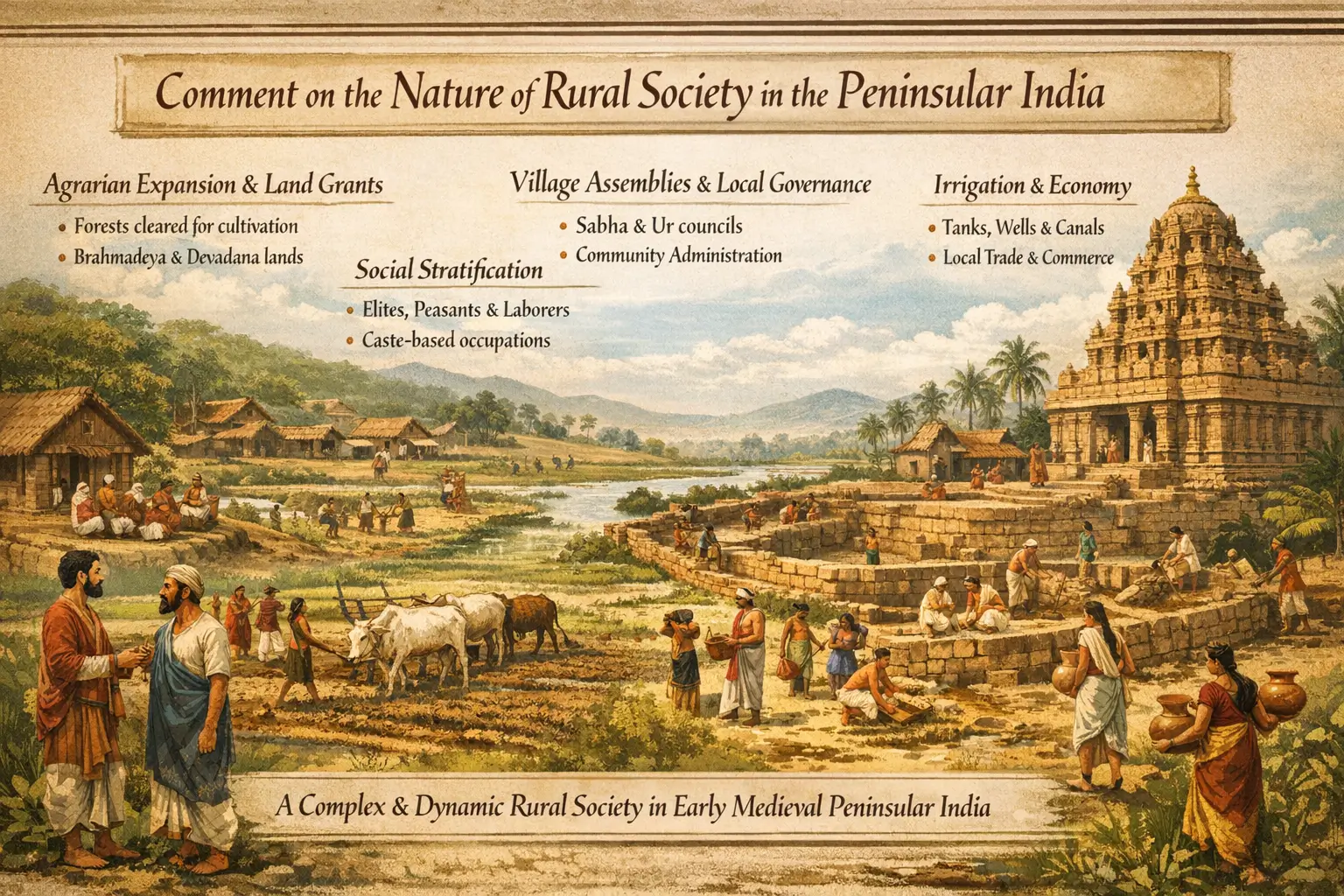
One of the most significant features of rural society in Peninsular India was the expansion of agrarian settlements. Large tracts of forest and wasteland were brought under cultivation through organized efforts by rulers, local chiefs, and Brahmanas. This process not only increased agricultural productivity but also led to the establishment of new villages. These settlements often formed the basic units of rural society and were relatively self-sufficient, producing most of what they needed locally.
Land played a central role in shaping rural society. It was not only an economic resource but also a source of social status and political power. The practice of land grants became widespread during this period. Rulers granted land to Brahmanas (known as brahmadeya lands) and to temples (devadana lands). These grants led to the emergence of new landed elites who exercised control over land and labor. Brahmanas, in particular, gained prominence as intermediaries between the state and the peasantry, often enjoying tax exemptions and administrative privileges.
The rural social structure became increasingly stratified over time. At the top were the Brahmanas and other landholding elites, followed by peasants who cultivated the land. Below them were landless laborers and service groups who performed various occupational roles within the village. The caste system became more deeply entrenched, with occupational specialization reinforcing social divisions. Different communities were assigned specific roles, such as artisans, herders, and agricultural workers, contributing to the functioning of the rural economy.
Village assemblies played an important role in the administration of rural areas, particularly in South India. Institutions such as the sabha (assembly of Brahmana landholders) and ur (assembly of non-Brahmana peasants) were responsible for managing local affairs, including irrigation, taxation, and dispute resolution. These assemblies indicate a degree of local self-governance and collective decision-making. In regions like Tamil Nadu, inscriptions provide detailed evidence of how these bodies functioned, suggesting a well-organized rural administration.
Irrigation was another crucial aspect of rural life in Peninsular India. Given the dependence on monsoon rains, communities invested in the construction and maintenance of irrigation facilities such as tanks, wells, and canals. These projects were often managed collectively or under the supervision of local authorities. The development of irrigation not only improved agricultural output but also strengthened community cooperation and organization.
Religion and temples had a profound influence on rural society. Temples were not merely places of worship but also centers of economic and social activity. They owned large tracts of land, employed various categories of workers, and acted as hubs of redistribution. Temples also played a role in legitimizing social hierarchies and political authority. Ritual practices and religious endowments reinforced the position of dominant groups, especially Brahmanas.
Another important feature of rural society was the integration of local economies with broader regional networks. While villages were largely self-sufficient, they were not isolated. Surplus produce, craft goods, and other commodities were exchanged through local markets and trade routes. This interaction contributed to the gradual monetization of the economy and the growth of commercial activities.
At the same time, rural society was not static. It witnessed tensions and changes arising from the expansion of state power, the assertion of local elites, and the pressures on peasant communities. Peasants were often subject to various forms of taxation and labor obligations, which could lead to resistance or negotiation. The presence of multiple layers of authority—kings, chiefs, Brahmanas, and local assemblies—created a complex system of governance.
In conclusion, rural society in Peninsular India during the early medieval period was characterized by agrarian expansion, social stratification, institutional development, and religious influence. It was a dynamic and evolving system in which economic, social, and political factors were closely interconnected. The village served as the core unit of this society, reflecting both continuity and change in the broader historical context of the region.
Comment on the nature of rural society in the Peninsular India Comment on the nature of rural society in the Peninsular India Comment on the nature of rural society in the Peninsular India Comment on the nature of rural society in the Peninsular India Comment on the nature of rural society in the Peninsular India Comment on the nature of rural society in the Peninsular India Comment on the nature of rural society in the Peninsular India Comment on the nature of rural society in the Peninsular India Comment on the nature of rural society in the Peninsular India