Comment on the nature of over seas migration during the colonial period
The nature of overseas migration during the colonial period was a significant and complex phenomenon shaped by economic exploitation, labor demands, and global imperial networks. From the 19th to early 20th centuries, millions of people, especially from Asia and Africa, migrated to different parts of the world under colonial rule. This migration was neither entirely voluntary nor completely forced; rather, it existed along a spectrum influenced by coercion, opportunity, and survival.
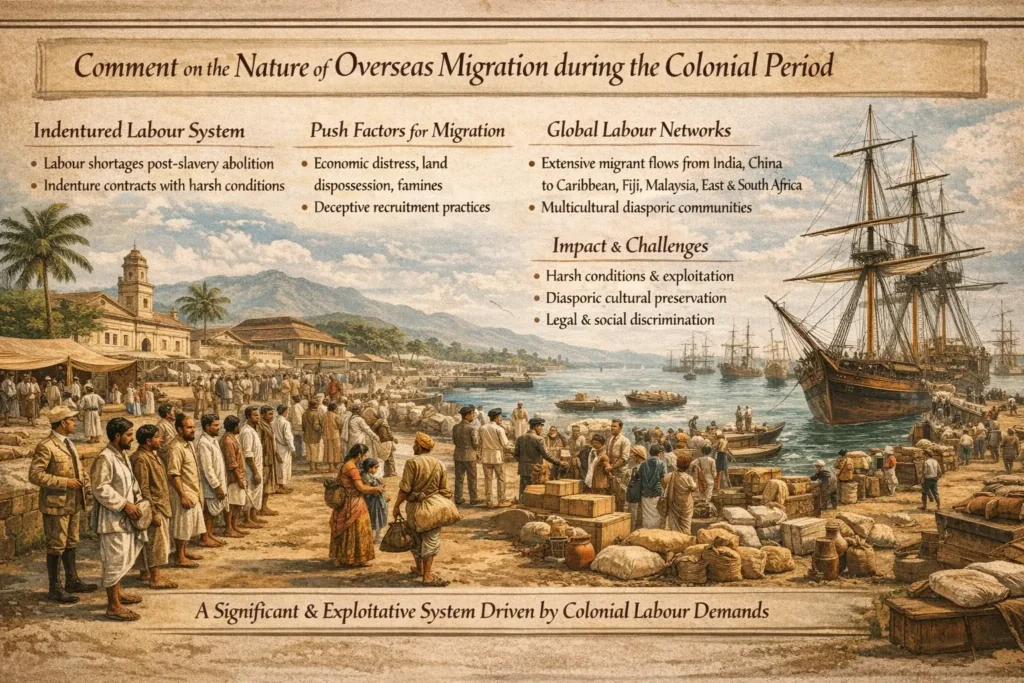
One of the most defining features of overseas migration in this period was the system of indentured labor. After the abolition of slavery in the British Empire in 1834, colonial plantations faced a severe shortage of labor. To address this, European colonial powers, particularly the British, initiated the indenture system. Under this system, laborers were recruited—often through deceptive contracts—from countries like India and China and sent to colonies such as the Caribbean, Fiji, Mauritius, South Africa, and Southeast Asia. These laborers agreed to work for a fixed number of years in return for wages, passage, and sometimes land grants. However, in practice, their conditions were harsh, and their freedom was limited, making indentured labor a “new system of slavery.”
Economic distress in the colonies played a crucial role in pushing people to migrate. In India, factors such as land dispossession, heavy taxation, famines, and the decline of traditional industries under colonial policies forced many peasants and artisans to seek livelihood elsewhere. Recruiters, known as arkatis, often exploited the vulnerability of these individuals by luring them with false promises of prosperity abroad. As a result, migration was frequently driven by compulsion rather than genuine choice.
Overseas migration also had a distinct regional pattern. A large number of migrants came from specific regions like eastern Uttar Pradesh, Bihar, Tamil Nadu, and Andhra Pradesh. These migrants formed the backbone of plantation economies in sugar, rubber, and tea-producing colonies. Similarly, Chinese migrants moved to Southeast Asia, the Americas, and the Pacific, contributing to trade and labor sectors. Thus, colonial migration created a global flow of labor that connected distant regions economically and culturally.
Another important aspect of this migration was its impact on social and cultural life. Migrants carried their languages, religions, and customs to new lands, leading to the formation of diasporic communities. Despite harsh working conditions, they preserved aspects of their identity through festivals, religious practices, and social organizations. Over time, these communities contributed to the multicultural character of many colonial societies. For instance, Indian communities in Trinidad, Guyana, and Mauritius continue to reflect this legacy.
However, the experience of migrants was marked by hardship and discrimination. They faced poor living conditions, low wages, racial prejudice, and strict control by plantation owners. Legal systems in colonial territories often favored employers, restricting the rights of laborers. Women migrants, in particular, were vulnerable to exploitation and abuse, although their presence also contributed to the formation of stable family structures in migrant communities.
Overseas migration also had significant implications for the home countries. It led to demographic changes, especially in regions with high out-migration. Remittances sent back by migrants provided some economic relief to families. At the same time, migration created new social dynamics, such as the emergence of returnees who brought back new ideas, experiences, and sometimes wealth. These influences contributed to social change in colonial societies.
Moreover, the colonial state played an active role in regulating and facilitating migration. Laws, contracts, and recruitment systems were designed to ensure a steady supply of cheap labor for colonial economies. The system was highly organized, with depots, medical inspections, and transportation networks. Yet, despite these structures, exploitation and abuse remained widespread.
In conclusion, overseas migration during the colonial period was a crucial aspect of the global economic system established by imperial powers. It was characterized by the movement of labor under conditions of inequality and coercion, driven by both economic necessity and colonial demands. While it led to the creation of vibrant diasporic communities and cultural exchanges, it also reflected the exploitative nature of colonial rule. The legacy of this migration continues to shape societies across the world today, highlighting both the resilience of migrants and the enduring impact of colonialism.
Comment on the nature of over seas migration during the colonial period Comment on the nature of over seas migration during the colonial period Comment on the nature of over seas migration during the colonial period Comment on the nature of over seas migration during the colonial period Comment on the nature of over seas migration during the colonial period Comment on the nature of over seas migration during the colonial period Comment on the nature of over seas migration during the colonial period Comment on the nature of over seas migration during the colonial period