Discuss the important trends in environmental history writing on India
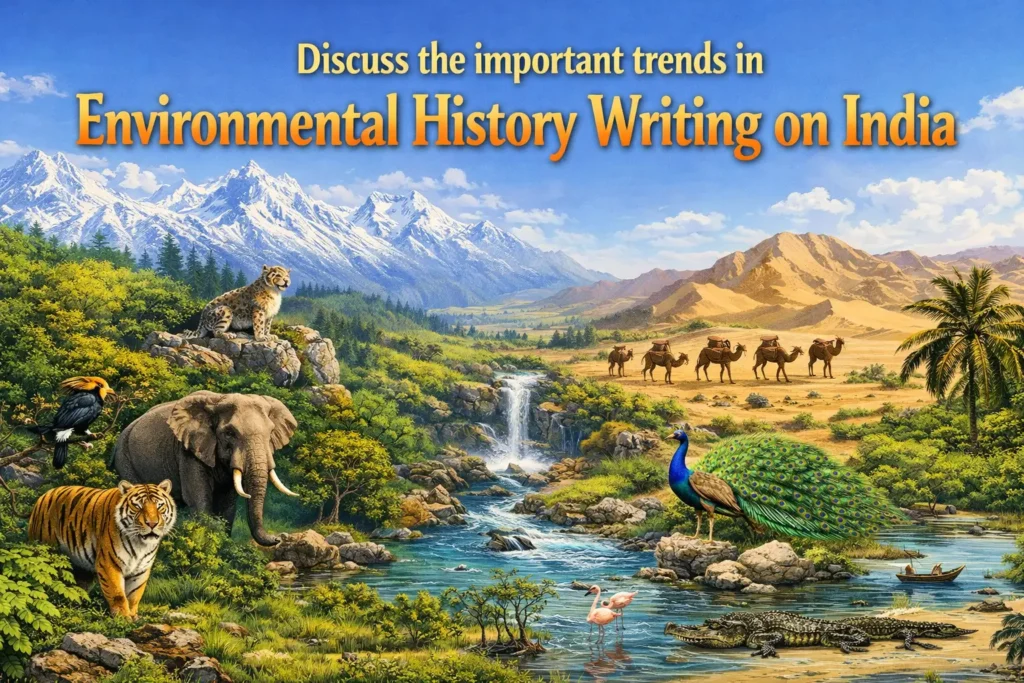
Environmental history writing on India has evolved significantly over the past few decades, emerging as an important interdisciplinary field that examines the dynamic relationship between humans and nature over time. Initially influenced by global environmental concerns, Indian environmental historiography has developed its own distinctive themes, approaches, and debates. Several important trends can be identified in this body of scholarship.
One of the earliest and most influential trends is the focus on colonial environmental transformation. Historians have examined how British colonial rule reshaped India’s natural landscapes through policies related to forests, land revenue, irrigation, and commercial agriculture. The establishment of scientific forestry, for instance, led to the commercialization and state control of forests, often at the expense of local communities. Scholars such as Ramachandra Guha and Madhav Gadgil highlighted how colonial interventions disrupted traditional ecological practices and led to environmental degradation as well as social conflict.
A second major trend is the emphasis on the relationship between ecology and livelihoods. Environmental historians have explored how peasants, pastoralists, and tribal communities interacted with their surroundings and managed natural resources. This approach underlines the idea that local communities possessed rich ecological knowledge and sustainable practices, which were often undermined by external interventions. The study of everyday forms of resistance—such as protests against forest laws or resistance to displacement—has revealed how marginalized groups actively contested environmental changes.
Another important trend is the rise of subaltern and people-centric environmental histories. Influenced by the Subaltern Studies framework, historians began to focus on the voices and experiences of those traditionally excluded from mainstream narratives. This includes forest dwellers, indigenous communities, and rural populations. Their struggles over access to land, water, and forests have been central to understanding environmental change in India. Movements such as the Chipko Movement have been widely studied to highlight grassroots environmentalism.
The integration of ecological science with historical analysis is another key trend. Environmental history in India often draws upon disciplines such as geography, ecology, and anthropology to reconstruct past environments and understand long-term changes. This interdisciplinary approach has enabled historians to study issues like deforestation, soil erosion, river dynamics, and climate variability in a more nuanced way.
In recent years, there has been growing attention to themes of environmental justice and sustainability. Historians have critically examined how environmental benefits and burdens are distributed unevenly across different sections of society. Industrialization, urbanization, and large development projects—such as dams and mining—have been analyzed for their ecological impacts as well as their social consequences, particularly displacement and inequality. This trend reflects broader global concerns about sustainable development and climate change.
Urban environmental history has also emerged as a significant area of study. Earlier scholarship largely focused on rural and forested regions, but recent work examines cities as important ecological spaces. Issues such as pollution, water supply, waste management, and urban planning are now central to understanding India’s environmental challenges. This shift recognizes that environmental change is not limited to rural landscapes but is equally critical in urban contexts.
Another notable trend is the increasing use of cultural and intellectual perspectives in environmental history. Scholars have explored how nature has been perceived, represented, and valued in Indian traditions, literature, and religious practices. This includes examining sacred groves, river worship, and conservation ethics embedded in cultural beliefs. Such studies reveal that environmental consciousness has deep historical roots in Indian society.
Finally, there is a growing emphasis on global and comparative perspectives. Indian environmental history is now situated within broader global processes such as colonialism, capitalism, and climate change. Comparative studies with other regions help highlight both unique and shared patterns of environmental transformation.
In conclusion, environmental history writing on India has moved from a narrow focus on colonial policies to a broader, more inclusive and interdisciplinary field. It now encompasses themes such as ecology and livelihoods, subaltern perspectives, environmental justice, urban environments, and cultural interpretations of nature. These trends not only deepen our understanding of India’s past but also provide valuable insights for addressing contemporary environmental challenges.
Discuss the important trends in environmental history writing on India Discuss the important trends in environmental history writing on India Discuss the important trends in environmental history writing on India Discuss the important trends in environmental history writing on India Discuss the important trends in environmental history writing on India Discuss the important trends in environmental history writing on India Discuss the important trends in environmental history writing on India Discuss the important trends in environmental history writing on India