Discuss the major characteristics of nomadic pastoralists
Nomadic pastoralists are communities whose primary livelihood depends on the herding of animals and seasonal movement in search of pasture and water. Found in different ecological regions—from arid deserts to mountainous terrains—they have historically played a crucial role in sustaining local economies and maintaining ecological balance. Their way of life is shaped by mobility, adaptability, and a deep understanding of nature.
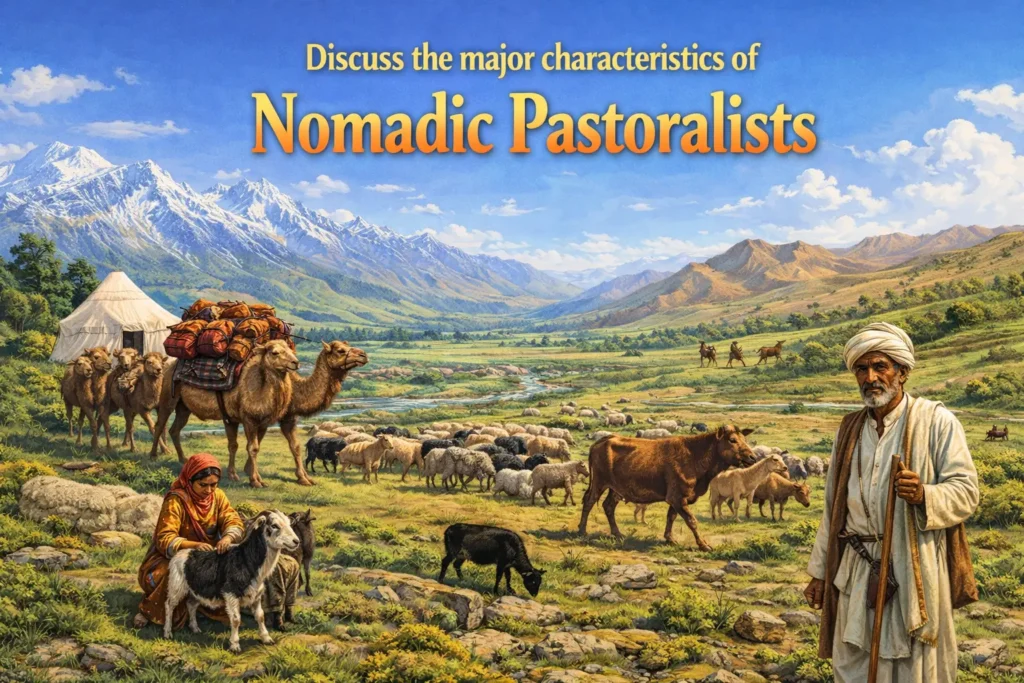
One of the most important characteristics of nomadic pastoralists is mobility. Unlike settled agricultural communities, pastoralists move from one place to another following seasonal cycles. This movement, often called transhumance, allows them to utilize scattered grazing resources efficiently. For example, in mountainous regions, pastoralists move to higher altitudes during summer and descend to lower valleys in winter. This cyclical movement ensures the sustainability of both pastures and livestock.
Another key feature is their dependence on livestock. Animals such as sheep, goats, cattle, camels, and yaks are central to their economy. These animals provide milk, meat, wool, hides, and even transport. The pastoralists’ wealth and social status are often measured by the size and health of their herds. Their knowledge of animal breeding, grazing patterns, and disease management is highly specialized and has been developed over generations.
Nomadic pastoralists also exhibit a strong adaptation to diverse ecological conditions. They possess intricate knowledge of landscapes, including water sources, seasonal vegetation, and climatic variations. This ecological knowledge helps them survive in harsh and unpredictable environments such as deserts or high-altitude regions. Their practices are generally sustainable, as they avoid overgrazing by moving regularly and allowing land to regenerate.
Social organization among pastoralists is usually based on kinship and clan networks. These networks provide support in times of need, regulate access to grazing lands, and help in conflict resolution. Decision-making is often collective, and customs and traditions play a significant role in maintaining social order. Their cultural life is closely tied to their environment, reflected in their rituals, songs, and oral traditions.
Another notable characteristic is their limited material possessions and flexible lifestyle. Since they are constantly on the move, they tend to carry only essential items. Their dwellings, such as tents, are portable and suited to mobility. This flexibility allows them to respond quickly to environmental changes.
The relationship between nomadic pastoralists and settled communities has historically been complex, involving both cooperation and conflict. On one hand, there exists a strong element of economic interdependence. Pastoralists supply animal products such as milk, wool, meat, and hides to settled agriculturalists. In return, they obtain grains, tools, and other goods. This exchange often takes place through barter systems or local markets, creating a mutually beneficial relationship.
Pastoralists also contribute to agriculture by providing manure for fields and draught animals, which enhance agricultural productivity. In some cases, they graze their animals on harvested fields, which helps fertilize the soil. Thus, their presence can support the agrarian economy.
However, the relationship is not always harmonious. There are frequent conflicts over resources, especially land and water. As settled agriculture expands, grazing lands shrink, leading to tensions between farmers and pastoralists. Encroachment on traditional migratory routes further restricts pastoral mobility. In many cases, pastoralists are viewed as outsiders or competitors, which leads to social and political marginalization.
Colonial and modern state policies have also affected these relationships. Restrictions on forest access, land privatization, and the imposition of boundaries have disrupted traditional pastoral routes and practices. This has often intensified conflicts with settled communities and reduced the autonomy of pastoral groups.
Despite these challenges, pastoralists and settled communities have developed mechanisms for coexistence. Traditional agreements, seasonal arrangements, and mutual understanding have often helped in managing conflicts. In many regions, pastoralists are recognized as an integral part of the rural economy.
In conclusion, nomadic pastoralists are characterized by mobility, dependence on livestock, ecological adaptability, and strong social networks. Their relationship with settled communities is marked by both cooperation and conflict, shaped by economic needs and resource competition. Understanding this relationship is essential for promoting sustainable development and ensuring the survival of pastoral traditions in the modern world.
Discuss the major characteristics of nomadic pastoralists Discuss the major characteristics of nomadic pastoralists Discuss the major characteristics of nomadic pastoralists Discuss the major characteristics of nomadic pastoralists Discuss the major characteristics of nomadic pastoralists Discuss the major characteristics of nomadic pastoralists Discuss the major characteristics of nomadic pastoralists Discuss the major characteristics of nomadic pastoralists Discuss the major characteristics of nomadic pastoralists Discuss the major characteristics of nomadic pastoralists