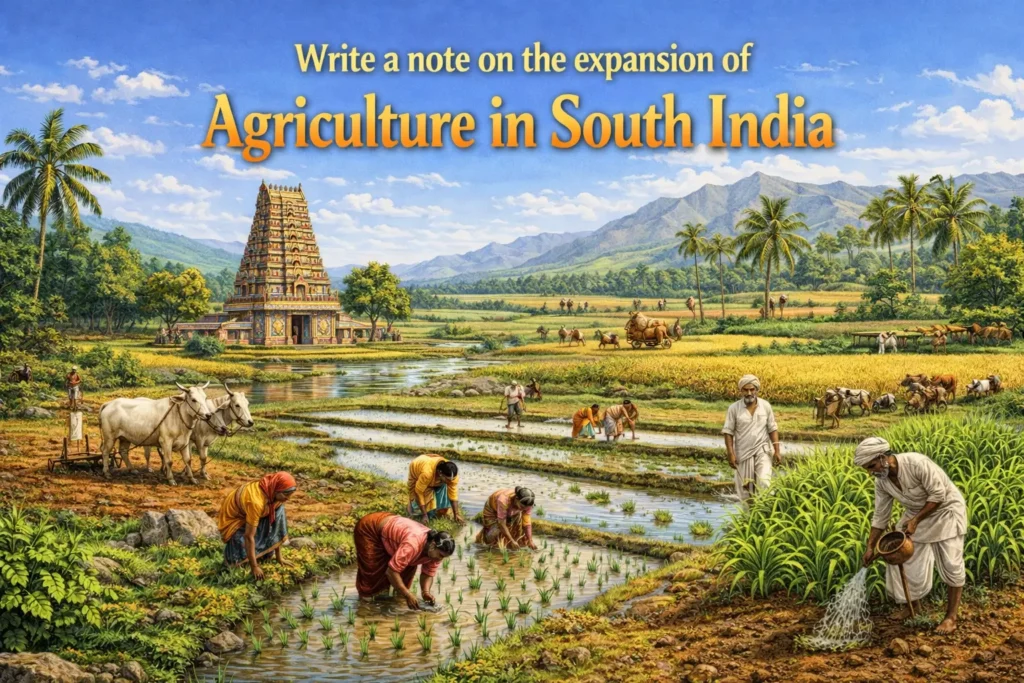
Write a note on the expansion of agriculture in south India
The expansion of agriculture in South India is a significant theme in the study of early and early medieval Indian history. It reflects the transformation of landscapes, the growth of settlements, and the evolution of socio-economic and political structures. This process was neither sudden nor uniform; rather, it occurred gradually over centuries through a combination of environmental adaptation, technological innovation, and state support.
In the early historical period, much of South India was covered with forests, pastoral tracts, and sparsely populated regions. Agriculture was initially limited to river valleys and fertile plains. Over time, however, there was a steady movement toward the clearing of forests and the extension of cultivation into new areas. This process is often referred to as the “agrarian expansion,” and it played a crucial role in shaping the region’s history.
One of the major factors behind agricultural expansion was the development of irrigation systems. South India, particularly the Deccan plateau and Tamil region, depended heavily on rainfall, which was often irregular. To overcome this limitation, people developed sophisticated irrigation techniques such as tanks (artificial reservoirs), canals, and wells. These systems enabled the cultivation of water-intensive crops like rice, especially in regions like the Kaveri delta. The construction and maintenance of irrigation works were often undertaken by local communities, rulers, and temple institutions.
The role of political authority was also crucial in promoting agricultural expansion. Rulers of various dynasties encouraged the clearing of forests and the establishment of new settlements. Land grants were frequently given to Brahmins, temples, and officials. These grants, known as brahmadeya and devadana lands, helped bring new areas under cultivation. The beneficiaries of such grants often organized agricultural production by mobilizing local labor and resources.
Temples emerged as important centers in this process. Beyond their religious functions, they acted as economic institutions that owned land, managed irrigation, and facilitated agricultural activities. Temples also served as hubs of redistribution, providing employment and supporting artisans, traders, and peasants. This integration of religion and economy contributed significantly to the expansion and consolidation of agriculture.
Another important aspect of agricultural expansion was the role of peasant communities. Local cultivators, often organized into village assemblies, played a key role in managing land and water resources. In regions like Tamil Nadu, institutions such as the sabha and ur were responsible for administering villages, collecting taxes, and maintaining irrigation systems. These self-governing bodies ensured the effective functioning of agrarian life.
Technological changes also contributed to agricultural growth. The use of iron tools facilitated the clearing of dense forests and improved farming efficiency. The adoption of new cropping patterns and agricultural techniques further enhanced productivity. Crop diversification, including the cultivation of millets, pulses, sugarcane, and cotton, supported both subsistence and commercial agriculture.
Trade and market integration provided additional impetus to agricultural expansion. Surplus production enabled the growth of local and long-distance trade networks. Agricultural produce, especially rice, spices, and textiles, became important commodities in regional and overseas trade. Ports on the eastern and western coasts connected South India with Southeast Asia and other parts of the world, further stimulating agricultural production.
The expansion of agriculture also had significant social implications. It led to the stratification of society, with the emergence of powerful landowners, tenant cultivators, and landless laborers. The caste system became more rigid, and occupational groups became closely tied to agrarian production. While agricultural growth brought prosperity to some, it also resulted in inequalities and exploitation.
Environmental changes accompanied this expansion. Large-scale deforestation altered the natural landscape, while irrigation systems transformed water regimes. Although these changes supported human settlement and agriculture, they also had long-term ecological consequences.
In conclusion, the expansion of agriculture in South India was a complex and multifaceted process driven by irrigation development, political support, temple institutions, peasant participation, and technological advancements. It not only transformed the physical landscape but also reshaped the economic, social, and cultural fabric of the region. This agrarian expansion laid the foundation for the development of stable kingdoms and vibrant societies in South India.
Write a note on the expansion of agriculture in south India Write a note on the expansion of agriculture in south India Write a note on the expansion of agriculture in south India Write a note on the expansion of agriculture in south India Write a note on the expansion of agriculture in south India Write a note on the expansion of agriculture in south India Write a note on the expansion of agriculture in south India Write a note on the expansion of agriculture in south India Write a note on the expansion of agriculture in south India