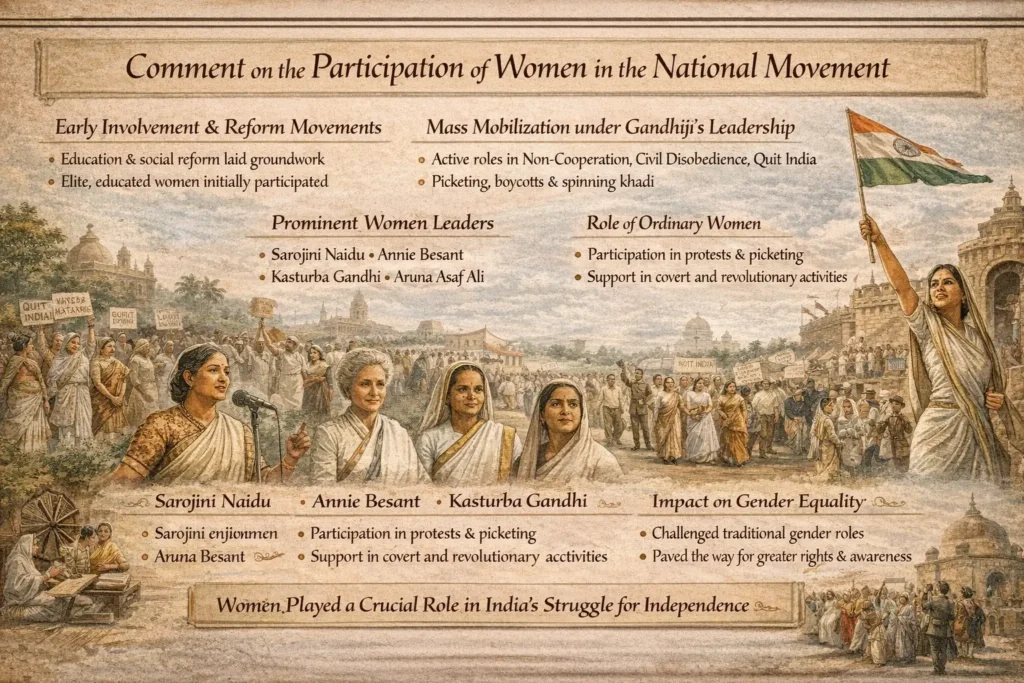
Comment on the participation of women in the national movement
The participation of women in the Indian national movement was a significant and transformative development that not only contributed to the struggle for independence but also reshaped the social position of women in Indian society. From the late 19th century to 1947, women from diverse backgrounds actively engaged in various phases of the freedom struggle, challenging traditional gender roles and asserting their political and social rights.
In the early stages of the national movement, women’s participation was limited and largely confined to elite and educated sections of society. Reform movements of the 19th century, which focused on issues such as female education, widow remarriage, and abolition of social evils, played a crucial role in preparing the ground for women’s public involvement. Educated women began to step out of the domestic sphere and engage in social and political activities.
A major turning point came with the Swadeshi Movement (1905–1908), which witnessed the active involvement of women, particularly in Bengal. Women participated in boycotts of foreign goods, promoted the use of indigenous products, and took part in public demonstrations. This marked the beginning of mass participation of women in nationalist activities.
The leadership of Mahatma Gandhi was instrumental in expanding the scope of women’s participation. Gandhi emphasized the importance of women in the struggle for freedom and encouraged them to join movements such as the Non-Cooperation Movement (1920–22), Civil Disobedience Movement (1930–34), and Quit India Movement (1942). He believed that women possessed qualities such as patience, resilience, and moral strength, which were essential for non-violent resistance. As a result, thousands of women across urban and rural areas took part in protests, picketing, and constructive programmes.
Prominent women leaders emerged during this period, playing vital roles in mobilizing people and leading movements. Sarojini Naidu was one of the most notable figures, who actively participated in the Civil Disobedience Movement and became the first Indian woman to preside over the Indian National Congress. Annie Besant, although of British origin, contributed significantly through the Home Rule Movement. Kasturba Gandhi played an important role in organizing women and participating in protests. Aruna Asaf Ali became a symbol of resistance during the Quit India Movement by hoisting the national flag in defiance of British authority.
Apart from these prominent figures, countless ordinary women also contributed to the national movement. Women from rural areas, working-class backgrounds, and marginalized communities participated in marches, strikes, and acts of civil disobedience. They picketed liquor shops and foreign cloth stores, spun khadi, and supported nationalist campaigns in various ways. Their participation gave the movement a mass character and broadened its social base.
Women also played a role in revolutionary activities. Some women joined underground movements and took part in armed resistance against British rule. For instance, women in Bengal and Punjab were involved in revolutionary organizations, carrying messages, sheltering revolutionaries, and sometimes directly participating in acts of defiance.
The participation of women in the national movement also had a profound impact on gender relations in Indian society. It challenged the traditional notion that women belonged only to the domestic sphere and demonstrated their capability in public and political life. Women’s involvement in the freedom struggle led to greater awareness about their rights and contributed to the growth of women’s organizations.
However, it is important to note that women’s participation was not entirely free from limitations. Social norms, patriarchal attitudes, and restrictions on mobility continued to affect the extent and nature of their involvement. In many cases, women’s roles were still seen as supportive rather than leadership-oriented. Despite these constraints, their contributions were crucial and cannot be overlooked.
In conclusion, the participation of women in the Indian national movement was both extensive and impactful. It played a vital role in strengthening the struggle against colonial rule while also paving the way for women’s emancipation in independent India. By stepping into the public sphere, women not only contributed to the achievement of independence but also redefined their position in society, leaving a lasting legacy in the history of modern India.
Comment on the participation of women in the national movement Comment on the participation of women in the national movement Comment on the participation of women in the national movement Comment on the participation of women in the national movement Comment on the participation of women in the national movement Comment on the participation of women in the national movement Comment on the participation of women in the national movement Comment on the participation of women in the national movement