Did colonialism shape the perception of cast
Yes, colonialism significantly shaped the perception of caste in India, transforming it from a fluid and context-dependent social structure into a more rigid, hierarchical, and systematized institution. While caste existed long before colonial rule, particularly within the framework of varna and jati, its meanings, functions, and social implications were profoundly altered under British administration.
Before colonial intervention, caste was not a single, uniform system across India. It varied regionally and was often flexible in practice. Social identities were negotiated through occupation, kinship, and local customs. Although hierarchy and exclusion were present, there was also a degree of mobility and adaptation. In many regions, caste identities could shift over time, and local power dynamics played a crucial role in determining status.
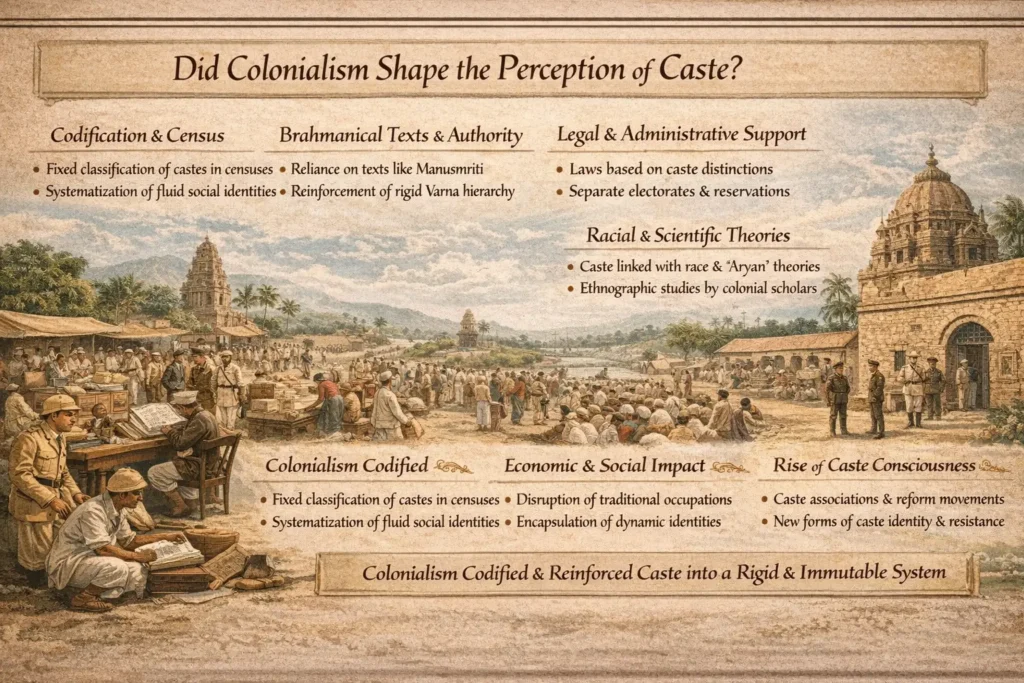
Colonialism, especially under British rule, sought to understand and categorize Indian society for administrative convenience. This led to the process of codification and enumeration of caste. One of the most influential tools in this regard was the decennial census, beginning in 1871. British officials attempted to classify the entire population into fixed caste categories, often forcing diverse and overlapping identities into rigid boxes. This process ignored the fluidity of caste and instead presented it as a static and all-encompassing system.
The colonial state also relied heavily on Brahmanical texts, such as the Manusmriti, to interpret Indian society. These texts represented an idealized version of social hierarchy rather than the lived realities of people. By treating these texts as authoritative, colonial administrators reinforced the idea of a fixed four-fold varna system and projected it onto the complex and varied jati structures across the country. This created a distorted understanding of caste, both among the British and among Indians themselves.
Another important aspect was the role of law and administration in reinforcing caste distinctions. The British introduced legal frameworks that often recognized caste identities in matters such as marriage, inheritance, and social customs. This gave caste a formal and institutional backing that it had not previously possessed in the same way. Additionally, policies such as separate electorates and reservations for certain communities further solidified caste identities in the political sphere.
Colonial ethnography and anthropology also played a key role in shaping perceptions of caste. British scholars and officials attempted to rank castes based on notions of race, occupation, and social status. Some even used pseudo-scientific methods, such as measuring skulls and noses, to classify people into racial categories. These practices linked caste with race and biology, giving it a seemingly scientific legitimacy and making it appear more rigid and immutable.
The economic changes brought about by colonialism also influenced caste dynamics. The introduction of new land revenue systems, commercialization of agriculture, and the decline of traditional crafts disrupted existing social structures. Some castes lost their traditional occupations and status, while others gained new opportunities. However, the colonial emphasis on classification often froze these changing realities into fixed categories, limiting social mobility.
At the same time, colonialism also led to new forms of caste consciousness and identity. As caste became a basis for classification and political representation, communities began to organize themselves to assert their status and demand rights. This gave rise to caste associations and reform movements. Leaders from marginalized communities challenged the oppressive aspects of caste and sought social equality and justice. Thus, colonialism not only reinforced caste hierarchies but also indirectly contributed to their critique.
Furthermore, missionary activities and Western education introduced new ideas of equality, individual rights, and social reform. These ideas influenced Indian thinkers and reformers, who began to question traditional social practices, including caste discrimination. Movements for social reform and anti-caste activism gained momentum during this period.
In conclusion, colonialism played a crucial role in reshaping the perception of caste in India. By codifying, classifying, and institutionalizing caste through administrative, legal, and intellectual means, it transformed a complex and dynamic social system into a more rigid and hierarchical structure. At the same time, it also created conditions for new forms of social awareness and resistance. The legacy of colonial interpretations of caste continues to influence modern understandings and debates, making it an essential aspect of India’s social and historical development.
Did colonialism shape the perception of cast Did colonialism shape the perception of castDid colonialism shape the perception of cast Did colonialism shape the perception of cast Did colonialism shape the perception of cast Did colonialism shape the perception of cast Did colonialism shape the perception of cast Did colonialism shape the perception of cast Did colonialism shape the perception of cast Did colonialism shape the perception of cast Did colonialism shape the perception of cast Did colonialism shape the perception of cast