Discuss the characteristic features of the traditional Chinese historiography
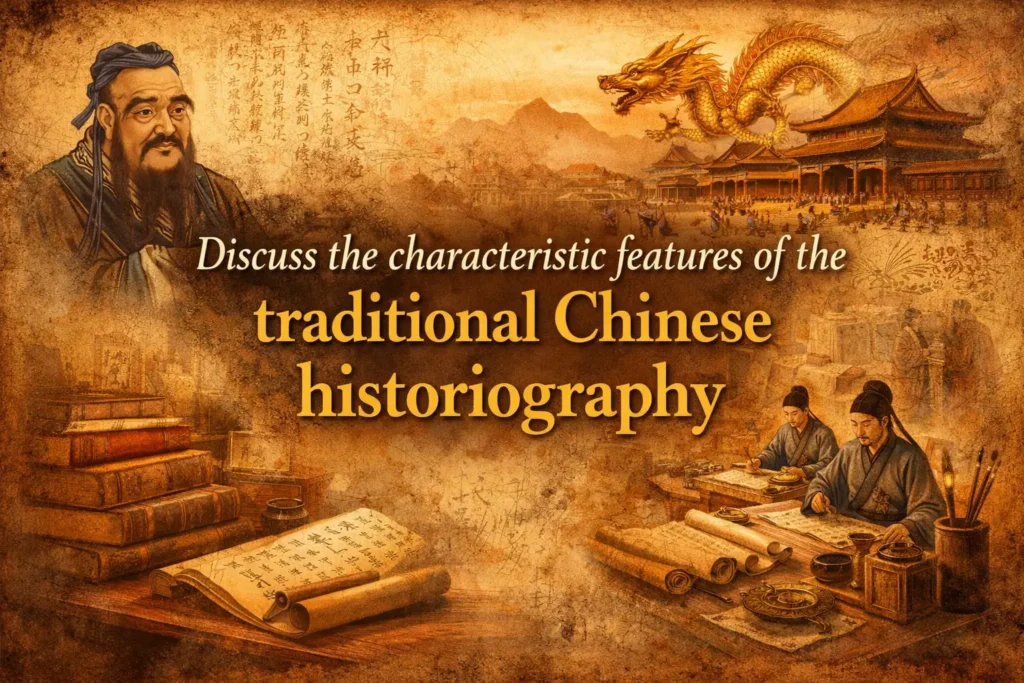
Traditional Chinese historiography is one of the oldest and most continuous historical traditions in the world, shaped by political, philosophical, and cultural forces over more than two millennia. It developed a distinctive set of characteristics that set it apart from Western historical writing, especially in its moral purpose, dynastic focus, and strong connection with state authority.
One of the most important features of traditional Chinese historiography is its close association with the state. History writing was often an official activity carried out by court-appointed historians. These historians were responsible for recording the deeds of emperors and important events of the dynasty. The state not only sponsored historical writing but also preserved records in imperial archives. This official nature ensured continuity and systematic documentation, but it also meant that historiography was influenced by political considerations.
Another defining feature is the dynastic cycle framework. Chinese historians organized history around successive dynasties, each believed to rise, flourish, decline, and fall according to the “Mandate of Heaven.” This concept implied that rulers governed with divine approval, and when they became corrupt or ineffective, they lost this mandate, justifying rebellion and the establishment of a new dynasty. As a result, historical writing often followed a cyclical pattern, emphasizing moral lessons drawn from the success and failure of rulers.
The moral and didactic purpose of history is another key characteristic. Influenced heavily by Confucian philosophy, Chinese historians viewed history as a means to instruct rulers and officials. The past was used as a guide for proper governance and ethical behavior. Historians often passed judgments on the actions of emperors and officials, praising virtue and condemning wrongdoing. Thus, history was not merely a record of events but a tool for moral education.
A major figure in shaping this tradition was Sima Qian, often regarded as the “Father of Chinese History.” His monumental work, Shiji, set the standard for later historiography. It combined chronological narrative with biographical accounts, covering a wide range of topics including politics, economics, and culture. Sima Qian’s method of organizing history into annals, biographies, and treatises became a model for subsequent official histories.
Another characteristic feature is the biographical approach. Instead of focusing solely on events, Chinese historiography often emphasized the lives of individuals—emperors, officials, scholars, and even common people. These biographies were used to illustrate moral virtues or failings, reinforcing the didactic purpose of history.
Traditional Chinese historiography is also marked by its comprehensive and systematic documentation. Official dynastic histories, known as the “Standard Histories,” were compiled for each dynasty, often by the succeeding one. These works followed a consistent structure, including imperial annals, chronological tables, treatises on various subjects, and biographies. This systematic approach ensured a remarkable continuity in historical records.
Another important feature is the use of chronological and annalistic methods. Events were carefully recorded year by year, sometimes even day by day, providing a detailed timeline of political and administrative developments. This emphasis on chronology helped maintain accuracy and coherence in historical narratives.
At the same time, traditional Chinese historiography tended to focus primarily on the elite and political sphere. The lives of emperors, officials, and scholars received the most attention, while the experiences of common people were less frequently documented. However, some works did include insights into social and economic life, especially in treatises and local histories.
Finally, there is a strong element of literary style and narrative sophistication. Chinese historians were often skilled writers who combined factual reporting with elegant prose. Their works were not only historical records but also literary achievements.
In conclusion, traditional Chinese historiography is characterized by its state sponsorship, dynastic organization, moral purpose, biographical emphasis, and systematic structure. Shaped by Confucian ideals and political needs, it created a rich and continuous record of China’s past. While it may reflect certain biases, particularly toward the ruling elite, its depth, organization, and longevity make it one of the most significant historiographical traditions in the world.
Click Here Buy @Rs.1/- only from Amazon
characteristic features of the traditional Chinese historiography characteristic features of the traditional Chinese historiography characteristic features of the traditional Chinese historiography characteristic features of the traditional Chinese historiography characteristic features of the traditional Chinese historiography characteristic features of the traditional Chinese historiography characteristic features of the traditional Chinese historiography