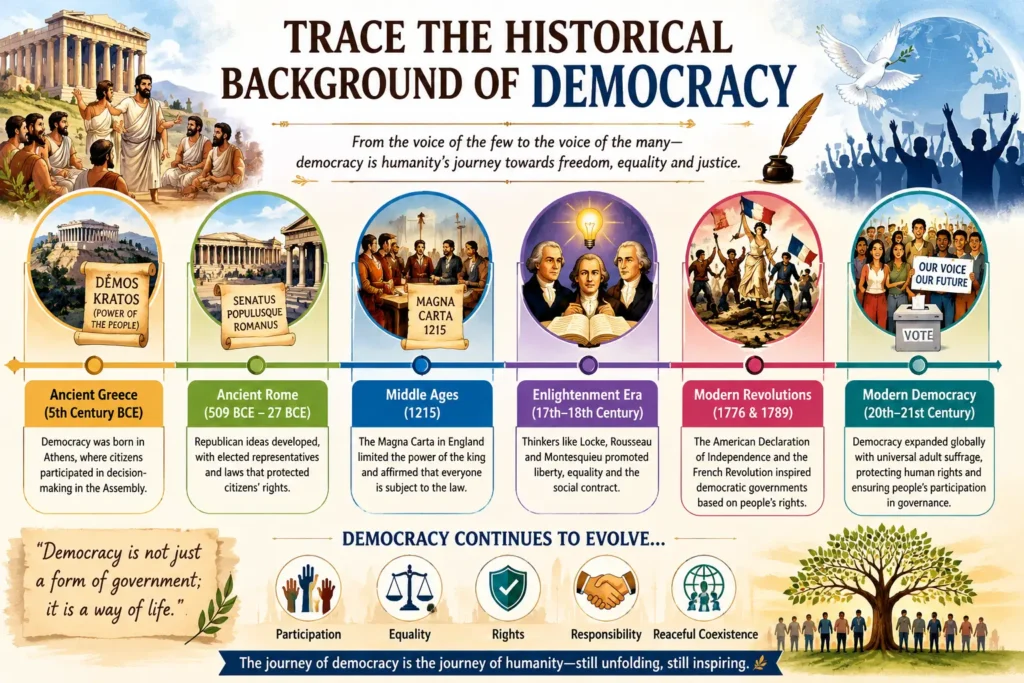
Trace the historical background of Democracy
Democracy is one of the most important forms of government in the modern world. The word “democracy” is derived from two Greek words: demos meaning “people” and kratos meaning “power” or “rule.” Thus, democracy means the rule of the people. It is a system of government in which the ultimate authority rests with the people, who either govern directly or through their elected representatives. The development of democracy has been a long historical process that evolved through different civilizations, political movements, and social struggles.
Ancient Greek Democracy
The origins of democracy can be traced to ancient Greece, particularly the city-state of Athens, during the 5th century BCE. Athens is often regarded as the birthplace of democracy. Under leaders such as Cleisthenes and Pericles, citizens participated directly in decision-making through public assemblies. Important matters concerning laws, war, and public policy were discussed and decided by citizens themselves.
However, Athenian democracy was limited because only adult male citizens were allowed to participate. Women, slaves, and foreigners were excluded from political rights. Despite these limitations, Athens introduced the principle that government should be based on the consent and participation of the people.
Democracy in Ancient Rome
After the decline of Greek city-states, democratic ideas influenced the political system of the Roman Republic. Although Rome was not a democracy in the modern sense, it developed representative institutions such as the Senate and popular assemblies. Citizens had some political rights and could elect certain officials. The Roman experience contributed to the development of constitutional government and the rule of law, which later became important democratic principles.
Democracy During the Middle Ages
The Middle Ages witnessed the decline of democratic institutions in Europe. Most countries were governed by monarchs and feudal lords. Political power was concentrated in the hands of kings, and ordinary people had little influence over government.
Nevertheless, certain events helped preserve democratic ideals. One of the most significant was the signing of the Magna Carta in 1215 in England. This document limited the powers of the king and established the principle that rulers must obey the law. It laid the foundation for constitutional government and the protection of individual rights.
The Renaissance and Enlightenment
The Renaissance and Enlightenment periods played a crucial role in the revival of democratic thought. During the Enlightenment, political philosophers challenged absolute monarchy and advocated liberty, equality, and popular sovereignty.
Thinkers such as John Locke argued that government exists to protect natural rights, including life, liberty, and property. He maintained that political authority derives from the consent of the governed. Jean-Jacques Rousseau emphasized the concept of popular sovereignty and the general will of the people. Their ideas greatly influenced the growth of democratic movements across the world.
Democratic Revolutions
The eighteenth century witnessed major democratic revolutions. The American Revolution led to the establishment of a government based on representative democracy and constitutional principles. The declaration that all people are created equal inspired democratic aspirations worldwide.
Similarly, the French Revolution challenged monarchy and aristocratic privilege. The revolution promoted the ideals of liberty, equality, and fraternity. It emphasized the sovereignty of the people and the protection of citizens’ rights. These revolutions marked a turning point in the history of democracy.
Growth of Modern Democracy
During the nineteenth century, democratic institutions expanded gradually. Voting rights were initially limited to wealthy men, but social and political movements demanded broader participation. Over time, property qualifications were abolished, and suffrage was extended to all adult men and later to women.
The rise of representative government, political parties, and elected legislatures strengthened democratic governance. Democratic principles spread across Europe, North America, and other regions of the world.
Democracy in the Twentieth Century
The twentieth century saw the rapid spread of democracy. After the two World Wars, many countries adopted democratic constitutions and established elected governments. The growth of human rights movements and international organizations promoted democratic values globally.
The end of colonial rule in Asia, Africa, and other regions also contributed to the expansion of democracy. Newly independent nations adopted democratic institutions based on universal adult suffrage, constitutional government, and the rule of law.
Conclusion
In conclusion, democracy has evolved through a long historical journey, beginning in ancient Athens and developing through Roman institutions, medieval constitutional struggles, Enlightenment philosophy, democratic revolutions, and modern political movements. Events such as the Magna Carta, the American Revolution, and the French Revolution significantly contributed to its growth. Today, democracy is regarded as one of the most effective systems of government because it ensures people’s participation, protects individual rights, and promotes accountable governance. The historical development of democracy reflects humanity’s continuous struggle for freedom, equality, and self-government.
Trace the historical background of Democracy Trace the historical background of Democracy Trace the historical background of Democracy Trace the historical background of Democracy Trace the historical background of Democracy Trace the historical background of Democracy Trace the historical background of Democracy Trace the historical background of Democracy Trace the historical background of Democracy Trace the historical background of Democracy Trace the historical background of Democracy Trace the historical background of Democracy Trace the historical background of Democracy Trace the historical background of Democracy