Founder of the Annals School of historiography
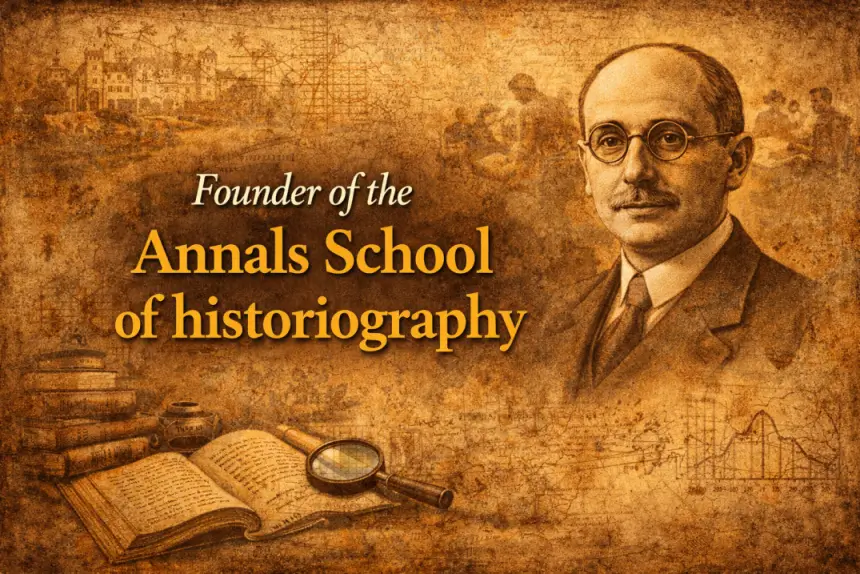
The Annales School of historiography is one of the most influential movements in modern historical writing. It is generally regarded as having been founded by Marc Bloch and Lucien Febvre in 1929 in France. However, if a single individual is to be highlighted as the principal founder, Marc Bloch is often given primary recognition due to his pioneering contributions and lasting intellectual impact.
The Annales School marked a radical departure from traditional historiography, which had largely focused on political events, kings, wars, and diplomacy. Instead, Bloch and Febvre emphasized a broader and more interdisciplinary approach to history, incorporating insights from sociology, geography, economics, and anthropology. Their aim was to study the totality of human life, rather than isolated political घटनाएँ.
Marc Bloch and His Writings
Marc Bloch (1886–1944) was a medieval historian whose works laid the intellectual foundation of the Annales School. His writings reflect a deep concern with understanding the structures and mentalities that shaped human societies over long periods.
One of his most important works is Feudal Society. In this book, Bloch examines the nature of feudalism in medieval Europe, not merely as a political system but as a complex social and economic order. He explores relationships between lords and vassals, landholding patterns, and social hierarchies. What makes this work distinctive is Bloch’s attempt to understand feudalism as a living system, shaped by customs, beliefs, and material conditions.
Another significant work is The Historian’s Craft. This unfinished but highly influential book reflects Bloch’s thoughts on the nature and methods of history. In it, he argues that history is the “science of men in time” and emphasizes the importance of critical analysis of sources, comparative methods, and asking meaningful questions. He also stresses that historians must avoid blindly accepting evidence and instead interpret it carefully within its context.
Bloch also wrote The Royal Touch, a fascinating study of the belief that kings in medieval Europe could heal diseases by touch. Through this work, he explored collective beliefs and mentalities, demonstrating that history should also examine how people in the past understood their world.
Contribution of Lucien Febvre
Although Bloch is often highlighted, Lucien Febvre played an equally crucial role in shaping the Annales tradition. Febvre emphasized the importance of geography and environment in shaping human history. He also promoted the study of emotions, beliefs, and what he called “mentalités” (collective attitudes and ways of thinking).
His notable work, The Problem of Unbelief in the Sixteenth Century, examines whether atheism was possible in the 16th century. Febvre argued that individuals are deeply shaped by the intellectual and cultural limits of their time, thereby introducing a new way of understanding historical context.
The Annales Journal
The foundation of the Annales School was closely linked to the journal Annales d’histoire économique et sociale, established by Bloch and Febvre in 1929. This journal became a platform for promoting new approaches to history, focusing on long-term structures (la longue durée), social history, and interdisciplinary research.
Conclusion
In conclusion, while both Marc Bloch and Lucien Febvre are regarded as founders of the Annales School, Bloch is often seen as the central figure due to his profound theoretical contributions. His works, along with those of Febvre, transformed historiography by shifting the focus from events to structures, mentalities, and everyday life. The Annales School continues to influence historians worldwide, making it one of the most important developments in the study of history.
founder of the Annals School of historiography founder of the Annals School of historiography founder of the Annals School of historiography founder of the Annals School of historiography founder of the Annals School of historiography founder of the Annals School of historiography founder of the Annals School of historiography founder of the Annals School of historiography