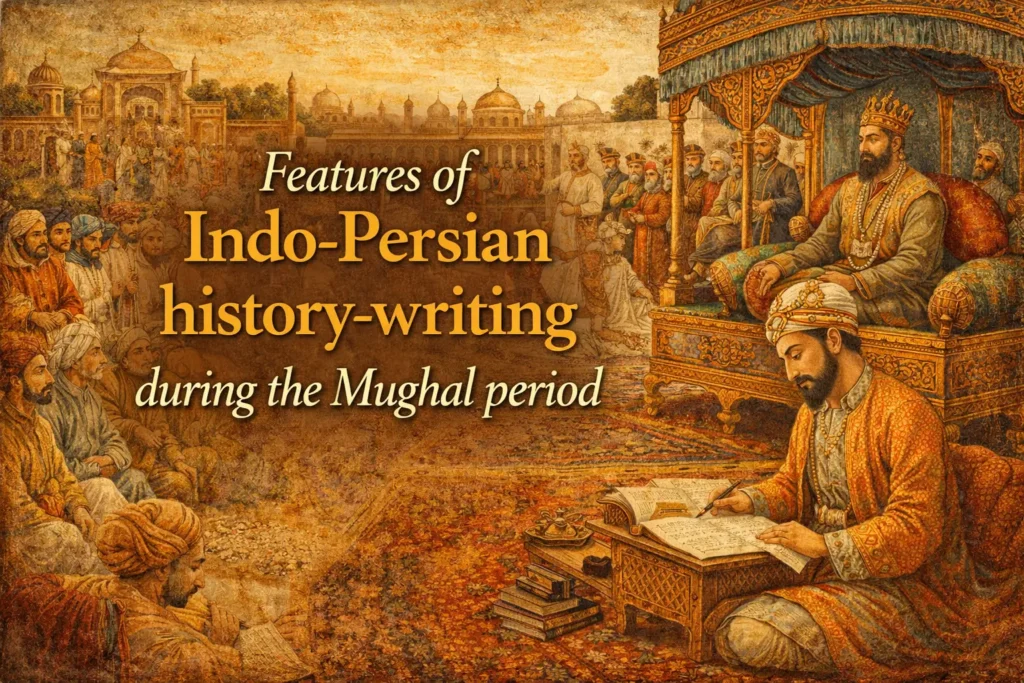
Features of Indo-Persian history-writing during the Mughal period
Indo-Persian historiography during the Mughal period represents a rich and sophisticated tradition of historical writing in medieval India. Written primarily in Persian—the official language of the Mughal court—this historiography reflects the political, cultural, and intellectual life of the empire. It developed under strong royal patronage and combined elements of Persian literary style with Indian historical realities. The important features of Indo-Persian history-writing during the Mughal period can be understood as follows:
One of the most striking features is its court-centered and official character. Most historical works were written under the direct patronage of Mughal emperors or high-ranking nobles. Historians were often appointed as court chroniclers, and their primary duty was to record the achievements, policies, and events of the reigning monarch. As a result, these works frequently glorified the emperor, portraying him as a just, wise, and divinely favored ruler. This tendency sometimes led to exaggeration and bias, especially in favor of the ruling authority.
Another important feature is the emphasis on political and administrative history. Indo-Persian historians focused mainly on the activities of the emperor, court politics, military campaigns, conquests, and administrative measures. Detailed accounts of governance, revenue systems, and imperial organization are found in these texts. For instance, the celebrated work Akbarnama by Abul Fazl provides a comprehensive account of Emperor Akbar’s reign, including his policies, achievements, and vision of kingship.
Closely related to this is the chronological and narrative style of writing. Most Indo-Persian histories follow a chronological order, recording events year by year. This annalistic method helped maintain a clear sequence of events, making the works valuable sources for reconstructing political history. However, the narrative often included elaborate descriptions, speeches, and dramatic elements, reflecting the influence of Persian literary traditions.
A distinctive feature is the influence of Persian literary style and rhetoric. Indo-Persian historical texts were not merely factual records but also literary compositions. They were written in ornate and sophisticated Persian, full of metaphors, poetic expressions, and rhetorical flourishes. This literary richness enhanced the aesthetic appeal of the texts but sometimes made them difficult to interpret and analyze critically.
Another key aspect is the integration of moral and ethical elements. Like many other pre-modern historiographical traditions, Indo-Persian history-writing aimed to provide moral lessons. Historians often highlighted virtues such as justice, generosity, and piety, using the lives of rulers and nobles as examples. At the same time, they criticized moral failings, thereby reinforcing ethical norms within society.
The tradition also shows a strong influence of Islamic worldview and ideology. Many historians interpreted events in the light of divine will, emphasizing the role of God in shaping history. The concept of kingship was often linked to divine sanction, with the emperor seen as God’s representative on earth. However, under certain rulers like Akbar, there was also an attempt to incorporate broader, more inclusive perspectives.
An important feature is the presence of diverse types of historical works. Indo-Persian historiography was not limited to official chronicles. It included biographies (tazkiras), memoirs, travel accounts, and regional histories. A notable example is Baburnama by Babur, which provides a personal and vivid account of the author’s life, thoughts, and experiences. Unlike official chronicles, such works offer more candid insights into the personality of rulers and the society of the time.
Similarly, Badshahnama documents the reign of Shah Jahan in great detail, focusing on court life, ceremonies, and imperial achievements. These works collectively provide a comprehensive picture of Mughal political and cultural life.
Despite its richness, Indo-Persian historiography had certain limitations. It largely ignored the lives of common people, focusing instead on elites and courtly affairs. Social and economic conditions of the masses were often neglected, except when they directly affected the state.
In conclusion, Indo-Persian history-writing during the Mughal period is characterized by its courtly nature, political focus, chronological structure, literary elegance, moral purpose, and Islamic ideological influence. While it reflects certain biases due to royal patronage, it remains an invaluable source for understanding the administration, culture, and intellectual life of the Mughal Empire.
Click Here Buy @Rs.1/- only from Amazon
features of Indo-Persian history-writing during the Mughal period features of Indo-Persian history-writing during the Mughal period features of Indo-Persian history-writing during the Mughal period features of Indo-Persian history-writing during the Mughal period features of Indo-Persian history-writing during the Mughal period features of Indo-Persian history-writing during the Mughal period