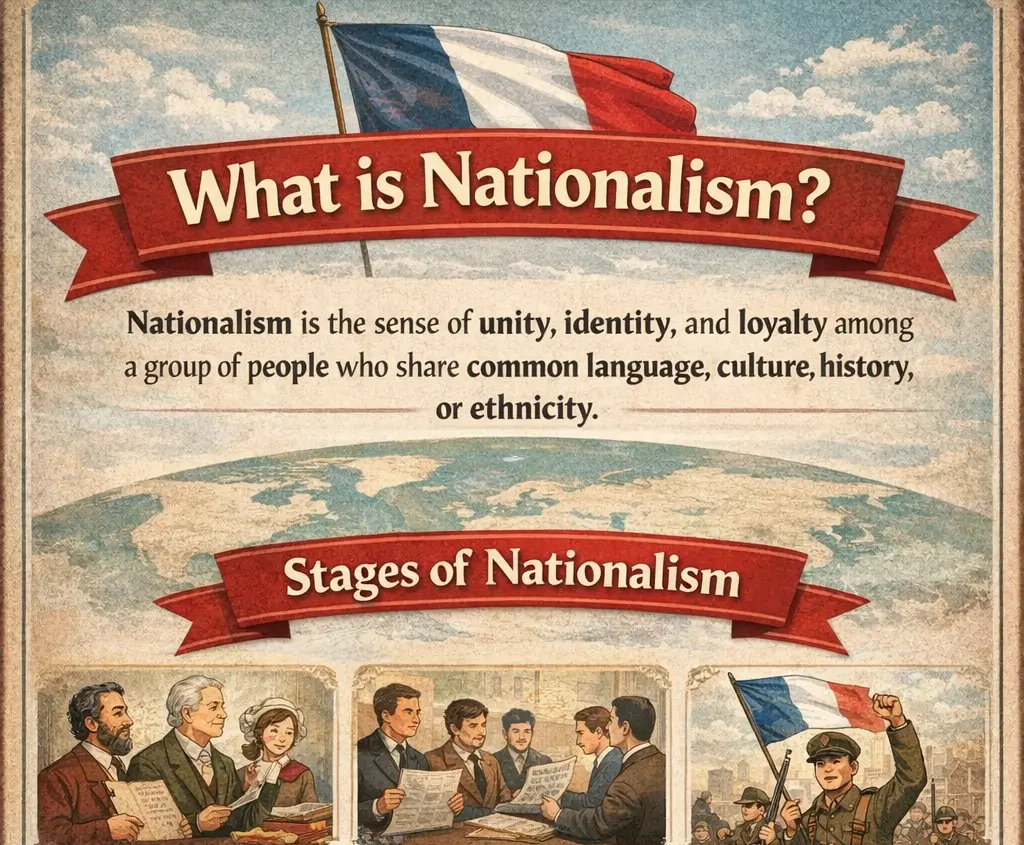
What is nationalism? Explain its various stage.
Nationalism is a political and ideological concept that emphasizes the sense of unity, identity, and loyalty among people who share common features such as language, culture, history, territory, or ethnicity. It promotes the idea that a nation should govern itself, free from external control, and that the interests of the nation are of primary importance. Nationalism played a crucial role in shaping modern states, especially from the 18th century onwards.
The development of nationalism is not sudden; it evolves through various stages. Scholars have identified different phases through which nationalism grows and matures. These stages can be broadly explained as follows:
1. Cultural or Proto-National Stage
This is the earliest stage of nationalism, where the idea of a shared identity begins to emerge. Intellectuals, writers, and historians play a key role in this phase. They promote a common language, revive traditions, and emphasize shared history and cultural heritage. At this stage, nationalism is more cultural than political.
For example, in Europe, thinkers like Johann Gottfried Herder emphasized the importance of folk culture, language, and traditions in shaping national identity. There is no mass political movement yet, but a foundation is being laid for future nationalism.
2. Political Awareness Stage
In this stage, the idea of nationalism begins to take a political form. Educated groups, middle classes, and elites become aware of political inequalities, foreign domination, or lack of representation. They start demanding rights, reforms, and participation in governance.
National consciousness becomes stronger, and people begin to see themselves as part of a nation with political aspirations. However, this stage is still limited to a small section of society and has not yet become a mass movement.
3. Mass Mobilization Stage
This is a crucial stage where nationalism spreads among the general population. Leaders mobilize peasants, workers, and other sections of society through movements, protests, and campaigns. Nationalism becomes a powerful force capable of challenging existing political structures.
A classic example is the French Revolution, which transformed nationalism into a mass political force by promoting ideas of liberty, equality, and fraternity. Similarly, in colonized countries, nationalism became a tool for anti-colonial struggles.
4. Struggle for Independence or Unification
At this stage, nationalism leads to organized struggles aimed at achieving independence or unification. Political movements become more intense and often involve revolutions, wars, or negotiations.
For instance, the unification movements in Germany and Italy were driven by nationalist aspirations. Leaders like Otto von Bismarck played a key role in unifying Germany. In colonies, nationalist movements aimed to end foreign rule and establish sovereign states.
5. Consolidation Stage
After achieving independence or unification, the focus shifts to consolidating the nation. This involves building institutions, creating a constitution, establishing governance systems, and promoting national integration.
During this stage, governments work to strengthen national identity, ensure political stability, and promote economic development. Efforts are made to integrate diverse groups within the nation and reduce internal conflicts.
6. Mature or Modern Nationalism
In the final stage, nationalism becomes more stable and institutionalized. It is reflected in the functioning of the state, public policies, and citizens’ sense of belonging. However, modern nationalism can take both positive and negative forms.
On the positive side, it promotes unity, development, and patriotism. On the negative side, it can lead to chauvinism, intolerance, or conflicts with other nations. Events like the World War I and World War II demonstrate how extreme nationalism can result in global conflicts.
Conclusion
Nationalism is a dynamic and evolving concept that develops through multiple stages—from cultural awakening to political mobilization and finally to nation-building. It has played a significant role in shaping the modern world by inspiring movements for independence, unity, and self-determination. While it has contributed to the creation of nation-states and democratic systems, it must be balanced with values of tolerance and cooperation to avoid conflict and division.
What is nationalism? Explain its various stage. What is nationalism? Explain its various stage. What is nationalism? Explain its various stage. What is nationalism? Explain its various stage. What is nationalism? Explain its various stage. What is nationalism? Explain its various stage.What is nationalism? Explain its various stage. What is nationalism? Explain its various stage. What is nationalism? Explain its various stage. What is nationalism? Explain its various stage.What is nationalism? Explain its various stage.