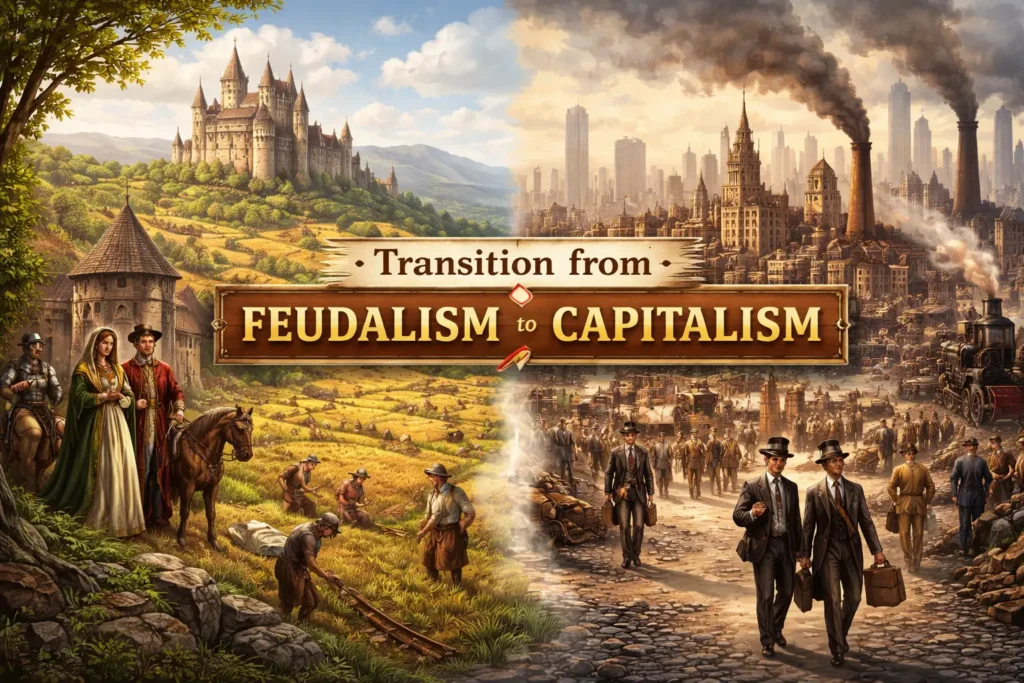
Write an essay on the transition from feudalism to capitalism
The transition from feudalism to capitalism marks one of the most significant transformations in world history, particularly in Europe between the late medieval and early modern periods. It involved profound economic, social, and political changes that laid the foundation for the modern industrial world.
Feudalism was a socio-economic system dominant in medieval Europe, characterized by a hierarchy based on land ownership. Kings granted land to nobles in exchange for military service, while peasants or serfs worked on the land and provided agricultural produce. The economy was largely agrarian, localized, and based on subsistence, with limited trade and mobility.
The decline of feudalism began due to multiple interconnected factors. One major cause was the growth of trade and commerce. From the 11th century onward, the revival of long-distance trade led to the rise of towns and markets. Merchants and traders began to accumulate wealth, forming a new social class known as the bourgeoisie. This shift weakened the rigid feudal hierarchy based on land.
The impact of the Black Death in the 14th century further accelerated the decline of feudalism. The massive loss of population led to a shortage of labor, which increased the bargaining power of peasants. Serfs demanded better wages and working conditions, and many were able to break free from feudal obligations. This undermined the traditional manorial system.
Another important factor was the growth of centralized monarchies. Kings began to consolidate power by reducing the influence of feudal lords. They established stronger administrative systems and standing armies, which decreased their dependence on feudal levies. This political centralization contributed to the decline of feudal structures.
The transformation was also influenced by intellectual and cultural developments such as the Renaissance and later the Reformation. These movements encouraged individualism, rational thinking, and a questioning of traditional authority, which indirectly supported the emergence of capitalist ideas.
As feudalism declined, the foundations of capitalism began to emerge. Capitalism is an economic system based on private ownership of the means of production, profit motive, market exchange, and wage labor. One of the early forms of capitalist development was the “putting-out system” or domestic system, where merchants provided raw materials to rural workers who produced goods for sale in markets.
The enclosure movement in England played a crucial role in this transition. Common lands that peasants once used were enclosed by landlords for private use, often for sheep farming. This displaced many peasants, forcing them to migrate to towns and cities in search of work. As a result, a labor force dependent on wages began to form—an essential feature of capitalism.
The expansion of global trade and exploration further strengthened capitalist development. The Age of Exploration opened new trade routes and markets. European powers accumulated wealth through trade, colonization, and exploitation of resources, which provided capital for investment in industries.
The culmination of these changes can be seen in the Industrial Revolution, which marked the full development of capitalism. Industrialization introduced machines, factories, and mass production, transforming the economic structure from agrarian to industrial. The relationship between employer and worker replaced the feudal bond between lord and serf.
Socially, this transition led to the rise of new classes: the capitalist class (owners of production) and the working class (wage laborers). Economically, markets became more integrated, and production was increasingly oriented toward profit rather than subsistence. Politically, capitalist development supported the growth of democratic institutions and the idea of individual rights.
However, the transition was not smooth or uniform. It involved conflicts, resistance, and inequalities. Many peasants suffered displacement, and early industrial workers faced harsh working conditions. Despite these challenges, the shift from feudalism to capitalism fundamentally reshaped society and laid the groundwork for modern economic systems.
In conclusion, the transition from feudalism to capitalism was a complex and gradual process driven by economic expansion, social changes, political centralization, and technological innovation. It marked the end of a land-based hierarchical system and the rise of a dynamic, market-oriented economy that continues to influence the modern world.
Write an essay on the transition from feudalism to capitalism Write an essay on the transition from feudalism to capitalism Write an essay on the transition from feudalism to capitalism Write an essay on the transition from feudalism to capitalism Write an essay on the transition from feudalism to capitalism Write an essay on the transition from feudalism to capitalism Write an essay on the transition from feudalism to capitalism Write an essay on the transition from feudalism to capitalism