What does decolonization mean? Discuss various approaches to understand it
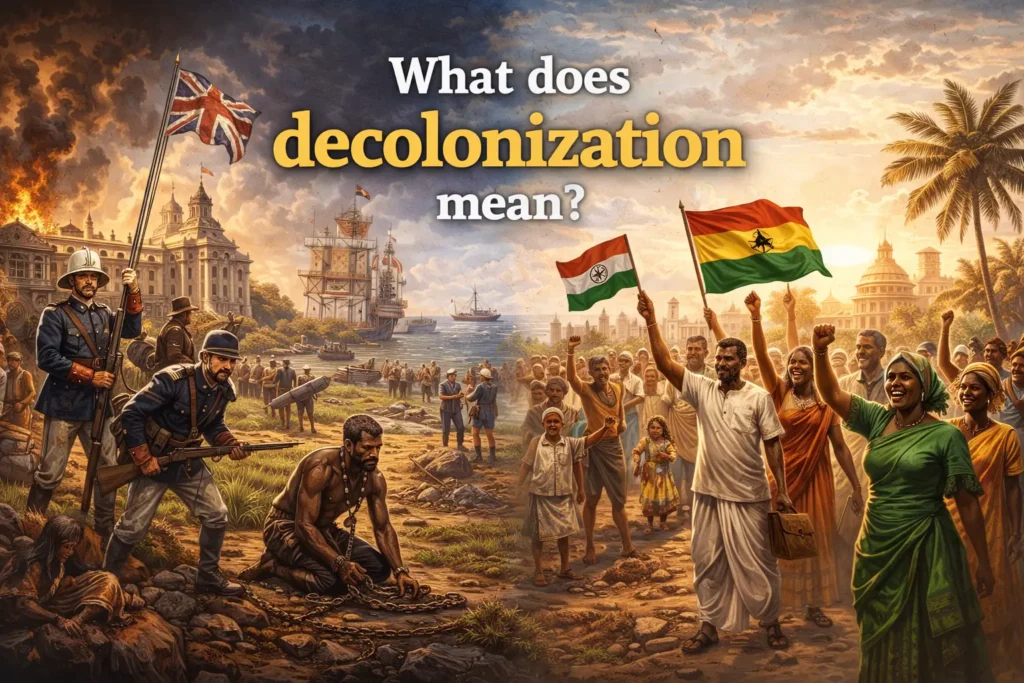
Decolonization refers to the process by which colonies gain independence from colonial powers and establish their own political, economic, and cultural systems. It is not only a political transition from foreign rule to self-governance but also a broader transformation that involves reclaiming identity, culture, and autonomy. Decolonization became a major global phenomenon in the mid-20th century, particularly after World War II, when many Asian, African, and Latin American nations freed themselves from European imperial control.
At its core, decolonization signifies the dismantling of colonial structures of domination and exploitation. However, understanding decolonization requires looking beyond formal independence to examine deeper social, economic, and cultural dimensions. Scholars have developed various approaches to interpret this complex process.
One important approach is the political perspective, which focuses on the transfer of power from colonial rulers to indigenous leaders. This approach emphasizes nationalist movements, leadership, and constitutional developments. Leaders like Mahatma Gandhi in India or Kwame Nkrumah in Ghana mobilized mass movements to challenge colonial authority. From this viewpoint, decolonization is seen as the achievement of sovereignty and the creation of nation-states. However, critics argue that political independence alone does not necessarily end colonial influence.
Another approach is the economic perspective, which highlights the continuation of economic dependence even after independence. According to this view, many newly independent countries remained tied to former colonial powers through trade, investment, and financial systems. This idea is often described as “neo-colonialism.” Economists and scholars argue that colonial powers structured economies in ways that benefited themselves, such as focusing on raw material exports rather than industrial development. As a result, decolonization did not always lead to genuine economic freedom.
The cultural approach to decolonization focuses on the recovery and reassertion of indigenous identities, languages, and traditions that were suppressed under colonial rule. Colonialism often imposed foreign values, education systems, and cultural norms. Decolonization, therefore, involves challenging these influences and reviving local heritage. Writers and thinkers emphasized the importance of mental liberation, arguing that true independence requires freeing the mind from colonial ideologies. This perspective is especially important in understanding how colonialism shaped identity and self-perception.
Another significant framework is the postcolonial approach, which examines the lasting impact of colonialism on societies even after independence. Postcolonial scholars analyze how power, knowledge, and representation were shaped by colonial rule. They explore issues such as race, identity, language, and inequality. This approach argues that colonial influence persists in subtle ways, including in education, governance, and global power relations. It shifts the focus from the moment of independence to the long-term consequences of colonial domination.
The subaltern approach offers another way to understand decolonization by focusing on marginalized groups, such as peasants, workers, women, and indigenous communities. Traditional histories often highlight elite leaders and political events, but subaltern studies seek to recover the voices and experiences of ordinary people. This approach shows that decolonization was not only led by prominent figures but also shaped by grassroots resistance and everyday struggles.
Finally, the global or international approach places decolonization within a broader world context. It considers the role of global forces such as the Cold War, the decline of European powers, and the rise of international organizations like the United Nations. These factors influenced the pace and nature of decolonization. For instance, both the United States and the Soviet Union supported decolonization movements for strategic reasons, which shaped the political landscape of newly independent nations.
In conclusion, decolonization is a multifaceted process that goes beyond the mere end of colonial rule. It involves political independence, economic restructuring, cultural revival, and ongoing struggles against inequality and external influence. Different approaches—political, economic, cultural, postcolonial, subaltern, and global—provide diverse insights into this complex phenomenon. Together, they help us understand that decolonization is not a single event but a continuous process of transformation and self-determination.
What does decolonization mean? Discuss various approaches to understand it What does decolonization mean? Discuss various approaches to understand it What does decolonization mean? Discuss various approaches to understand it What does decolonization mean? Discuss various approaches to understand it What does decolonization mean? Discuss various approaches to understand it What does decolonization mean? Discuss various approaches to understand it What does decolonization mean? Discuss various approaches to understand it