Discuss the nature of state formation of the bahmani kingdom
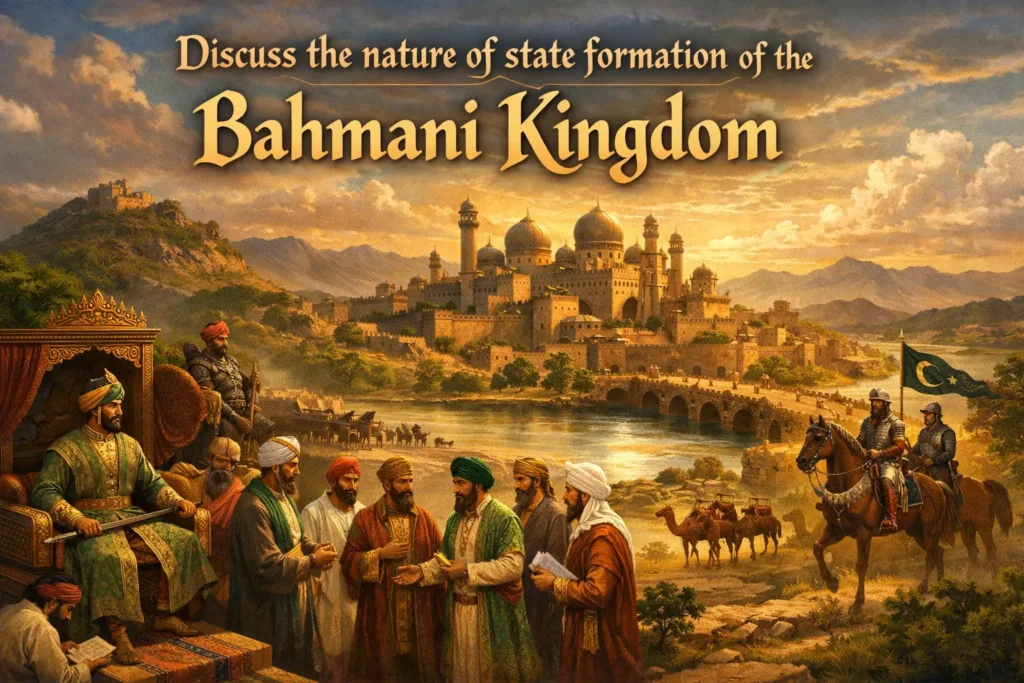
The nature of state formation of the Bahmani Kingdom represents a significant phase in the political and cultural history of the Deccan in medieval India. Established in 1347 by Alauddin Bahman Shah (also known as Hasan Gangu), the Bahmani state emerged out of the weakening control of the Delhi Sultanate over the Deccan. Its formation illustrates a complex interplay of military assertion, regional identity, administrative innovation, and socio-cultural synthesis.
At its core, the Bahmani state was born from a rebellion against centralized authority. The governors of the Deccan, dissatisfied with the distant rule of Delhi and its inability to manage local conditions effectively, asserted independence. This reflects a broader medieval pattern where provincial elites played a crucial role in state formation. The Bahmani Kingdom thus began as a regional power, rooted in the political realities of the Deccan rather than imposed from the north.
One of the key features of Bahmani state formation was its military foundation. The kingdom was established through armed struggle and maintained its authority through a strong military organization. The rulers relied on a combination of foreign (Afaqis) and local (Deccanis) nobles, who were granted land assignments in return for military service. This system, similar to the iqta system of the Delhi Sultanate, helped in consolidating power but also led to factional conflicts within the ruling elite.
The administrative structure of the Bahmani state was relatively well organized. The kingdom was divided into provinces called tarafs, each governed by a tarafdar. These officials were responsible for maintaining law and order, collecting revenue, and ensuring military readiness. The central administration included key positions such as the wazir (prime minister), mir bakshi (military head), and qazi (judicial authority). Despite this structure, the state often faced challenges in maintaining effective control over distant regions, reflecting a semi-centralized nature of governance.
Another important aspect of state formation was agrarian expansion and revenue system. The Bahmani rulers encouraged the cultivation of new lands and improved agricultural productivity. Revenue collection was a major concern, as it formed the economic backbone of the state. Land grants and taxation policies were designed to ensure a steady flow of income while also integrating local chieftains into the administrative framework. This process helped in extending state control into rural areas and stabilizing the economy.
The Bahmani state also exhibited a strong element of cultural and religious synthesis. The rulers were Muslims, but they governed a largely Hindu population. As a result, they adopted a policy of accommodation and pragmatism. Local traditions, languages, and administrative practices were incorporated into the functioning of the state. Persian culture influenced the court, but regional elements remained significant. This cultural blending was a hallmark of the Deccan and played a vital role in legitimizing Bahmani rule.
Factionalism between the Deccanis (local Muslims and converted groups) and Afaqis (foreign nobles from Persia and Central Asia) was a defining feature of the Bahmani polity. These internal divisions often weakened the central authority and led to political instability. Over time, such conflicts contributed to the fragmentation of the kingdom into smaller Deccan Sultanates like Bijapur, Golconda, Ahmadnagar, Berar, and Bidar in the late 15th and early 16th centuries.
The role of urban centers and trade was also crucial in the formation of the Bahmani state. Cities like Gulbarga (the first capital) and later Bidar became important administrative and cultural hubs. The kingdom benefited from its strategic location, engaging in trade with the Arabian Peninsula and beyond. This economic prosperity supported the state’s military and administrative machinery.
In conclusion, the state formation of the Bahmani Kingdom was a dynamic and multifaceted process. It combined elements of military conquest, administrative organization, agrarian development, and cultural accommodation. While it succeeded in establishing a powerful regional state in the Deccan, internal conflicts and decentralizing tendencies eventually led to its decline. Nevertheless, the Bahmani Kingdom laid the foundation for subsequent Deccan states and left a lasting legacy in the political and cultural landscape of medieval India.
Discuss the nature of state formation of the bahmani kingdom Discuss the nature of state formation of the bahmani kingdom Discuss the nature of state formation of the bahmani kingdom Discuss the nature of state formation of the bahmani kingdom Discuss the nature of state formation of the bahmani kingdom Discuss the nature of state formation of the bahmani kingdom Discuss the nature of state formation of the bahmani kingdom Discuss the nature of state formation of the bahmani kingdom