Write a note on the formation of the kingdom of Malwa
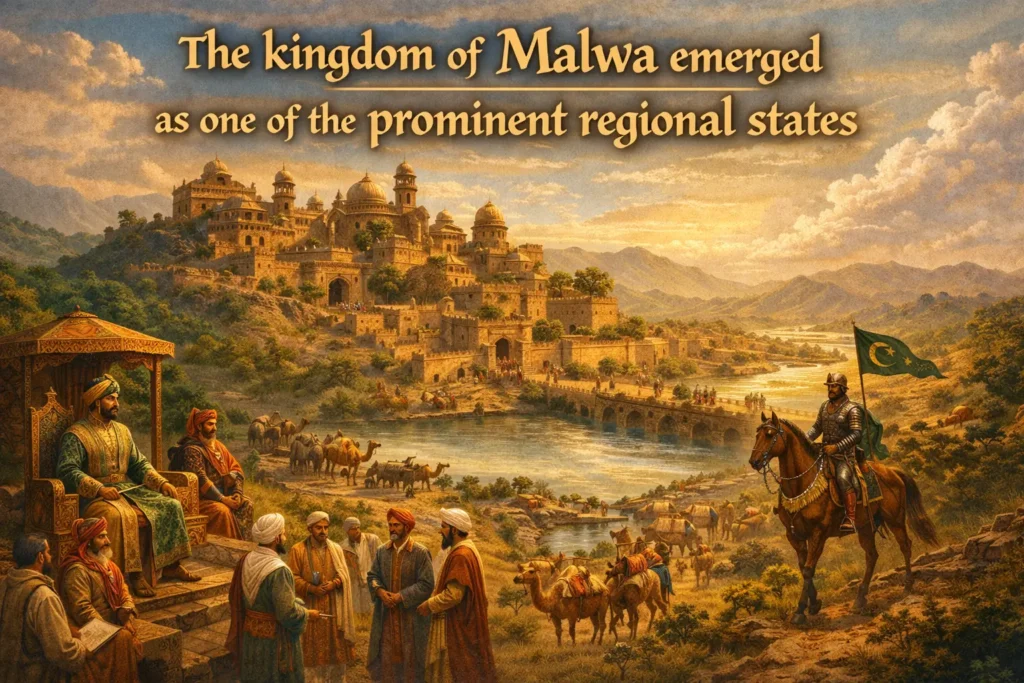
The kingdom of Malwa emerged as one of the prominent regional states in central India during the late medieval period, particularly in the context of the decline of the Delhi Sultanate. Its formation reflects the broader pattern of political fragmentation and regional assertion that marked the 14th and 15th centuries in Indian history.
The Malwa region, located in present-day western Madhya Pradesh, had long been strategically and economically significant due to its fertile plateau, trade routes, and urban centers such as Dhar and Ujjain. During the early medieval period, it was ruled by various dynasties, including the Paramaras, before coming under the control of the Delhi Sultanate in the 13th century. However, as the central authority of the Sultanate weakened in the late 14th century, provincial governors began to assert their independence.
The foundation of the independent Malwa Sultanate is closely associated with Dilawar Khan Ghuri. He was initially appointed as the governor of Malwa by the Delhi Sultanate, likely during the reign of Firuz Shah Tughlaq. Taking advantage of the political instability that followed the invasion of Timur in 1398, which severely weakened the Delhi Sultanate, Dilawar Khan gradually consolidated his power in the region.
Around 1401, Dilawar Khan effectively declared independence, although he did not immediately assume royal titles. His rule marked the beginning of a new political order in Malwa, characterized by regional autonomy and the establishment of a distinct السلطanate. After his death, his son Hoshang Shah formally assumed the title of Sultan, thereby giving full shape to the Malwa Sultanate.
Under Hoshang Shah, the kingdom saw consolidation and expansion. He shifted the capital from Dhar to Mandu, which became one of the most celebrated medieval cities in India. Mandu’s strategic location on a plateau made it easily defensible, and it was developed into a center of administration, culture, and architecture. The formation of the Malwa kingdom was thus not merely political but also involved urban development and state-building.
The emergence of Malwa as an independent kingdom was part of a larger pattern of regionalization in India during the late medieval period. Alongside Malwa, other regional states such as Gujarat, Jaunpur, and the Bahmani kingdom also arose from the weakening of the Delhi Sultanate. These states were often founded by ambitious governors or military leaders who capitalized on the decline of central authority.
The nature of state formation in Malwa combined elements of continuity and change. On the one hand, the administrative framework, revenue systems, and military organization bore the imprint of the Delhi Sultanate. Persian culture, language, and court practices were also retained, reflecting the broader Indo-Islamic political tradition. On the other hand, the rulers of Malwa adapted to local conditions by incorporating regional elites, including Hindu chiefs and landholders, into their administration. This helped in stabilizing their rule and securing local support.
Economic factors also played an important role in the formation and consolidation of the Malwa kingdom. The region was agriculturally rich and lay along important trade routes connecting northern and western India with the Deccan. Control over these routes enabled the Malwa rulers to accumulate wealth and maintain a strong military.
Furthermore, the formation of the Malwa Sultanate was accompanied by cultural and architectural developments. The rulers patronized art, architecture, and learning, leading to the construction of notable monuments in Mandu, such as mosques, palaces, and tombs. This cultural patronage helped legitimize their rule and project their authority.
In conclusion, the formation of the kingdom of Malwa was a result of the decline of the Delhi Sultanate, the ambitions of provincial governors like Dilawar Khan Ghuri, and the favorable geographical and economic conditions of the region. It exemplifies the broader process of regional state formation in medieval India, where new political entities emerged by blending inherited administrative structures with local adaptations. The Malwa Sultanate thus stands as an important example of how regional powers shaped the political and cultural landscape of India in the late medieval period.
Write a note on the formation of the kingdom of Malwa Write a note on the formation of the kingdom of MalwaWrite a note on the formation of the kingdom of Malwa Write a note on the formation of the kingdom of Malwa Write a note on the formation of the kingdom of Malwa Write a note on the formation of the kingdom of Malwa Write a note on the formation of the kingdom of Malwa Write a note on the formation of the kingdom of Malwa Write a note on the formation of the kingdom of Malwa Write a note on the formation of the kingdom of Malwa