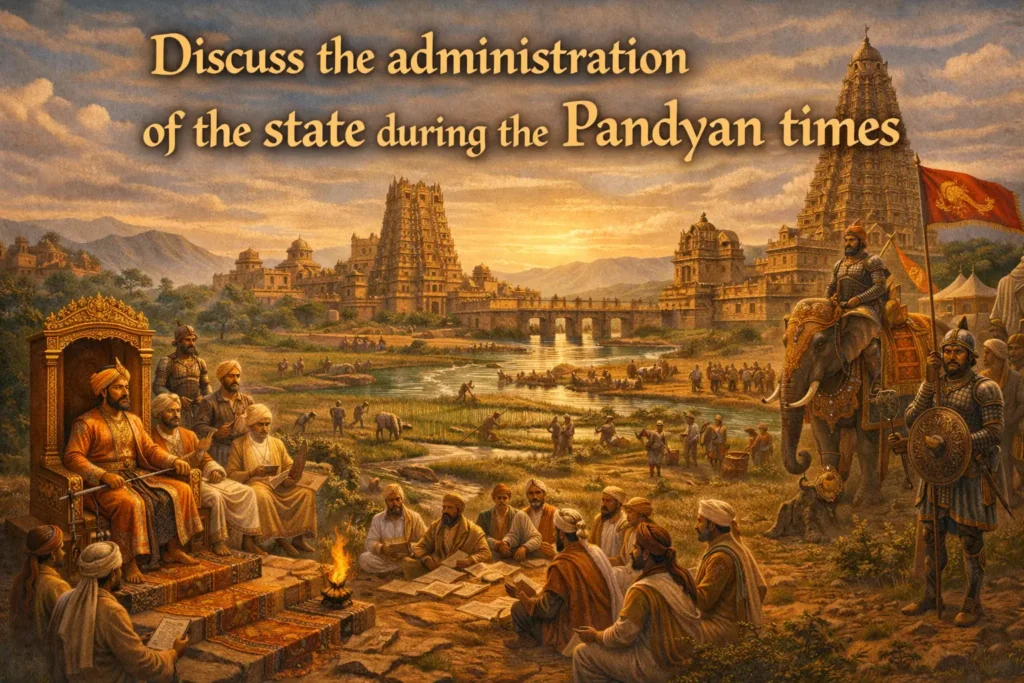
Discuss the administration of the state during the Pandyan times
The administration of the state during the Pandyan dynasty represents a significant phase in the political history of South India. The Pandyas, who ruled mainly over the southern parts of Tamil Nadu with centers such as Madurai, developed an administrative system that combined monarchical authority with local institutional participation. Their governance reflects both continuity with earlier South Indian traditions and adaptation to changing political and economic conditions.
At the apex of the administration stood the king, who was the supreme authority in political, military, and judicial matters. The Pandyan rulers claimed divine sanction and were regarded as protectors of dharma. Kings maintained elaborate courts, supported by ministers, military commanders, priests, and officials. The court played an important role in policy-making, dispute resolution, and maintaining diplomatic relations with neighboring kingdoms such as the Cholas and Cheras.
The administrative structure of the Pandyan state was territorial and hierarchical. The kingdom was divided into provinces, which were further subdivided into smaller units such as districts and villages. These units were administered by appointed officials who ensured the implementation of royal orders, collection of revenue, and maintenance of law and order. While the king exercised overall control, the efficiency of governance depended largely on these local officials.
One of the key features of Pandyan administration was the importance of local institutions. Village assemblies played a crucial role in managing day-to-day affairs, including irrigation, land management, and dispute settlement. These assemblies consisted of local elites, landholders, and influential members of society. They functioned with a degree of autonomy, indicating that the Pandyan state, like other South Indian polities, was not entirely centralized.
Revenue administration formed the backbone of the Pandyan state. Land revenue was the primary source of income, and taxes were assessed based on the fertility of the land and the nature of cultivation. The state maintained records of land ownership and productivity, which helped in efficient tax collection. In addition to land revenue, the Pandyas collected taxes on trade, professions, and various economic activities.
Irrigation and agriculture were given special attention under the Pandyas. The region depended heavily on monsoon rains, so the rulers invested in building tanks, canals, and reservoirs to ensure a stable water supply. These irrigation works not only increased agricultural productivity but also strengthened the economic base of the state. Local communities often participated in the maintenance of these systems, reflecting cooperation between the state and society.
The military organization of the Pandyan state was another important aspect of its administration. The Pandyas maintained a strong army consisting of infantry, cavalry, and elephant corps. The army was essential for defending the kingdom, expanding territory, and maintaining internal stability. Military officers held significant positions in the प्रशासनिक hierarchy and were often rewarded with land grants.
Trade and commerce flourished under the Pandyas, contributing significantly to the state’s revenue. The Pandyan ports facilitated overseas trade with regions such as Southeast Asia and the Roman world in earlier periods. Merchant guilds played a vital role in organizing trade and maintaining commercial networks. The state provided protection and support to traders, ensuring the smooth functioning of economic activities.
Religion and temples played a central role in the administration and society of the Pandyan kingdom. Temples were not only places of worship but also centers of economic activity and social organization. They owned land, employed artisans and workers, and acted as institutions for redistribution of resources. The Pandyan rulers were great patrons of temple construction and religious endowments, which helped legitimize their authority.
Justice administration was carried out at various levels. The king was the highest judicial authority, but local assemblies and officials also handled disputes and legal matters. Punishments were based on customary laws and royal decrees, and efforts were made to maintain social order and stability.
In conclusion, the administration of the Pandyan state was a well-structured system that balanced central authority with local autonomy. It was characterized by an efficient revenue system, strong military organization, active local institutions, and a vibrant economic base supported by agriculture and trade. The integration of political power with religious and social institutions further strengthened the state. The Pandyan administrative system thus reflects the dynamic and adaptable nature of early medieval South Indian polity.
Discuss the administration of the state during the Pandyan times Discuss the administration of the state during the Pandyan times Discuss the administration of the state during the Pandyan times Discuss the administration of the state during the Pandyan times Discuss the administration of the state during the Pandyan times Discuss the administration of the state during the Pandyan times Discuss the administration of the state during the Pandyan times Discuss the administration of the state during the Pandyan times