What was the nature of the Mughal administaration
The nature of the Mughal administration under the Mughal Empire was highly centralized, hierarchical, and efficient, reflecting a blend of Turko-Mongol, Persian, and Indian traditions. It evolved significantly from the reign of Babur to Aurangzeb, reaching its peak of organization and effectiveness during the rule of Akbar.
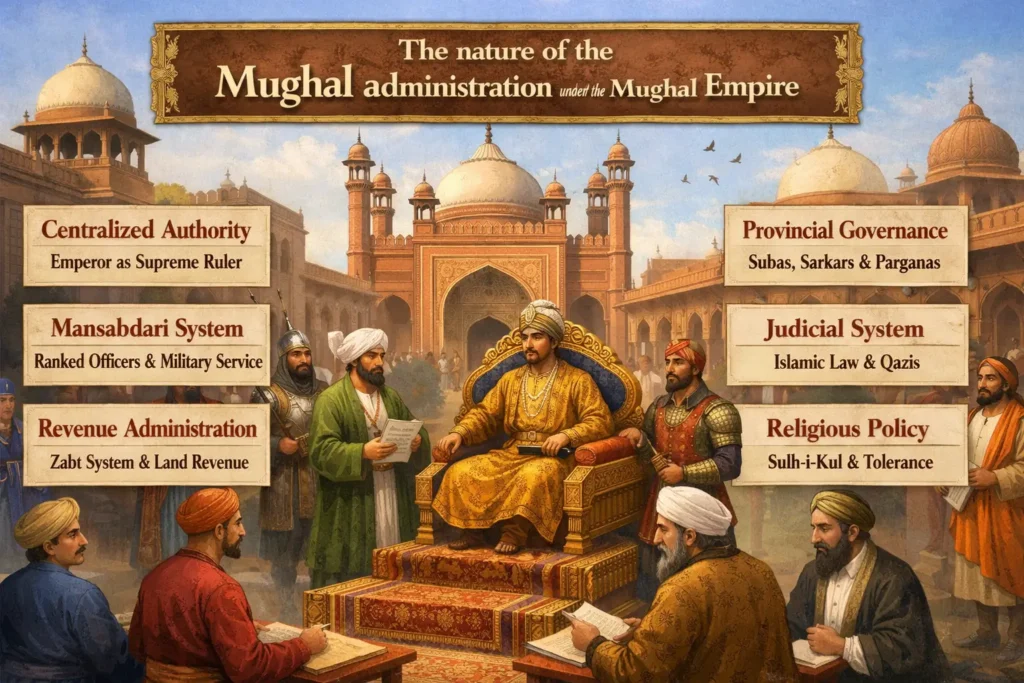
At its core, the Mughal administration was a centralized autocracy where the emperor held absolute authority. The emperor was the supreme head of the state, the military, and the judiciary. He was considered the source of all laws and commands, although in practice, he was advised by a council of ministers. The emperor’s will was implemented through an elaborate bureaucratic system, ensuring uniform governance across vast territories.
One of the key features of Mughal administration was the mansabdari system, introduced and refined by Akbar. Under this system, officials known as mansabdars were assigned ranks (mansabs) that determined their status, salary, and military responsibilities. Each mansabdar was required to maintain a specified number of cavalry, thus linking civil administration with military organization. This system helped maintain loyalty to the emperor and prevented the rise of independent regional powers.
The central administration was divided into several departments, each headed by a high-ranking official. The most important among them was the Wazir (or Diwan), who was in charge of revenue and finance. The Mir Bakshi handled military administration and recruitment, while the Sadr-us-Sudur managed religious and charitable affairs. The Qazi-ul-Quzat served as the chief judicial authority. These officials ensured smooth governance and acted as checks on each other’s powers.
Provincial administration under the Mughals was also well-structured. The empire was divided into provinces called subas, each governed by a Subadar (or governor). The Subadar was responsible for maintaining law and order, implementing imperial orders, and overseeing military operations in the province. Alongside him was the provincial Diwan, who looked after revenue collection, ensuring a balance of power and preventing misuse of authority.
Further subdivisions included sarkars (districts), parganas (sub-districts), and villages. At the village level, local officials such as the muqaddam (village headman) and patwari (record keeper) played important roles in administration and revenue collection. This multi-tiered structure ensured efficient governance at all levels.
Revenue administration was a cornerstone of the Mughal system. The primary source of income was land revenue, which was systematically assessed and collected. Akbar introduced the zabt system, based on careful measurement of land and average produce. The revenue demand was generally fixed as a share of the produce, ensuring stability and predictability for both the state and the peasants. This system was later modified in different regions according to local conditions.
The Mughal administration also maintained a strong judicial system. Justice was administered based on Islamic law (Sharia), supplemented by local customs and royal decrees. The emperor was regarded as the highest court of appeal and often held public audiences to hear grievances.
Another significant aspect was the policy of religious tolerance, especially under Akbar, who promoted the idea of Sulh-i-Kul (universal peace). This policy helped integrate diverse communities into the empire and contributed to political stability. However, this approach varied under different rulers, notably changing during Aurangzeb’s reign.
In conclusion, the Mughal administration was a sophisticated and well-organized system characterized by centralization, a strong bureaucracy, and efficient revenue mechanisms. It played a crucial role in maintaining the stability and prosperity of the empire for over two centuries. Despite its strengths, the system began to weaken in the later period due to administrative inefficiencies, corruption, and the inability to adapt to changing political and economic conditions, ultimately contributing to the decline of the Mughal Empire.
What was the nature of the Mughal administaration What was the nature of the Mughal administaration What was the nature of the Mughal administaration What was the nature of the Mughal administaration What was the nature of the Mughal administaration What was the nature of the Mughal administaration What was the nature of the Mughal administaration What was the nature of the Mughal administaration What was the nature of the Mughal administaration What was the nature of the Mughal administaration