Comment on the nature of the colonial forest policy
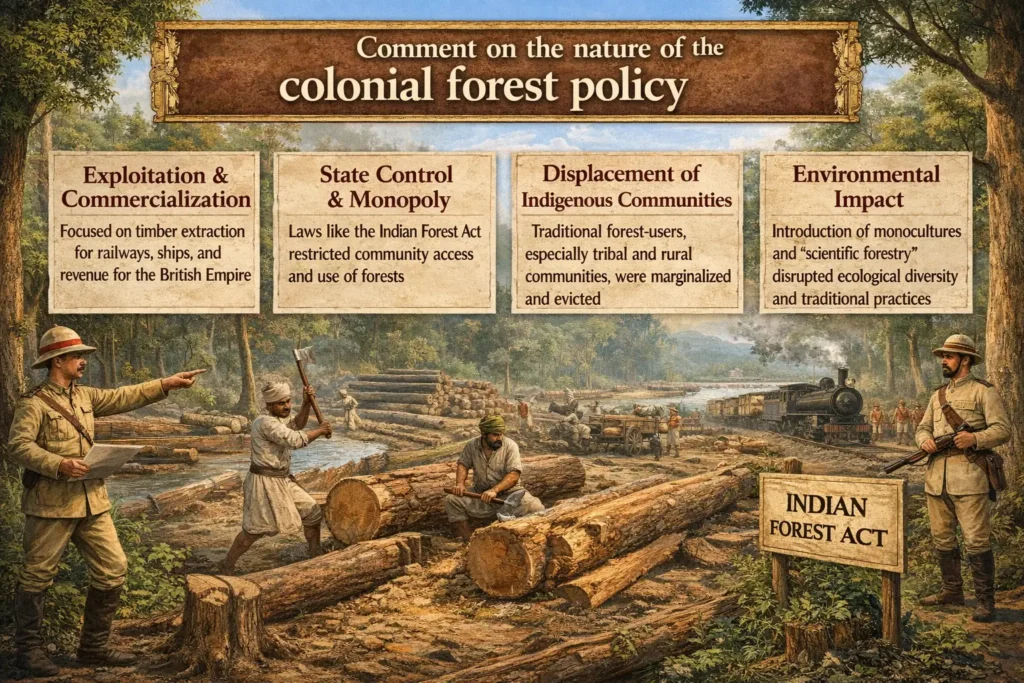
The nature of the colonial forest policy in India under British Empire was primarily exploitative, commercial, and state-controlled. Introduced during the 19th century, this policy marked a significant shift from traditional community-based forest management to centralized regulation by the colonial state. Its core objective was not conservation in the modern sense, but the extraction of forest resources to serve imperial economic and strategic interests.
One of the defining features of colonial forest policy was the assertion of state monopoly over forests. The British administration systematically brought vast forest areas under its control through legislations such as the Indian Forest Act 1865, followed by the more comprehensive Indian Forest Act 1878 and later the Indian Forest Act 1927. These laws empowered the state to declare forests as reserved, protected, or village forests, thereby restricting access and usage by local communities.
The policy was largely driven by commercial interests. Forests were seen as a valuable source of raw materials such as timber, which was in high demand for shipbuilding, railway sleepers, and construction. The expansion of railways in India greatly increased the demand for durable wood like teak and sal. As a result, forests were managed scientifically to ensure a steady supply of timber. This led to the introduction of “scientific forestry,” a system inspired by European practices, focusing on regulated cutting, plantation, and monoculture. However, this approach often ignored the ecological diversity of forests and replaced mixed forests with commercially profitable species.
Another important aspect of colonial forest policy was its impact on indigenous communities and traditional rights. For centuries, tribal and rural populations had depended on forests for livelihood—grazing, fuelwood, shifting cultivation, and collection of minor forest produce. The new policies criminalized many of these customary practices. Shifting cultivation (jhum) was particularly targeted and discouraged, as it was seen as destructive by colonial authorities. Communities were often evicted from their ancestral lands or forced to work as laborers in forest operations.
The policy also had a strong element of surveillance and control. Forest officials were given extensive powers to regulate access, enforce rules, and punish violations. This created conflicts between the state and local populations, leading to resistance and protests. Several tribal uprisings, such as those led by forest communities in central and eastern India, were partly a response to these restrictive policies.
Although the colonial government justified its forest policy in terms of conservation and efficient management, its underlying motive was resource extraction and revenue generation. Conservation efforts were selective and aimed at sustaining commercial exploitation rather than protecting biodiversity or community rights. The idea of preserving forests for ecological balance or indigenous welfare was largely absent.
In conclusion, the colonial forest policy in India was characterized by centralization, commercialization, and exclusion of local communities. It transformed forests from shared ecological resources into state-controlled economic assets. While it introduced systematic management and legal frameworks, it also disrupted traditional livelihoods, marginalized forest-dependent communities, and altered the ecological landscape. The legacy of these policies continued to influence post-colonial forest governance, making it a critical area of study in understanding environmental and social history in India.
Comment on the nature of the colonial forest policy Comment on the nature of the colonial forest policy Comment on the nature of the colonial forest policy Comment on the nature of the colonial forest policy Comment on the nature of the colonial forest policy Comment on the nature of the colonial forest policy Comment on the nature of the colonial forest policy Comment on the nature of the colonial forest policy Comment on the nature of the colonial forest policy Comment on the nature of the colonial forest policy