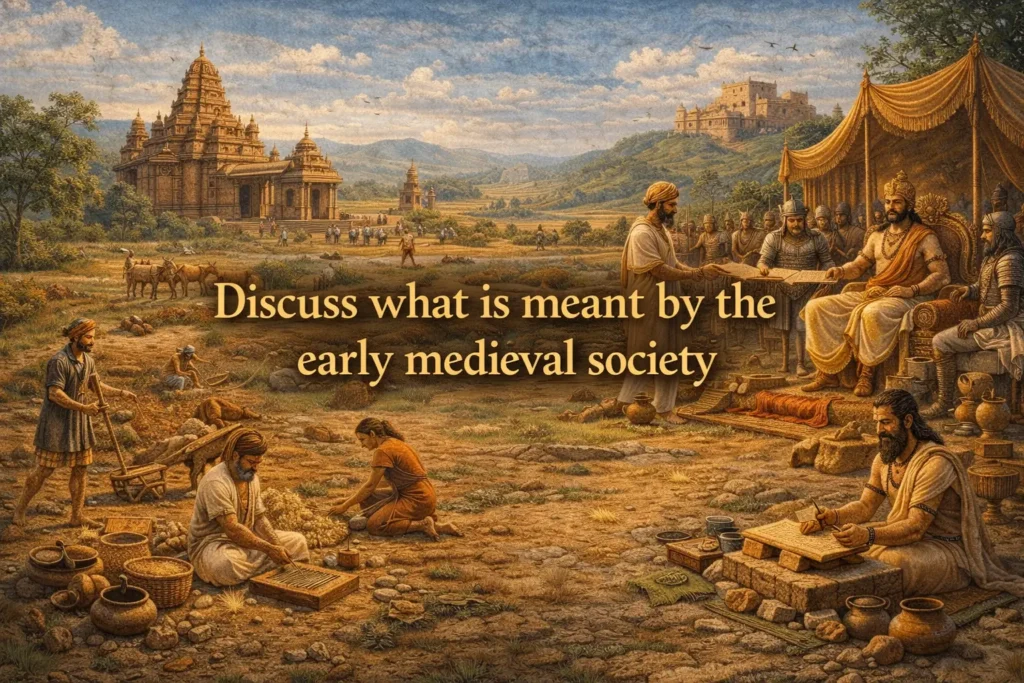
Discuss what is meant by the early medieval society
The term “early medieval society” refers to the social, economic, and political formations that developed roughly between the 6th and 12th centuries CE in many parts of the world, including India. In the Indian context, this period marks a transition from the ancient phase, characterized by large empires like the Guptas, to a more regionally fragmented but culturally dynamic phase. Early medieval society was not static; rather, it was marked by significant changes in social organization, economy, polity, and cultural life.
One of the most important features of early medieval society was the process of regionalization. After the decline of large centralized empires, power became distributed among numerous regional kingdoms such as the Chalukyas, Pallavas, Rashtrakutas, and later the Cholas. This political decentralization influenced the structure of society, as local rulers, chiefs, and intermediaries gained importance. Authority was often exercised through networks of local elites rather than a strong central administration.
A key concept associated with early medieval society is the idea of land grants. Kings frequently granted land to Brahmanas, temples, and officials. These grants were not just economic transactions but also instruments of social and political control. The donees often received not only land but also rights over the peasants living on it, including the collection of taxes. This led to the emergence of a hierarchical society where landlords and intermediaries exercised power over cultivators. Such developments are often linked to the concept of “Indian feudalism,” although historians debate the exact nature and applicability of this term.
Agrarian expansion was another defining characteristic of early medieval society. New areas, especially forest and tribal regions, were brought under cultivation. This process involved the migration of peasants, the use of new agricultural techniques, and the integration of tribal communities into the caste-based social order. As agriculture expanded, rural society became more complex, with different groups performing specialized roles.
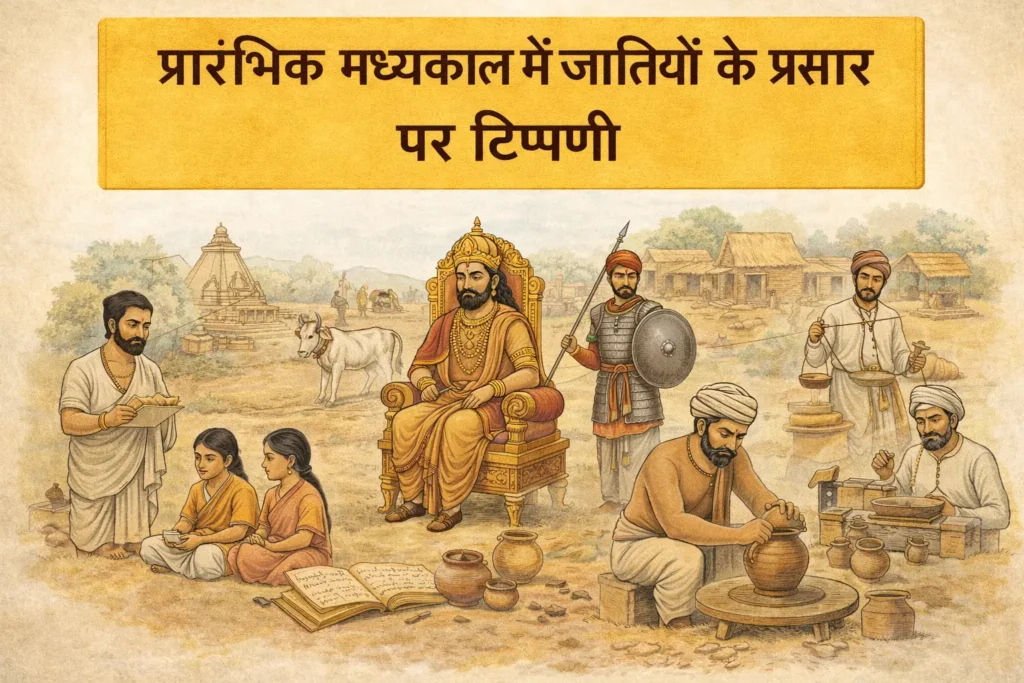
The caste system became more elaborate and rigid during this period. While the basic varna framework existed earlier, early medieval society saw the proliferation of numerous jatis (sub-castes), often linked to specific occupations and regions. Social hierarchy became more pronounced, and ideas of purity and pollution gained greater importance in regulating social interactions. Brahmanas continued to enjoy high status due to their religious and intellectual authority, while other groups were placed in a graded social order.
Religion and temple institutions played a central role in early medieval society. The growth of temples as religious, economic, and cultural centers is a notable feature of this period. Temples were not only places of worship but also major landholders and employers of labor. They acted as hubs of economic activity, redistributing resources and supporting artisans, priests, and other service groups. The Bhakti movement, which emphasized personal devotion to deities like Shiva and Vishnu, also gained momentum during this period, influencing social and cultural life.
Urban centers, although fewer than in the earlier ancient period, did not disappear entirely. Some towns continued as centers of trade, craft production, and administration. Trade networks, both internal and external, persisted, though their scale and nature may have changed. Guilds and merchant groups played a role in economic activities, and in some regions, trade contributed to the prosperity of local societies.
The nature of early medieval society was thus characterized by a combination of continuity and change. While certain elements such as agriculture and caste hierarchy continued from earlier periods, new features like regional political structures, land grant systems, and temple-centered economies emerged. Social relations became more localized, and power was often mediated through a network of intermediaries rather than centralized authority.
In conclusion, early medieval society in India was a complex and evolving formation marked by regional diversity, agrarian expansion, hierarchical social structures, and the growing importance of religious institutions. It laid the foundation for many aspects of later medieval Indian society, including patterns of landholding, social stratification, and cultural development. Understanding this period is essential for tracing the long-term transformations in Indian history.
Discuss what is meant by the early medieval society Discuss what is meant by the early medieval society Discuss what is meant by the early medieval society Discuss what is meant by the early medieval society Discuss what is meant by the early medieval society Discuss what is meant by the early medieval society Discuss what is meant by the early medieval society Discuss what is meant by the early medieval society Discuss what is meant by the early medieval society Discuss what is meant by the early medieval society