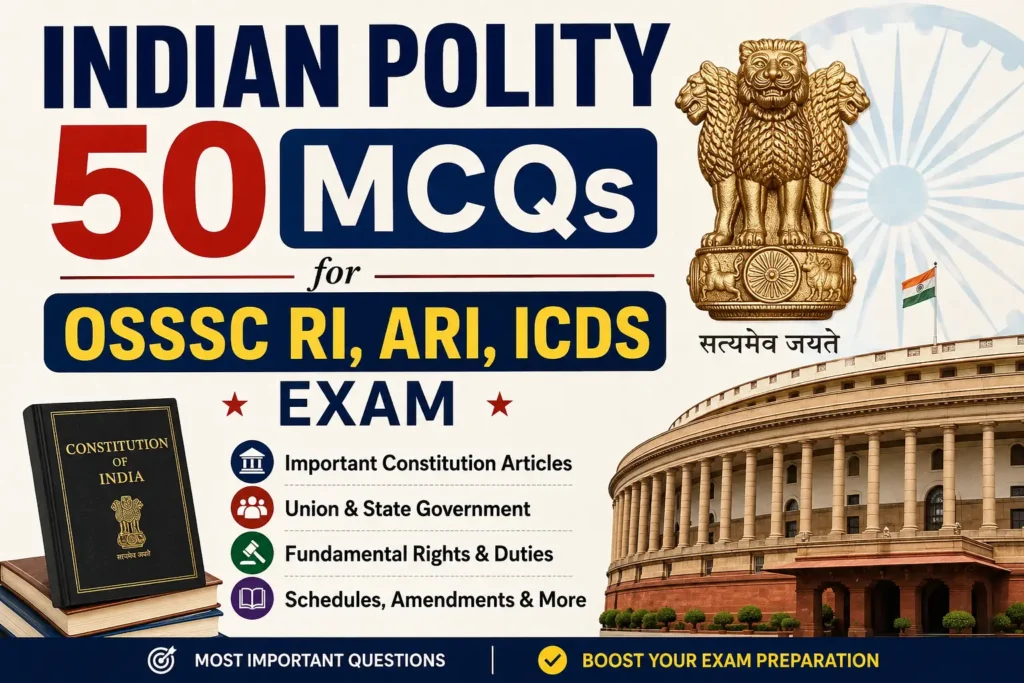
Indian Polity MCQs for OSSSC RI, ARI, ICDS Exam
- Who is known as the Father of the Indian Constitution?
A) Mahatma Gandhi
B) Jawaharlal Nehru
C) Dr. B. R. Ambedkar
D) Sardar Patel
2. Which part of the Indian Constitution deals with Fundamental Rights?
A) Part I
B) Part II
C) Part III
D) Part IV
3. Who appoints the Prime Minister of India?
A) Chief Justice of India
B) President of India
C) Parliament
D) Governor
4. What is the maximum strength of the Lok Sabha?
A) 500
B) 545
C) 552
D) 560
5. Which house of Parliament is known as the Upper House?
A) Lok Sabha
B) Rajya Sabha
C) Vidhan Sabha
D) Legislative Council
6. What is the minimum age required to become the President of India?
A) 30 years
B) 35 years
C) 40 years
D) 45 years
7. Which Article of the Constitution provides the Right to Equality?
A) Articles 14-18
B) Articles 19-22
C) Articles 25-28
D) Articles 32-35
8. How many schedules are there in the Indian Constitution at present?
A) 10
B) 11
C) 12
D) 13
9. Which body conducts elections in India?
A) UPSC
B) Supreme Court
C) Election Commission
D) Parliament
10. The Directive Principles of State Policy are included in which part of the Constitution?
A) Part III
B) Part IV
C) Part V
D) Part VI
11. Who is the constitutional head of India?
A) Prime Minister
B) President
C) Chief Justice
D) Governor
12. Which amendment lowered the voting age from 21 to 18 years?
A) 42nd Amendment
B) 44th Amendment
C) 61st Amendment
D) 73rd Amendment
13. The Panchayati Raj system was constitutionalized by which amendment?
A) 42nd Amendment
B) 44th Amendment
C) 73rd Amendment
D) 74th Amendment
14. Which Article is known as the “Heart and Soul” of the Constitution?
A) Article 14
B) Article 19
C) Article 21
D) Article 32
15. The tenure of the President of India is:__________.
A) 4 years
B) 5 years
C) 6 years
D) 7 years
16. Who presides over the Rajya Sabha?
A) President
B) Prime Minister
C) Vice President
D) Speaker
17. Which Constitutional Amendment is known as the “Mini Constitution”?
A) 24th Amendment
B) 42nd Amendment
C) 44th Amendment
D) 52nd Amendment
18. The Supreme Court of India was established in:_________.
A) 1947
B) 1948
C) 1950
D) 1952
19. Which Article provides for Constitutional Remedies?
A) Article 19
B) Article 21
C) Article 32
D) Article 44
20. Who is the head of the state government?
A) Governor
B) Chief Minister
C) President
D) Chief Justice
21. The Governor of a state is appointed by:_________.
A) Prime Minister
B) Chief Minister
C) President
D) Supreme Court
22. Which language was originally adopted for the Constitution of India?
A) English
B) Hindi
C) Sanskrit
D) Urdu
23. The Finance Commission is constituted under which Article?
A) Article 280
B) Article 324
C) Article 356
D) Article 370
24. Which Article abolished untouchability?
A) Article 14
B) Article 15
C) Article 17
D) Article 21
25. The Speaker is the presiding officer of:_________.
A) Rajya Sabha
B) Lok Sabha
C) Supreme Court
D) Vidhan Parishad
26. How many members can the President nominate to the Rajya Sabha?
A) 10
B) 12
C) 14
D) 15
27. Which Article provided special status to Jammu and Kashmir before its removal?
A) Article 356
B) Article 360
C) Article 370
D) Article 371
28. The Indian Constitution was adopted on:________.
A) 15 August 1947
B) 26 January 1950
C) 26 November 1949
D) 2 October 1950
29. Fundamental Duties were added by which amendment?
A) 24th Amendment
B) 42nd Amendment
C) 44th Amendment
D) 52nd Amendment
30. The Chief Justice of India is appointed by:_________.
A) Prime Minister
B) Parliament
C) President
D) Vice President
31. Which schedule deals with Anti-Defection Law?
A) 8th Schedule
B) 9th Schedule
C) 10th Schedule
D) 11th Schedule
32. The concept of Judicial Review in India is borrowed from:__________.
A) UK
B) USA
C) Canada
D) Ireland
33. Which Article deals with the amendment procedure of the Constitution?
A) Article 352
B) Article 356
C) Article 360
D) Article 368
34. The first President of India was:________.
A) Rajendra Prasad
B) S. Radhakrishnan
C) Zakir Hussain
D) V. V. Giri
35. The term “Secular” was added to the Preamble by:_________.
A) 24th Amendment
B) 42nd Amendment
C) 44th Amendment
D) 52nd Amendment
36. Which body is known as the guardian of the Constitution?
A) Parliament
B) President
C) Supreme Court
D) Election Commission
37. The Parliament of India consists of:_________.
A) President and Lok Sabha
B) Rajya Sabha and Lok Sabha
C) President, Rajya Sabha and Lok Sabha
D) Prime Minister and Council of Ministers
38. Which Article provides freedom of speech and expression?
A) Article 14
B) Article 19
C) Article 21
D) Article 25
39. The Constitution of India came into force on:________.
A) 15 August 1947
B) 26 November 1949
C) 26 January 1950
D) 2 October 1950
40. Which schedule contains the list of states and union territories?
A) First Schedule
B) Second Schedule
C) Third Schedule
D) Fourth Schedule
41. The Vice President of India is elected by:_________.
A) Lok Sabha only
B) Rajya Sabha only
C) Members of both Houses of Parliament
D) State Legislatures
42. Who can declare a National Emergency?
A) Prime Minister
B) President
C) Parliament
D) Supreme Court
43. The idea of Fundamental Rights was borrowed from:_________.
A) UK
B) USSR
C) USA
D) Canada
44. Which constitutional body recommends the distribution of taxes between Centre and States?
A) Election Commission
B) Finance Commission
C) Planning Commission
D) NITI Aayog
45. The minimum age to become a member of Lok Sabha is:_________.
A) 21 years
B) 25 years
C) 30 years
D) 35 years
46. Which part of the Constitution deals with Citizenship?
A) Part I
B) Part II
C) Part III
D) Part IV
47. The Attorney General of India is appointed by:_________.
A) Prime Minister
B) Chief Justice
C) President
D) Parliament
48. Which amendment introduced the Goods and Services Tax (GST)?
A) 99th Amendment
B) 100th Amendment
C) 101st Amendment
D) 102nd Amendment
49. Which Article deals with President’s Rule in states?
A) Article 352
B) Article 356
C) Article 360
D) Article 370
50. Which organ of the Indian government makes laws?
A) Judiciary
B) Executive
C) Legislature
D) Election Commission
Indian Polity MCQs for OSSSC RI Indian Polity MCQs for OSSSC RI Indian Polity MCQs for OSSSC RI Indian Polity MCQs for OSSSC RI Indian Polity MCQs for OSSSC RI Indian Polity MCQs for OSSSC RI Indian Polity MCQs for OSSSC RI Indian Polity MCQs for OSSSC RI Indian Polity MCQs for OSSSC RI Indian Polity MCQs for OSSSC RI Indian Polity MCQs for OSSSC RI Indian Polity MCQs for OSSSC RI Indian Polity MCQs for OSSSC RI Indian Polity MCQs for OSSSC RI Indian Polity MCQs for OSSSC RI Indian Polity MCQs for OSSSC RI